 CosmosIn60CosmosIn60

NASA's James Webb Space Telescope detected methane and carbon dioxide in the atmosphere of K2-18b — a temperate sub-Neptune 120 light-years away that may harbor a global ocean.
For the first time in the history of astronomy, a space telescope has read the chemical fingerprints of a temperate alien world and found molecules that, on Earth, are signatures of life. In September 2023, NASA's James Webb Space Telescope detected methane and carbon dioxide in the atmosphere of exoplanet K2-18b — a planet eight times Earth's mass sitting squarely inside its star's habitable zone, 120 light-years away. Then in April 2025, the same telescope pushed deeper and found a possible trace of dimethyl sulfide, a molecule that on Earth is produced exclusively by marine life. That is not a confirmed discovery of extraterrestrial life. But it is the most compelling atmospheric measurement ever taken of a world that could, in principle, support it.
K2-18b was first discovered in 2015 by NASA's Kepler Space Telescope during its extended K2 mission, which is where the planet gets its designation. It orbits an M-dwarf star — a cool red star roughly a third the size of our Sun — in the constellation Leo. The orbital period is just 33 days, but because K2-18 burns so much cooler than the Sun, a 33-day orbit still lands the planet inside the habitable zone, where temperatures could permit liquid water.
The planet is classified as a sub-Neptune: larger than Earth (2.6 times the radius) but smaller than Neptune, and 8.6 times Earth's mass. This places it in an intriguing size category that has no analogue in our own solar system. For years, astronomers debated whether sub-Neptunes were scaled-up rocky worlds with thick atmospheres, or scaled-down gas giants with no solid surface at all. K2-18b occupies that ambiguous middle ground, and JWST arrived at exactly the right moment to start answering those questions.
The concept of a "Hycean world" — a planet with a hydrogen-rich atmosphere overlying a global liquid water ocean — was theorized in 2021 by Cambridge astronomer Nikku Madhusudhan and colleagues. K2-18b became the prototype for this class. A Hycean world would look nothing like Earth from orbit, but the physics of liquid water under a hydrogen envelope could still support biochemistry. The JWST methane detection is the first direct atmospheric evidence that such worlds are chemically complex enough to take seriously.
Webb observed K2-18b using two complementary instruments: NIRISS (Near-Infrared Imager and Slitless Spectrograph) and NIRSpec (Near-Infrared Spectrograph). The technique is transmission spectroscopy — Webb stares at the exoplanet's host star as the planet passes across its face. Some starlight filters through the planet's atmosphere, and different molecules absorb specific wavelengths of that light. The resulting spectrum acts like a chemical barcode.
From just two transit observations, JWST extracted a spectrum equivalent in precision to what the Hubble Space Telescope would have taken eight separate observations over several years to produce. That improvement in efficiency is not incremental — it is transformative for the pace of exoplanet science.
The confident detections were methane (CH₄) and carbon dioxide (CO₂). Notably absent were ammonia (NH₃) and carbon monoxide (CO). That combination matters. In a hydrogen-dominated atmosphere sitting above a warm ocean, ocean chemistry would dissolve ammonia into the water. The non-detection of ammonia is consistent with — though not proof of — an ocean surface below. The co-presence of both methane and CO₂, with no CO, matches what atmospheric models predict for a relatively cool, chemically active atmosphere rather than a hot, stripped gas giant.
The initial 2023 observations also hinted at dimethyl sulfide (DMS) at low significance. In April 2025, follow-up observations using Webb's MIRI (Mid-Infrared Instrument) pushed that signal to 10–15 parts per million — roughly a thousand times the DMS concentration found in Earth's atmosphere. The team reported the result at three-sigma statistical significance, meaning there is roughly a 0.3% chance the signal occurred by random noise. Three-sigma is a strong indication but falls short of the five-sigma threshold astronomers traditionally require to claim a discovery.
The atmospheric chemistry JWST found fits a specific and provocative planetary model. A Hycean world has a hydrogen-rich atmosphere (as opposed to Earth's nitrogen-oxygen mix) sitting over a global ocean of liquid water. The hydrogen envelope creates a greenhouse effect, keeping the ocean liquid even at greater distances from the star. The ocean itself would be under enormous atmospheric pressure — quite different from Earth's surface water, but not outside the range of conditions that support extremophile life in Earth's deep seas or hydrothermal vents.
K2-18b's equilibrium temperature — the theoretical temperature based purely on how much starlight it receives — sits in the range of about −73 °C to 47 °C (−99 °F to 117 °F) depending on the reflectivity assumed for its atmosphere. That range straddles Earth-like temperatures, which is what originally earned it the "habitable zone" classification. However, that temperature refers to an effective average, and the actual surface temperature (if a surface exists beneath the hydrogen layer) would depend heavily on greenhouse warming from the thick hydrogen atmosphere. Some models suggest the ocean surface could be considerably warmer — up to 374 °C (705 °F) near the water's critical point, above which liquid water cannot exist as a distinct phase.
That upper bound is a concern for habitability, and it illustrates the complexity of these detections: the data are real, but the inferences from the data depend on which atmospheric model you trust. Madhusudhan's team favors interpretations consistent with a cooler, ocean-preserving scenario. Critics point out that the same spectral data can be fit by a hot, gas-rich mini-Neptune with no ocean at all.
Dimethyl sulfide (DMS) is produced on Earth almost entirely by marine phytoplankton and other microbial life. It is considered one of the most promising potential biosignature gases because no known abiotic (non-biological) geological or chemical process produces it in significant quantities on Earth. If K2-18b's atmosphere genuinely contains DMS at 10–15 parts per million, and if that DMS was produced biologically, it would imply a staggeringly productive ocean biosphere — far more biologically active per unit area than Earth's oceans.
The caveat is that "no known abiotic process on Earth" does not mean "no possible abiotic process on a hydrogen-dominated alien world." K2-18b's atmospheric chemistry differs fundamentally from Earth's. Researchers at Astronomy & Astrophysics published a competing analysis in 2025 arguing the joint JWST dataset shows insufficient evidence for DMS and DMDS when all available instruments — NIRISS, NIRSpec, and MIRI — are analyzed together. The debate is active and unresolved.
This kind of scientific back-and-forth is not a flaw in the process — it is the process. Extraordinary claims require extraordinary evidence, and astronomers are applying exactly the right level of scrutiny. What is not in dispute is that JWST detected methane and carbon dioxide with high confidence, and that K2-18b's atmospheric chemistry is unlike any other exoplanet studied to date.
K2-18b is not the only temperate sub-Neptune being studied this way. TOI-270 d, another planet in the same general size category, received similar JWST transmission spectroscopy treatment. Results published in 2024 and 2025 confirm methane and CO₂ in its atmosphere as well, along with possible detections of carbon disulfide (CS₂) and water vapor. TOI-270 d has about half the mass of K2-18b, a slightly smaller radius, and a higher equilibrium temperature — placing it at the warmer edge of what might support liquid water.
These two planets — K2-18b and TOI-270 d — are the opening entries in what is likely to become a substantial catalog. Sub-Neptunes are, statistically, the most common type of planet in the galaxy. The Milky Way appears to be packed with them. Before JWST, essentially nothing was known about their atmospheric chemistry. Now, within two years of scientific operations, Webb has shown that at least some temperate sub-Neptunes carry carbon-bearing molecules in their atmospheres, and that those atmospheres are rich enough in detail to distinguish between competing planetary models.
That is a paradigm shift. The exoplanet field spent its first three decades cataloguing planets from the outside — measuring sizes, masses, and orbital periods. JWST has opened the interior chapter: what these worlds are actually made of, chemically, in their upper atmospheres.
The methane detection on K2-18b matters on several levels simultaneously, and it is worth separating them to avoid over-claiming.
At the most cautious level, this is a demonstration that JWST works as advertised for atmospheric characterization of temperate worlds. Two transit observations produced a spectrum that resolved multiple molecules. The telescope's capabilities exceeded pre-launch projections, and it still has years of operational life ahead. The implication is that the coming decade will produce atmospheric data on dozens of sub-Neptunes and, eventually, smaller rocky planets.
At an intermediate level, K2-18b's chemical fingerprint — methane, carbon dioxide, no ammonia, possible DMS — is genuinely consistent with a Hycean world. No previous exoplanet observation has produced an atmospheric chemistry profile this close to what theorists predicted for a potentially habitable world. That does not make it habitable. It makes it the strongest candidate yet for further study.
At the most speculative level, if the DMS signal holds up under continued observation and no abiotic explanation emerges, it would represent the first tentative evidence of biological activity beyond Earth. The scientific community is appropriately cautious about this interpretation, but the possibility is no longer in the realm of science fiction — it is a hypothesis being tested with real data against real observations.
The broader implication is a recalibration of where to look for life. For decades, the search focused almost exclusively on rocky, Earth-sized planets with thin, Earth-like atmospheres. K2-18b suggests that large, hydrogen-wrapped ocean worlds orbiting cool red dwarf stars — which vastly outnumber Sun-like stars in the galaxy — deserve a serious place in that search.
Yes. K2-18b orbits its host star, a cool M-dwarf, at a distance that places it within the habitable zone — the region where a planet's surface temperature could allow liquid water to exist. Its orbital period is 33 days, which sounds short, but because K2-18 burns far cooler than our Sun, that orbit receives comparable energy to what Earth receives from the Sun.
A Hycean world (from "hydrogen" and "ocean") is a theoretical class of exoplanet with a thick hydrogen-dominated atmosphere overlying a global ocean of liquid water. The concept was formalized by Cambridge astronomer Nikku Madhusudhan in 2021. K2-18b is considered the best current candidate for this type of planet, though whether it truly has an ocean beneath its atmosphere remains unconfirmed.
No. Methane and carbon dioxide can be produced by geological processes with no biological input whatsoever. On Earth, methane is also produced biologically, but on an alien world with a hydrogen-rich atmosphere, non-biological chemistry could produce it too. The more intriguing signal is the possible detection of dimethyl sulfide (DMS), which on Earth is produced only by life — but even that requires further confirmation and a ruling out of unknown abiotic sources.
K2-18b is approximately 120 light-years from Earth in the constellation Leo. At the speed of current spacecraft — even the fastest probes like Voyager 1, which travels at roughly 17 kilometers per second — reaching K2-18b would take over two million years. No conceivable propulsion technology on the near-term horizon changes that calculus meaningfully. The search for life there will be conducted entirely through spectroscopy from Earth orbit.
JWST has studied the atmospheres of dozens of exoplanets since beginning science operations in mid-2022. Among the most notable: TRAPPIST-1b and TRAPPIST-1c (rocky, Earth-sized planets found to have no thick atmosphere), WASP-39b (a hot Jupiter with a detailed chemical inventory including sulfur dioxide), and TOI-270 d (a temperate sub-Neptune with confirmed methane and CO₂, similar to K2-18b). The telescope has also studied planets in our own solar system, refining atmospheric models for all the gas giants.
The story of K2-18b is not finished — it has barely started. Webb's MIRI instrument is scheduled for continued observation of the system, and each additional transit builds the statistical case for or against the DMS signal. If the signal strengthens with more data and no abiotic explanation emerges, the conversation about life beyond Earth will change in ways that cannot be predicted. Even if K2-18b turns out to be a barren mini-Neptune, JWST has established that the atmospheric chemistry of distant ocean worlds is measurable, interpretable, and scientifically meaningful — which is a profound result on its own. The question worth watching in 2025 and 2026 is not whether JWST can detect biosignature candidates. It already has. The question is whether the candidates survive scrutiny.
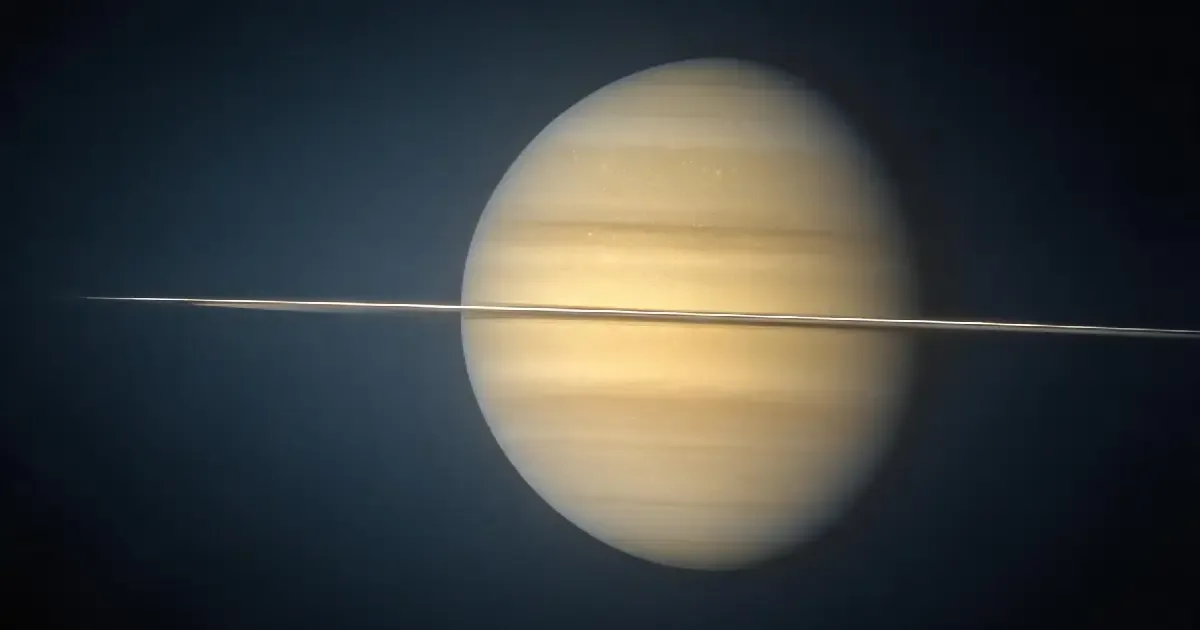
Saturn's main rings span about 273,600 km yet are typically only 10 meters thick. Run the math and the famous paper comparison undersells them by a factor of roughly 10,000.
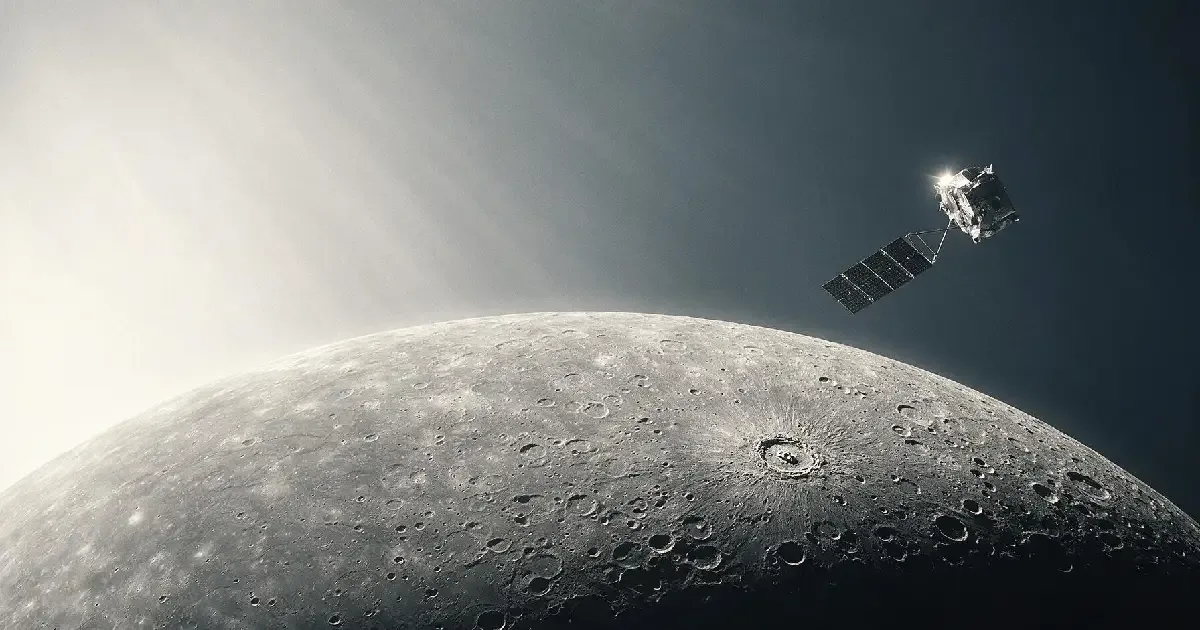
"Pluto is roughly twenty times farther away, yet BepiColombo needed eight years to reach Mercury. The culprit is braking, not distance, and it makes Mercury costlier to reach than Pluto.
