
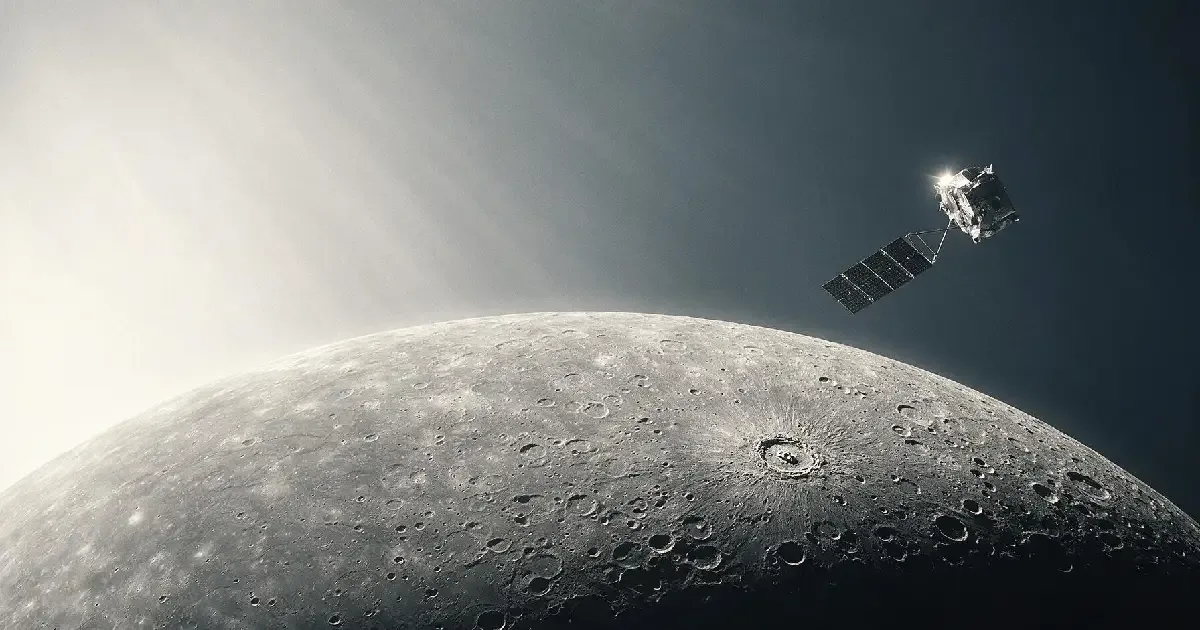
Why Mercury Took Eight Years to Reach
"Pluto is roughly twenty times farther away, yet BepiColombo needed eight years to reach Mercury. The culprit is braking, not distance, and it makes Mercury costlier to reach than Pluto.
Put two spacecraft side by side. NASA's New Horizons launched in January 2006 and flew past Pluto in July 2015, finishing a three-billion-mile journey in about nine and a half years. ESA and JAXA's BepiColombo launched in October 2018 toward a planet that never gets more than 221.9 million km from Earth, and it will not enter orbit until 21 November 2026. That is eight years to reach a planet that, even at its farthest, sits less than a twentieth of the distance New Horizons flew.
That near-tie is the whole story. The eight-year road to Mercury is not a distance problem; it is a braking problem, and measured by the energy it demands, the smallest planet is a harder place to arrive than Pluto. Run the comparison round by round and the paradox comes apart. The name painted on the spacecraft turns out to be part of the answer.
Round One: Distance, Where Pluto Should Win Easily
On distance alone, the contest is not close. Mercury swings between 77.3 and 221.9 million km from Earth, while New Horizons had to cover roughly 4.8 billion km. For a sense of what "nearby" normally buys, a spacecraft bound for Mars spends only about 200 days in interplanetary cruise, and Perseverance made the crossing in seven months.
Mercury can be reached that fast too. NASA's Mariner 10 got there in just 147 days in 1974. The catch is what Mariner 10 did on arrival: it kept going. It flew past, looped around the Sun, and came back for two more passes, never slow enough to stay.
That single fact reframes the question. The trip to Mercury is short. Stopping at Mercury is what takes eight years. Asking why Mercury is "far" is like blaming a missed motorway exit on its distance when the real problem was taking it at 200 km/h.
Round Two: The Energy Bill, 18.5 km/s Against 17
ESA puts a number on the paradox. The total velocity change, or delta-v, needed to reach Mercury is about 18.5 km/s, while Pluto needs about 17 km/s. For scale, Rosetta's entire campaign to catch comet 67P needed about 5 km/s. By this measure, a Mercury mission costs more than a trip to the outer edge of the planetary system and nearly four times as much as a comet chase.
The reason is the Sun's gravity well, which works in opposite directions for the two trips. Every spacecraft launched from Earth inherits Earth's orbital speed of 29.78 km/s. To fall inward, it must cancel part of that sideways motion. Then, as it drops toward the Sun, gravity converts height into speed, and it accelerates the whole way down. JAXA's mission team states it plainly: travelling straight toward the Sun would leave the spacecraft moving too fast for Mercury's gravity to pull it into orbit.
Outbound missions face the mirror image. Climbing away from the Sun costs a large burst of energy at launch, after which the spacecraft coasts, slowing gently as it goes. Heading out, the Sun's gravity is a hill you climb once. Heading in, it is a slope you ride the brakes on for the entire descent, and the brakes are what cost the time.
Round Three: A 30,000 mph Flyby Versus Catching the Fastest Planet
New Horizons had one enormous advantage: it never had to stop. It crossed the Pluto system at more than 30,000 mph, passed about 7,750 miles above the surface, and was gone. Its job was to photograph the train from the platform.
BepiColombo's job is to board it. Mercury races around the Sun at an average of 47.36 km/s, roughly 106,000 mph and the fastest orbital pace of any planet. To be captured, a spacecraft has to arrive travelling in almost the same direction at almost the same speed. According to JAXA, after its final Mercury swing-by BepiColombo was moving at nearly Mercury's own speed around the Sun, so that when the two met again in November 2026 their relative speed would be small enough for capture.
This is the half of the Pluto comparison that rarely gets said. New Horizons' famous speed is not the sign of a harder mission; it is the sign of an easier one. Its designers could spend their energy budget on getting there quickly. Mercury orbiters spend theirs on arriving slowly, and a slow arrival at the fastest planet is exactly what that 18.5 km/s bill pays for.
Round Four: Nine Borrowed Brakes and Three Coins of Thrust
If raw rocket power were the answer, the trip would be short. ESA notes that braking with thrusters alone would demand so much fuel that the spacecraft would become far too heavy to launch. BepiColombo already left Earth at 4,100 kg, including 1,400 kg of propellant.
So it borrowed its brakes. The route used nine gravity assists: Earth in April 2020, Venus in October 2020 and August 2021, and Mercury six times between October 2021 and January 2025. Passing a planet on the correct side lets a spacecraft hand some of its orbital energy to that planet, which absorbs it without noticing. Between flybys, the Mercury Transfer Module fired its T6 ion thrusters, each pushing at full power with a force equal to the weight of three 1-euro coins, for a combined maximum of 250 mN when two fire together. That gentle push, sustained for months, bends the orbit a little at a time, with xenon ions leaving the engines at 50,000 m/s.
Here is the connection most coverage skips. The spacecraft is named for Giuseppe "Bepi" Colombo (1920 to 1984), the Padua mathematician who explained Mercury's habit of rotating three times for every two orbits and who, in 1970, noticed that Mariner 10's post-flyby orbit could bring it back to Mercury six months later, turning one pass into three. Colombo showed how to use Mercury's own rhythm to return to it. Half a century later, the mission carrying his name used that rhythm six times over, turning the destination into its own brake. It is a better tribute than any plaque.
MESSENGER Versus BepiColombo: Why the Sequel Took Longer
NASA's MESSENGER, the only spacecraft to orbit Mercury so far, launched on 3 August 2004 and entered orbit on 18 March 2011 after a 4.9-billion-mile journey and six flybys: one of Earth, two of Venus, three of Mercury. That is about six and a half years. BepiColombo needed nine flybys and, even on its original plan, was due in December 2025, just over seven years after launch.
Part of the difference is ambition. BepiColombo carries two orbiters, ESA's Mercury Planetary Orbiter (MPO) and JAXA's Mio, bound for different orbits, with the MPO dipping as low as 480 km above the surface. More hardware and two separate orbits to set up make the arrival far more demanding.
The other part is bad luck, handled well. In April 2024, unexpected electric currents between the solar array and the power unit reduced the power available to the ion engines. ESA mission manager Santa Martinez confirmed the thrusters would "remain operating below the minimum thrust required" for a December 2025 arrival. ESA's flight dynamics team answered with a new route: the fourth Mercury flyby, on 4 September 2024, dropped to about 165 km above the surface, closer than planned, squeezing extra braking out of the planet to make up for the weaker engines. The cost was eleven months.
That delay deserves a careful reading. The mission did not lose time because it failed; it lost time because its trajectory team was good enough to trade months for thrust. A route that can absorb an engine shortfall by stretching the calendar shows exactly why these missions take the slow road in the first place.
What 21 November Decides
As of late September 2026, the long road is nearly over. The ion engines went quiet on 15 June 2026, and the Mercury Transfer Module was jettisoned on 3 September 2026, with the spacecraft more than 200 million km from Earth. Orbit insertion is scheduled for 21 November. The MPO and Mio separate on 9 and 10 December, and science operations begin in April 2027.
Our take: the eight years were a bargain, not a delay. Mariner 10's 147-day sprint bought three brief looks. MESSENGER's six-and-a-half-year crawl bought roughly four years in orbit, from 2011 to 2015. Time spent in transit is the price of time spent on station, and no shortcut changes that exchange rate.
The capture is the obvious thing to watch. The more interesting question is what two spacecraft can do that one never could. With the MPO close in and Mio farther out at the same moment, Mercury's small magnetosphere can be sampled from two places at once for the first time. If BepiColombo delivers one genuine surprise, the smart bet is that it comes from that pairing.
Quick Answers About the Road to Mercury
How long does it take to get to Mercury?
That depends on whether you want to stop. Mariner 10 flew past after 147 days. MESSENGER needed about six and a half years to enter orbit, and BepiColombo will need just over eight.
Why is Mercury harder to reach than Pluto?
Because arriving means braking. ESA estimates about 18.5 km/s of velocity change for Mercury against about 17 km/s for Pluto. A spacecraft falling toward the Sun keeps gaining speed, and the excess has to be shed before Mercury's gravity can capture it.
Why can't a spacecraft fly straight to Mercury?
A direct fall would bring it in far faster than Mercury is moving, and carrying enough propellant to cancel the difference would make it too heavy to launch. Planetary flybys and low-thrust ion engines do the braking instead, and both are slow.
Has any spacecraft orbited Mercury before?
Yes, one. NASA's MESSENGER orbited from 2011 until it struck the surface on 30 April 2015. BepiColombo will be the second mission to orbit Mercury and the first to put two orbiters there at once.
Related Posts
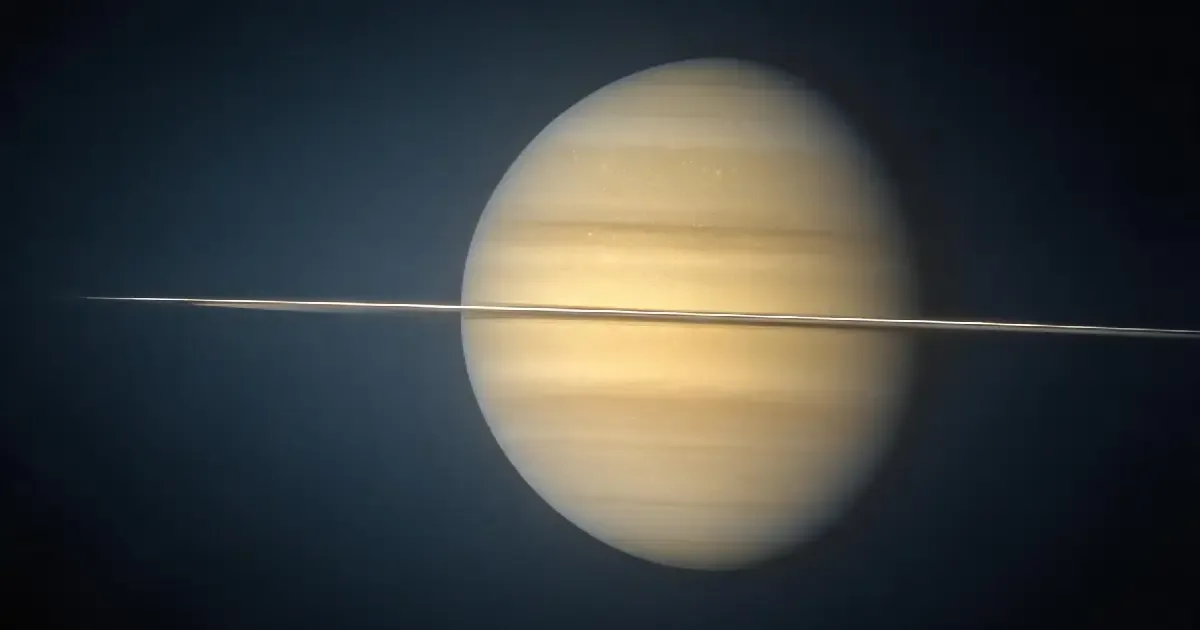
Saturn's Rings: Far Thinner Than Paper, at Scale
Saturn's main rings span about 273,600 km yet are typically only 10 meters thick. Run the math and the famous paper comparison undersells them by a factor of roughly 10,000.

