
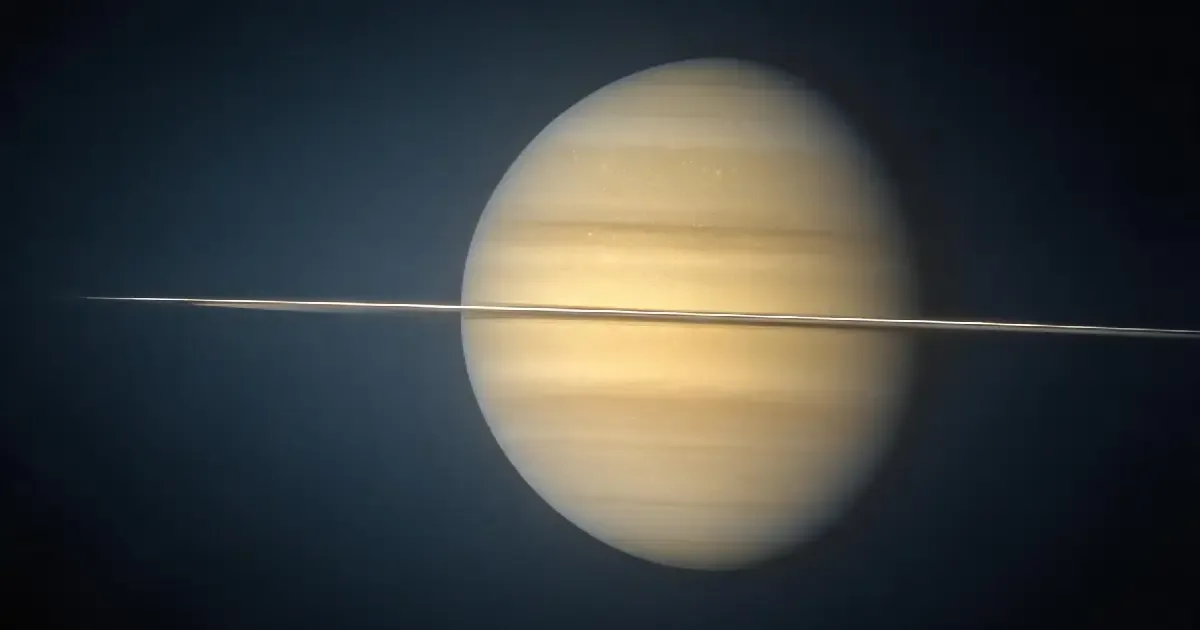
Saturn's Rings: Far Thinner Than Paper, at Scale
Saturn's main rings span about 273,600 km yet are typically only 10 meters thick. Run the math and the famous paper comparison undersells them by a factor of roughly 10,000.
Saturn's rings are thinner than a sheet of paper. The line turns up on science accounts, museum placards, and late-night videos, and it is a good line: it takes the most famous structure in the solar system and shrinks it into something you can hold. It is also misleading, in the most interesting way a fact can mislead. Run the numbers and the paper comparison turns out to be timid. At the same proportions, the main rings are not slightly thinner than paper. They are roughly ten thousand times flatter than any sheet in a printer tray, and that flatness is exactly what makes them a natural laboratory for disk physics, a clock nobody can agree how to read, and a planetary feature that can vanish from view.
The Comparison Everyone Shares, Checked With Arithmetic
Start with the two numbers the comparison rests on. NASA puts the vertical height of the main rings at typically about 10 meters (30 feet). Those main rings, the C, B, and A rings, reach 136,780 km from Saturn's center at the outer edge of the A ring, which makes them roughly 273,600 km (170,000 miles) across.
Divide one by the other and the main rings are about 27 million times wider than they are thick. Everything below is a calculation built on those two figures, not a measured result, and the paper thickness is a typical value for office paper rather than a sourced constant.
| Quantity | Real Saturn | Scaled so the rings are one sheet of paper thick |
|---|---|---|
| Main ring thickness | ~10 m | ~0.1 mm |
| Main ring span | ~273,600 km | ~2.7 km |
| Saturn's equatorial diameter | ~120,500 km | ~1.2 km |
In that model, Saturn's equatorial diameter of about 120,500 km shrinks to a ball about 1.2 km wide, sitting inside a paper ring one sheet thick and nearly three kilometers across. A real sheet of US letter paper is about 279 mm long and 0.1 mm thick, a ratio of roughly 2,800 to 1. The rings' ratio is about 27 million to 1. Divide one ratio by the other and the rings come out roughly 10,000 times more slender than the paper they are compared to.
Run it backward and the picture gets stranger. Shrink the rings until they span the long edge of that letter sheet, and they would be about 10 nanometers thick, thousands of times thinner than a human hair.
Why the Rings Look Like a Solid Plate
The comparison spreads because it feels surprising, and it feels surprising because every image of Saturn suggests the opposite. Through a telescope or in a spacecraft photo, the rings read as a broad, bright band with crisp edges, often throwing a hard shadow onto the cloud tops. The intuitive guess is that something that bright and that sharply outlined must have real depth.
What looks like a plate is a crowd. NASA describes the rings as billions, if not trillions, of chunks of water ice, with particles that range from tiny dust-sized grains to chunks as big as a house, plus a few as large as mountains. So are Saturn's rings solid? No. Their brightness comes from area, not depth: fresh ice reflects sunlight well, and spread across roughly 41 billion square kilometers of main-ring surface (by this article's calculation), even a thin scattering of it catches an enormous amount of light.
There is a sharper way to see how little material is actually there. During Cassini's 2017 Grand Finale orbits, the spacecraft flew between the planet and the rings, and a team led by Luciano Iess used its tracking data to weigh the rings directly: about 1.54 × 10¹⁹ kg, roughly 41 percent of the mass of the moon Mimas, published in 2019. Treat that mass as solid ice at the standard density of about 917 kg per cubic meter, spread it evenly from the inner C ring to the outer A ring, and the result, again a calculation rather than a measurement, is a layer roughly 40 centimeters thick. That suggests most of the famous 10 meters is open space between moving particles. Packed tight, the whole disk would be an ice sheet about knee-deep.
The particle sizes add a second surprise. At the 10-meter figure, a house-sized chunk is nearly as tall as the ring layer it orbits in, which makes the main rings less like a sheet of paper and more like a thin, loosely packed layer of boulders and snow, possibly only a few large particles deep in places.
Ten Meters Is a Typical Value, Not a Rule
How thick are Saturn's rings, exactly? It depends on where you measure. NASA's Saturnian rings fact sheet lists the C ring at about 5 meters, the B ring at 5 to 10 meters, and the A ring at 10 to 30 meters. Plug the thickest of those into the arithmetic and the rings still come out more than 3,000 times more slender than paper. The comparison survives every version of the math; it only gets more extreme in some of them.
The exceptions are where the story gets good. In July 2009, shortly before Saturn's equinox, when sunlight was striking the rings almost exactly edge-on, Cassini photographed vertical structures at the outer edge of the B ring towering as high as 2.5 km (1.6 miles) above the ring plane, revealed by the long shadows they cast across the flat ring. Mission scientists attributed them to moonlets embedded near the ring's edge, compressing passing material and throwing it upward. In the paper-scale model, those peaks become bumps about 2.5 centimeters tall on a sheet nearly three kilometers wide. Barely a crumple.
The faint outer rings play by different rules. The same fact sheet lists the diffuse E ring at around 10⁷ meters thick, about 10,000 km, but that ring is a tenuous haze of fine particles, not the bright structure people picture. The paper comparison is really a statement about the A, B, and C rings, the ones that appear in almost every photograph.
A Flat Disk Is a Laboratory
Why are Saturn's rings so thin in the first place? Collisions. A NASA Goddard explainer puts it plainly: particles that wander high above or below the ring plane sit on tilted orbits with extra energy, and when they collide with other particles, some of that energy is lost, moving them to lower-energy orbits closer to the ring plane. Countless gentle, slightly inelastic bumps grind every vertical wobble flat.
Related disk physics shapes the rings of gas and dust around young stars where planets form, which is why a ring this flat is scientifically valuable rather than merely pretty. When Cassini found self-excited wave oscillations distorting the B ring's outer edge, JPL called it the first large-scale wave oscillations of this type in a broad disk of material anywhere in nature, behavior that resembles what is suspected in spiral disk galaxies. A disk tens of meters thick and hundreds of thousands of kilometers wide is about as close to a two-dimensional system as nature offers. It amounts to a galaxy model parked in orbit around one planet.
Flatness also explains the disappearing act. Saturn's rings turn edge-on to Earth every 13 to 15 years. The last crossing, on 23 March 2025, happened while Saturn sat too close to the Sun to observe, and when the planet emerged into the dawn sky that April, the rings were still an ultra-thin sliver. A structure with a 27-million-to-one aspect ratio, seen edge-on from more than a billion kilometers away, presents almost nothing to reflect toward us. Will Saturn's rings disappear from view again? Yes, on the same cycle; the next crossing falls in the late 2030s.
A Paper-Thin Clock Nobody Can Read Yet
Here the myth-busting turns into an open question. That thin, bright layer of nearly pure ice is the central exhibit in an argument about the rings' age. If the rings had been sitting in the solar system's slow drizzle of dark micrometeoroid dust for billions of years, the reasoning goes, they should look dirtier than they do. Using Cassini's measurements of that infall, Sascha Kempf and colleagues constrained the rings' exposure age to no more than a few hundred million years, in line with the Iess team's reading of the low ring mass as pointing to rings roughly 10 to 100 million years old.
Then the counterarguments arrived. In December 2024, Ryuki Hyodo and colleagues published simulations in Nature Geoscience showing that micrometeoroids striking ring particles largely vaporize instead of leaving dark residue behind, so the rings could look young while being as old as Saturn itself, around 4.5 billion years. In March 2026, Gregorio Ricerchi and Aurélien Crida recalculated how strongly Saturn's gravity focuses incoming dust, found the effect about five times less important than previously thought, and concluded that the exposure-age argument for young rings is "completely undercut" until impact vaporization and space weathering are better pinned down.
Notice what ties this back to the paper comparison: the debate leans heavily on the rings being so thin. A layer that would be roughly knee-deep if packed solid has nowhere to bury contamination; whatever dark dust sticks stays visible. The same thinness that makes a good party fact is what turns the rings into a clock, even if nobody yet agrees on how fast it ticks.
Saturn After Opposition: What to Watch
Our take: the paper line deserves retirement in favor of the arithmetic, because the arithmetic is more astonishing. The age question probably will not be settled by another round of modeling old Cassini data, since the latest papers turn on impact parameters nobody has measured at Saturn. What is worth watching is whether a dedicated ring mission, such as the Saturn Ring Skimmer concept, ever moves beyond the proposal stage. A close pass that sees individual ring particles for the first time is likely what it would take.
In the meantime, the rings are easy to check for yourself. Saturn reached opposition on 4 October 2026, shining at about magnitude 0.3 in front of Cetus and visible all night, with the rings gradually opening again after the 2025 crossing. Can you see Saturn's rings with a small telescope right now? Yes, and the weeks after opposition are a good time to try. Just keep the scale model in mind: that bright ellipse in the eyepiece is a crowd of ice that, shrunk to the thickness of one sheet of paper, would still stretch nearly three kilometers.