

Crescent Moon Meets Venus: The July 17 Conjunction
On July 17, 2026, a 3-day-old crescent Moon pairs with brilliant Venus in the western twilight. They look like neighbors. They are separated by 139 million kilometres.
On the evening of July 17, 2026, a slender crescent Moon will hang a few finger-widths from Venus in the western twilight, and roughly every skywatching post about it will use the same word: close. That word is the single most misleading thing said about a conjunction. The Moon and Venus will not be close on July 17. They will be, by any physical measure, absurdly far apart — and the interesting story of this event is not that two objects meet, but that the sky is a flat screen that hides depth so completely you can stack a rock, a furnace-planet, and a blue-white giant star into one glance and never feel the gap.
Here is the claim worth arguing: the July 17 pairing is the best free demonstration of astronomy's oldest illusion, and you can dismantle it yourself in about ninety seconds of arithmetic while you're standing outside.
"Conjunction" Only Ever Means One Thing — And It Isn't Distance
A conjunction is a bookkeeping event. It happens when two objects share the same right ascension — the celestial equivalent of longitude — from Earth's point of view. Nothing about the definition requires them to be near each other. It requires only that our line of sight to one nearly grazes our line of sight to the other.
For July 17, that alignment is exact at 16:31 UTC, when the Moon passes 2°01' south of Venus in the constellation Leo. Two degrees is tight — four Moon-widths. Which raises the question most people ask next: so will they really be that close together when I look up?
No. And that is the first thing the word "conjunction" quietly lies about. The instant of conjunction is a calculated moment, not a viewing appointment, and 16:31 UTC lands in broad daylight for the Americas. The Moon is the fastest-moving object in our sky, sliding roughly 13 degrees eastward per day — about its own apparent width every hour. By the time the sky is dark over North America, the Moon has walked several degrees past the alignment. Observers will find the crescent about 6.4° to Venus' left, not 2° below it.
That is not an error in the forecast. It is the difference between a geometric event and a human one — and it's a distinction almost no skywatching headline bothers to make.
The 350-to-1 Gap Hiding Inside a 6-Degree Gap
Now the arithmetic. The Moon on July 17 is a 3-day-old waxing crescent, 17% illuminated, which fits neatly with NASA's calendar: new Moon fell on July 14. It sits at the Moon's usual remove — an average of 384,400 km (238,855 miles) from Earth.
Venus is further, and you can prove how much further without trusting anyone. Its disk spans about 16 arcseconds on July 1 and 21 arcseconds by July 31, so mid-month it's roughly 18 arcseconds wide. Venus is 12,104 km across. Run the small-angle formula — distance ≈ diameter × 206,265 ÷ apparent size in arcseconds — and you land near 139 million kilometres.
So the two "neighbours" in your July 17 photograph are separated in depth by a factor of about 350. Line up 350 Moon-distances end to end and you have only just reached the bright dot beside it. The 6.4° gap your eye measures is the least significant distance in the entire scene.
There's a second thing hidden in that disk measurement, and it's the detail I'd point a friend toward first. Venus is 69% lit on July 1, falling to 56% by July 31 — so on the 17th you are looking at a gibbous Venus, roughly 60-something percent illuminated, shrinking week by week as it swings toward Earth. The Moon shows you a crescent because it orbits us. Venus shows you a phase because it orbits inside our orbit. Two objects, side by side, both lit from the same Sun, both caught mid-phase — and one of them is a planet performing the exact trick Galileo used to break the Earth-centred universe. Point binoculars at both and you are running his experiment.
Brilliance Is a Property of Clouds, Not Closeness
Venus will shine at magnitude −4.1, bright enough to punch through twilight while the sky is still blue and bright enough to draw the "what is that, a plane?" reaction from anyone standing next to you. The intuitive explanation — it's bright because it's near — is wrong twice over. Venus is not particularly near in July, and it isn't especially large.
It is bright because it is wrapped in the most reflective cloud deck in the solar system. Venus' atmosphere is overwhelmingly carbon dioxide, capped by dense clouds of sulfuric acid that bounce back roughly three-quarters of the sunlight striking them. That reflectivity is also why Venus is a white-cream point of light rather than the angry red-orange most people imagine — the hellish 867 °F (464 °C) surface under those clouds is completely invisible from Earth. The same shield that makes Venus dazzling is the reason we could not see its surface until radar went there.
Which produces a nice inversion worth sitting with: the reason Venus is the easiest object in the July sky to find is precisely the reason it was, for centuries, the hardest object in the solar system to actually study.
The Third Object That Detonates the Illusion
Look below and right of Venus and you'll find Regulus, Leo's brightest star, sitting about 9.0° from Venus on July 17 — the pair had their own conjunction on July 9, and Venus has been pulling away since. All three objects fit in one wide view, spanning a little over 15 degrees.
Regulus is a blue-white star roughly 79 light-years away. Convert that and it's about 7.5 × 10¹⁴ km — some 5.5 million times further than Venus, which is itself 350 times further than the Moon. Three objects, one glance, and the depth ratios run from a rock next door to a star that emitted this light around the time of the Second World War.
That is the real content of a conjunction. Not proximity — parallax you cannot perform. Your two eyes are 6.5 cm apart, which is enough to sense depth across a room and worth precisely nothing against 139 million kilometres. Every conjunction is your visual system failing, gracefully, in public.
What to Actually Do on the Night
Face west about 45 minutes after sunset. The pair becomes comfortably visible in mid-twilight, around 16° above the western horizon and well placed until the Moon sets roughly 90 minutes later. Venus will appear first, before the sky darkens; the crescent takes a few more minutes.
Skip the telescope. This is my strongest practical opinion on the event: at 6.4° apart the two objects cannot share a telescopic field, and a high magnification will actively destroy the thing that makes the night beautiful. Binoculars — anything from 7×50 up — are the correct instrument, and the naked eye is a perfectly good second choice.
What you're hunting for in binoculars is earthshine: the ghostly grey completion of the lunar disk, where the 83% of the Moon that is technically in night is dimly lit by sunlight reflected off Earth's clouds and oceans. Leonardo da Vinci worked out the mechanism roughly five centuries ago, and he was broadly right, though the light comes mostly from cloud tops rather than the seas he credited. On a 17%-lit crescent it is at its most dramatic. If you photograph it, bracket your exposures — the bright crescent and the earthshine differ by so many stops that no single frame captures both honestly.
And if the weather ruins it, this is not a one-shot event. Venus is climbing toward greatest eastern elongation on August 15, 2026, its widest apparent separation from the Sun in this evening apparition, when it stands highest and lingers longest after sunset. July 17 is the prettiest night of the run. It is not the last.
The Moon will move on within a day — it always does, 13 degrees at a time. Venus will keep drifting, its crescent thinning and its disk swelling as it closes on us through the autumn. The alignment is an accident of sightlines that will never repeat in exactly this configuration. That is not a reason to call it profound. It's a reason to go outside and watch three objects at wildly different depths pretend, for one evening, to be standing together.
Related Posts
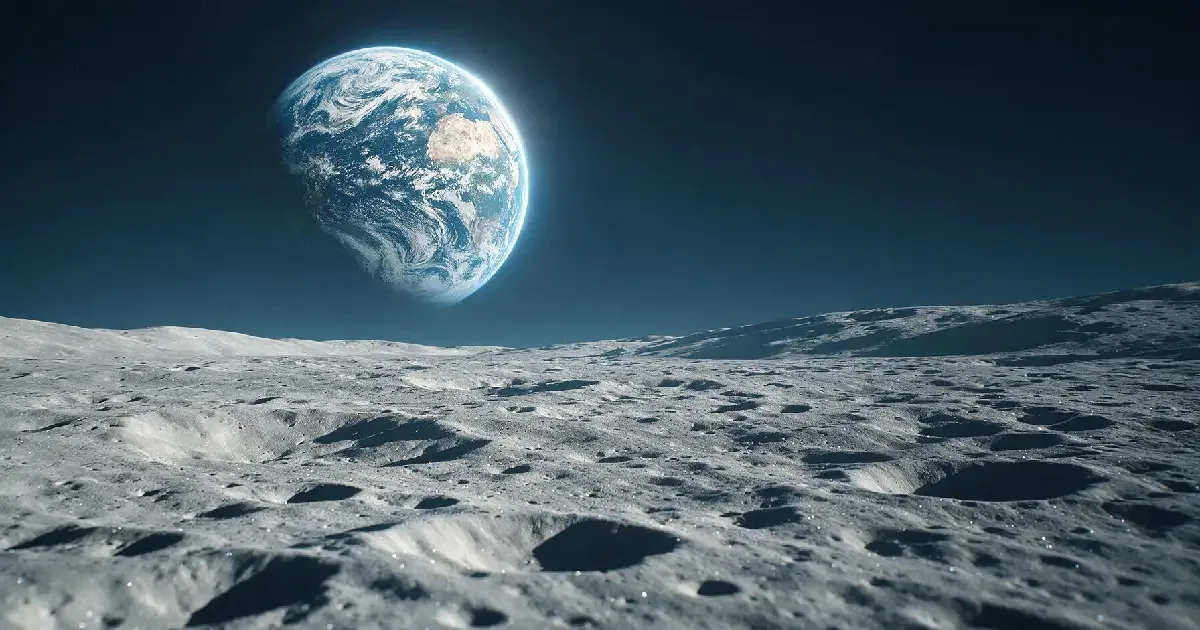
Earthshine: The Moon's Glow That Shows Earth Is Dimming
The ashen glow on a thin crescent Moon is sunlight bounced off Earth. Decades of measuring that earthshine revealed something unsettling: the planet is reflecting less light.

JWST Mapped a Nearby Rocky Planet's Surface — And It Looks Like the Moon
For the first time, the James Webb Space Telescope has directly characterized the surface of a rocky exoplanet, and what it found is a dark, basalt-covered world with no atmosphere — eerily similar to the Moon.
