
Earthshine: The Moon's Glow That Shows Earth Is Dimming
The ashen glow on a thin crescent Moon is sunlight bounced off Earth. Decades of measuring that earthshine revealed something unsettling: the planet is reflecting less light.
Step outside before sunrise on October 8 or 9, look low in the east, and you will find a thin waning crescent Moon closing in on the new moon of October 10. Look past the bright sliver. The rest of the disc is not black. It glows a faint ash-grey, the sight old sky-watchers called the new moon in the old moon's arms. None of that grey light belongs to the Moon. It is sunlight that struck Earth, bounced off its clouds, ice and oceans, crossed roughly 384,000 kilometres of space, lit the lunar night side, and then made the trip back to your eye.
That makes the ashen glow more than a pretty sight. It is a reading of Earth's brightness, taken with one of the oldest and cheapest instruments in climate science: a grey rock that has kept the same airless, weatherless surface for billions of years. And the readings have been falling. Earth is reflecting less sunlight than it did at the turn of the century, which means the ghostly part of this week's crescent is, in a measurable sense, a slightly darker ghost.
What Lights the Crescent's Night Side
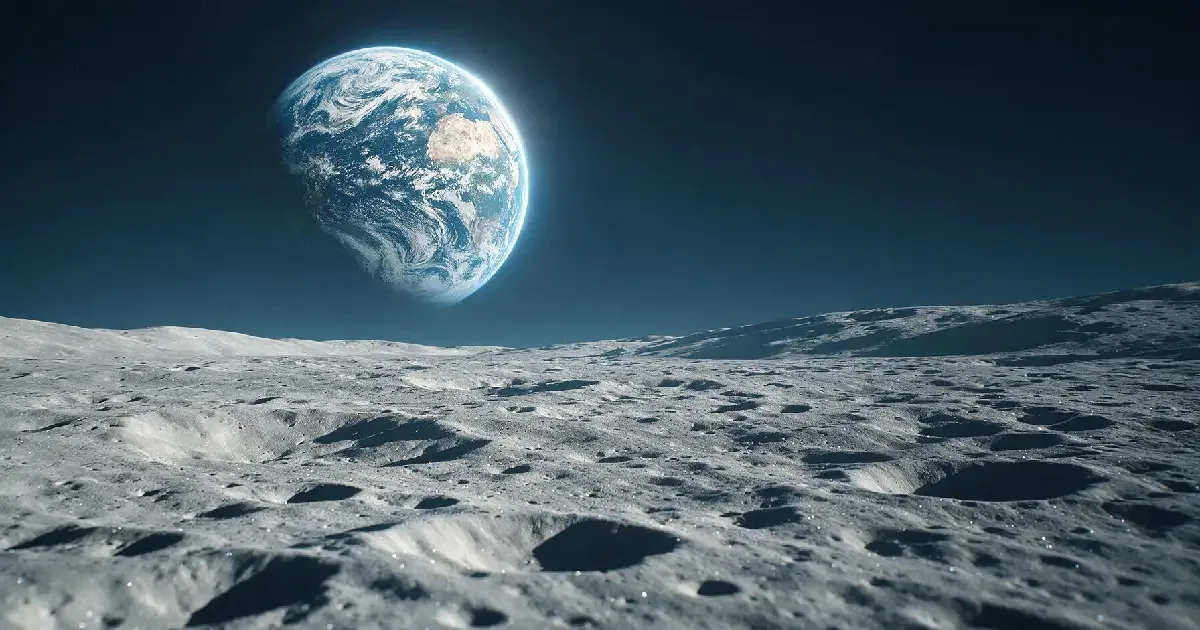
Earthshine is strongest when the Moon is a thin crescent, which feels backward until you swap viewpoints. When you see a sliver of Moon, someone standing on the dark lunar ground would see an almost full Earth. The thinner your crescent, the fuller their Earth, and the more light falls on the lunar night side. Near full moon the geometry flips: Earth turns its night side toward the Moon, and earthshine all but disappears.
An Astronomical Society of the Pacific review puts earthshine at the lunar surface at about one ten-thousandth of the illumination direct sunlight delivers there. Your eye catches it anyway because the sunlit crescent is too narrow to swamp the rest of the disc.
Viewing note: at mid-northern latitudes, autumn is the best season for morning crescents, because the Moon's path climbs steeply out of the eastern horizon before dawn. The young evening crescent returning around October 12 or 13 will sit lower, in brighter twilight. Southern Hemisphere observers get the reverse: their spring evenings favour the waxing crescent.
Thirty-Six Times Brighter Than a Full Moon
How bright is that full Earth from the Moon? NASA's planetary fact sheets let you run the numbers yourself. Earth's equatorial radius is 6,378 kilometres and the Moon's is 1,738 kilometres, so Earth's disc covers about 13.5 times as much sky. Earth's Bond albedo, the share of all incoming sunlight it reflects, is 0.294; the Moon's is just 0.11. Multiply the bigger disc by the brighter surface and a full Earth comes out roughly 36 times brighter than a full Moon seen from here. Swap in geometric albedo (0.434 for Earth, 0.12 for the Moon) and the figure climbs toward 50.
That lopsided relationship is why earthshine works as a climate gauge. The Moon's dull, airless surface does not change from year to year, so any long-term change in the glow on its night side traces back to the bright, restless planet doing the lighting. Clouds are the restless part. They are among the most reflective things on Earth, while the open ocean usually reflects less than 10 percent of the sunlight that reaches it. Thin the clouds over an ocean and you swap a white sheet for a dark floor, and the Moon's night side dims accordingly.
From Leonardo's Notebook to a Six-Inch Refractor
Leonardo da Vinci explained the ashen glow correctly more than 500 years ago, describing sunlight reflected by Earth's oceans lighting the Moon's dark surface, as NASA's Astronomy Picture of the Day recounts. He was half right in a way that matters for this story. Earth does the lighting, but the ocean is the dark part of the planet. The bright part is the cloud deck floating above it, and that is the part now thinning.
The first measurements came from French astronomer André Danjon, who in 1926 built a cat's-eye photometer to compare the earthlit and sunlit parts of the Moon, and logged more than 200 observations. Then, as a 2001 NASA feature puts it, the technique lay dormant for nearly 50 years, until physicist Steven Koonin revived it in a 1991 paper.
From late 1998, Philip Goode's team at the New Jersey Institute of Technology's Big Bear Solar Observatory in California turned a six-inch refractor on the Moon night after night. An early result put Earth's albedo at 0.297, plus or minus 0.005. The same NASA feature carried a line that reads differently a quarter-century later: if Earth reflected even one percent less light, the effect would be significant enough to be a concern for global warming.
Half a Watt per Square Metre, Gone
In 2021 the Big Bear team published two decades of results in Geophysical Research Letters. Between 1998 and 2017, Earth's reflected light fell by about 0.5 watts per square metre, roughly a 0.5 percent drop in albedo. Most of the decline arrived in the final three years, after 17 years of nearly flat readings, a turn Goode called "such a surprise." The team traced it chiefly to fewer bright, low clouds over the eastern Pacific off the Americas, as ocean waters warmed with a reversal of the Pacific Decadal Oscillation.
Half a watt sounds trivial next to the 1,361 watts per square metre of sunlight arriving at Earth's distance. The researchers' comparison lands harder: the extra solar energy now being absorbed is of the same magnitude as the total human-caused climate forcing added over those two decades.
Two details make the result sturdier than one small telescope should manage. The earthshine record showed no correlation with solar activity, so the Sun was not quietly fading. And NASA's CERES instruments, measuring Earth's energy budget from orbit since 2000, tracked the same year-to-year pattern where the records overlap; in fact the CERES decline is about twice as large as the earthshine one. The two disagree on the size of the change, but agree on its direction.
The orbital record kept going. A NASA and NOAA study found that Earth's energy imbalance, the gap between sunlight absorbed and heat radiated away, roughly doubled between 2005 and 2019, with fewer clouds and less sea ice among the causes. Then 2023 delivered a temperature jump that known drivers, including human warming and El Niño, fell about 0.2 °C short of explaining. A team at Germany's Alfred Wegener Institute, writing in Science in December 2024, pinned most of that gap on a record-low planetary albedo. In 2023, Earth's reflectivity may have been lower than at any time since at least 1940, mainly because low clouds thinned over the northern mid-latitudes and the tropics. Shrinking polar ice accounted for only about 15 percent of that decline.
Who Thinned the Clouds?
Here the story gets less tidy: the cause is still being argued over. The leading suspects overlap:
- Ocean cycles. The Pacific Decadal Oscillation flip flagged by the Big Bear team and by NASA's CERES researchers cleared clouds across wide stretches of ocean.
- Cleaner air. In 2020 the International Maritime Organization required an 86 percent cut in the sulfur content of ship fuel. A NASA Goddard team scanning 17 years of MODIS satellite images found that ship tracks, the bright cloud lines seeded by exhaust particles, then fell to record lows across the major shipping lanes. Fewer seed particles can mean fewer and dimmer clouds, and the Wegener team lists tighter shipping rules among its candidate causes.
- A feedback. The Wegener team also raised the possibility that warming itself is thinning low clouds. That is the least comforting option, because it would amplify whatever warming comes next.
Then there is the hemisphere puzzle. For as long as satellites have measured it, Earth's Northern and Southern Hemispheres have reflected almost the same amount of sunlight, even though the north holds far more land, cities and pollution. A 2025 PNAS study led by Norman Loeb at NASA Langley, using CERES data from 2001 through 2024, found the north now darkening faster, by about 0.34 watts per square metre per decade relative to the south. The main drivers were cleaner air, shrinking snow and sea ice, and extra water vapour. Clouds, which many researchers expected to even out the difference, did not.
Editor's take: The clean-air thread is the uncomfortable part of this story. Cutting sulfur from ship fuel was the right call for the air people breathe. It also removed an accidental sunshade, and a darker Earth, the kind earthshine measurements were designed to catch, is probably part of the bill. The lesson is not to pollute more. It is that a planet's brightness is a shared budget, and every policy that touches aerosols draws on it.
The Moon Keeps Its Night Shift
The satellite record has a handoff coming. The next-generation radiometer, Libera, is set to continue the CERES record from a NOAA polar-orbiting satellite targeted for launch in 2027. One detail closes a neat loop: Libera is planned to view the Moon 8 to 12 times a year as an independent calibration check. The same unchanging grey rock that makes earthshine a trustworthy ruler from the ground will help keep the orbital ruler honest.
What is worth watching next: whether the low clouds come back. The Pacific cycle that helped clear them will eventually swing again. If it does and the clouds stay thin, the feedback explanation becomes much harder to set aside. The prediction here is that the next five years of overlapping CERES and Libera data will settle more of this argument than any climate model run, because the competing explanations make different forecasts, and the Moon will be checking the answer every month.
Earthshine Questions, Answered
Can you see Earth's dimming by looking at earthshine?
No. The long-term drop is around half a percent to one percent of Earth's reflected light, while earthshine varies much more than that within single nights and across seasons as clouds shift. Only careful photometry averaged over whole years can pull the trend out.
Why is earthshine called the Da Vinci glow?
Because Leonardo da Vinci gave the first correct explanation of it, in notebooks written more than 500 years ago. His only miss was crediting the oceans, which are among the darkest surfaces on the planet.
Is Earth's dimming caused by global warming, or causing it?
It is clearly adding to warming: fewer low clouds let the ocean absorb more sunlight, heat that stacks on top of the greenhouse effect. Whether warming is itself thinning those clouds remains the open question, and the answer decides how much more dimming lies ahead.
Sources
- Earth's Albedo 1998–2017 as Measured From Earthshine — Goode et al., Geophysical Research Letters (AGU), 2021
- Earth's Albedo 1998-2017 as Measured From Earthshine (abstract page) — Instituto de Astrofísica de Canarias, 2021
- News release on the Big Bear earthshine albedo study — EurekAlert! (AAAS), 2021
- APOD: The Da Vinci Glow — NASA, 2025
- Scientists Watch Dark Side of the Moon to Monitor Earth's Climate — NASA, 2001
- Moon Fact Sheet — NASA Space Science Data Coordinated Archive
- Earth Fact Sheet — NASA Space Science Data Coordinated Archive
- Albedo — NASA Earthdata
- By the Light of Earth, Moon Mysteries Shine — Astronomical Society of the Pacific, Mercury, 2020
- Earth's Radiation Budget Is Out of Balance — NASA Earth Matters, 2021
- Recent global temperature surge intensified by record-low planetary albedo — Goessling, Rackow & Jung, Science, 2024
- Recent global temperature surge intensified by record-low planetary albedo (preprint) — arXiv, 2024
- The planet's lower reflectivity is causing a sharp increase in global warming — Helmholtz Association / Alfred Wegener Institute, 2024
- NASA Study Finds Evidence That Fuel Regulation Reduced Air Pollution from Shipping — NASA, 2022
- Emerging hemispheric asymmetry of Earth's radiation — Loeb et al., PNAS, 2025
- Libera — NOAA NESDIS
- Libera calibration overview (CALCON 2022 abstract) — CALCON Technical Meeting, Utah State University, 2022
- Moon Phases, October 2026 — Catalina Sky Survey, University of Arizona Lunar and Planetary Laboratory, 2026
Related Posts

Crescent Moon Meets Venus: The July 17 Conjunction
On July 17, 2026, a 3-day-old crescent Moon pairs with brilliant Venus in the western twilight. They look like neighbors. They are separated by 139 million kilometres.

JWST Mapped a Nearby Rocky Planet's Surface — And It Looks Like the Moon
For the first time, the James Webb Space Telescope has directly characterized the surface of a rocky exoplanet, and what it found is a dark, basalt-covered world with no atmosphere — eerily similar to the Moon.
