 CosmosIn60CosmosIn60

Gamma Cassiopeiae blazed with X-rays 40 times stronger than expected for half a century. In 2026, the XRISM space telescope finally unmasked the hidden culprit: a ravenous white dwarf.
Look up at the night sky on a clear evening and find the constellation Cassiopeia — that unmistakable W-shape anchored to the northern sky. The star sitting at the very center of the W is Gamma Cassiopeiae, a brilliant blue-white giant visible to the naked eye from anywhere in the Northern Hemisphere. For more than 50 years, that unassuming pinpoint of light was hiding something extraordinary: a hidden white dwarf companion that was feeding on its neighbor and screaming in X-rays — and astronomers could not figure out why. In March 2026, a Japanese space telescope changed everything.
Gamma Cassiopeiae has been causing trouble for astronomers since 1866, when Italian astronomer Angelo Secchi noticed something odd in its light spectrum: bright hydrogen emission lines that should not have been there. That discovery created an entirely new stellar classification — the "Be" star category, where "e" stands for emission. Be stars are massive, hot, fast-spinning giants that shed material from their equatorial regions, forming a surrounding disk of expelled gas detectable through spectral analysis.
Gamma Cassiopeiae sits approximately 550 light-years from Earth, making it close enough to study in detail but far enough to have kept its secrets well. The star itself is a beast: a blue-white giant spinning at a projected rotational velocity of around 450 km/s, so fast that its equator bulges outward and its surface temperature varies from roughly 26,500 K at the poles to 17,300 K at the equator. For context, our Sun's surface temperature is about 5,778 K. Gamma Cassiopeiae is in a different league entirely.
For most of the twentieth century, astronomers accepted it as an unusually energetic Be star and moved on. Then the X-ray detectors arrived — and everything changed.
In the mid-1970s, when space-based X-ray observatories began systematically scanning the sky, astronomers pointed their instruments at Gamma Cassiopeiae and got a shock. The star was emitting X-rays roughly 40 times more powerful than would be expected from a massive star of its type. Worse, the plasma generating those X-rays was heated to approximately 150 million degrees Celsius — hotter than the core of the Sun, which reaches about 15 million degrees. Something was pumping enormous amounts of energy into the region around this star, and no one knew what.
Three competing theories emerged over the following decades. The first proposed that Gamma Cassiopeiae's rapid spin and expulsion disk were creating magnetic interactions that somehow heated plasma to these extreme temperatures. The second suggested the X-rays came from the Be star itself through an unusually powerful stellar wind. The third — the most dramatic — argued that an invisible companion object was present, feeding on the star's expelled disk material and releasing X-ray energy as it swallowed that matter. Each theory had supporting evidence, and each had fatal flaws.
The debate ran for half a century. The star became famous in the astronomical community not for any particular discovery, but for being stubbornly unexplainable. The class of stars sharing its unusual X-ray properties — about 20 known objects now called "gamma-Cas analogs" — grew slowly, each new member adding weight to the puzzle without resolving it.
The breakthrough came from an instrument that did not even exist until 2023. The X-Ray Imaging and Spectroscopy Mission, known as XRISM and pronounced "crism," is a joint mission between JAXA (Japan's space agency), NASA, and ESA. At its heart is an instrument called Resolve — a microcalorimeter spectrometer capable of measuring the energy of individual X-ray photons with precision that previous telescopes could not approach.
A team led by researchers at the University of Liège pointed Resolve at Gamma Cassiopeiae during three dedicated observing sessions: December 2024, February 2025, and June 2025. The timing was deliberate. Earlier observations had determined that Gamma Cassiopeiae has a companion object orbiting it on a 203-day period. By spacing three observations across this orbital period, the team could check whether the X-ray signatures moved in lockstep with that companion's orbit — the definitive test that would reveal whether the companion was the true X-ray source.
The answer was unambiguous. The high-temperature plasma signatures shifted velocity between all three observations, and those shifts matched the orbital motion of the companion perfectly. As the lead study team stated: "This shift was measured with high statistical reliability. It is, in fact, the first direct evidence that the ultra-hot plasma responsible for the X-rays is associated with the compact companion, and not with the Be star itself."
The mystery was solved. The X-rays were coming from the companion — a white dwarf.
What exactly is this hidden companion, and why does it produce such extreme X-ray emission? A white dwarf is the dense remnant left behind when a star similar to or moderately more massive than our Sun exhausts its nuclear fuel and sheds its outer layers. What remains is a stellar corpse roughly the mass of the Sun compressed to the size of Earth — a solid, crystallizing object of extraordinary density where a teaspoon of material would weigh several tonnes.
In the Gamma Cassiopeiae system, the white dwarf sits inside the Be star's expelled disk, steadily siphoning gas from that reservoir through gravitational attraction. As this material spirals inward toward the white dwarf's surface — a process called accretion — it accelerates to enormous velocities. When it finally impacts the white dwarf's surface or is funneled toward its magnetic poles, the kinetic energy converts directly to heat, reaching those baffling temperatures of 150 million degrees and radiating furiously in X-rays.
XRISM's Resolve instrument added one more crucial detail: the white dwarf is magnetic. Its magnetic field — far stronger than anything found in ordinary stars — truncates the surrounding disk of infalling material and channels the gas toward the white dwarf's poles rather than allowing it to fall uniformly. The spectral feature widths of approximately 200 km/s detected by Resolve are characteristic of this polar accretion scenario and rule out non-magnetic alternatives. The white dwarf is not just feeding — it is a highly organized, magnetically controlled engine converting stolen stellar material into X-ray energy.
The Gamma Cassiopeiae solution does not just close one chapter — it opens several new ones. If Gamma Cassiopeiae is confirmed as a Be star with a white dwarf companion, the approximately 20 known gamma-Cas analogs are almost certainly the same type of system. That means astronomers have been sitting on an entire population of "stellar vampire" binaries, hiding in plain sight as apparently ordinary bright stars, for decades.
The published research in Astronomy & Astrophysics confirms this: gamma-Cas analogs represent roughly 10% of massive Be stars studied to date. Across the Milky Way, that implies a significant population of these compact binary systems — far more than previously appreciated. Each one contains a dead star quietly feeding on a living companion, radiating at X-ray luminosities that dwarf what any isolated massive star should produce.
What makes this even more significant is that these Be plus white dwarf binaries had been theoretically predicted for years. Stellar evolution models suggested they should exist in meaningful numbers. But observational confirmation had always been elusive because white dwarfs are far dimmer than their Be star companions at optical wavelengths — invisible to most instruments, present only as an anomaly in the X-ray data that nobody could satisfactorily explain. XRISM finally provided the spectral precision needed to catch the white dwarf's fingerprints in motion.
The resolution of the Gamma Cassiopeiae mystery is not simply a satisfying answer to a long-standing puzzle. It demonstrates something fundamental about the tools astronomers now have available, and what those tools will reveal about the universe going forward.
For 50 years, the X-ray signal from Gamma Cassiopeiae was real and measurable — every X-ray telescope that pointed at it saw the same thing. The data was not the problem. The problem was spectral resolution: the ability to measure the precise energy of each X-ray photon with enough accuracy to detect the tiny Doppler shift caused by a white dwarf moving at orbital velocities around its companion. Previous telescopes could detect X-rays but could not perform this kind of precision velocity measurement. XRISM's Resolve microcalorimeter changed the upper limit of what is detectable.
The broader implication is that a significant fraction of the binary star systems scattered across our galaxy may contain hidden compact remnants — white dwarfs, neutron stars, or even black holes — silently feeding on their companions. Many of these systems look, at optical wavelengths, like ordinary single stars. It is only in the X-ray regime, measured with sufficient precision, that their true nature becomes visible. XRISM has demonstrated it can make those measurements, and the gamma-Cas analog population is almost certainly just the beginning of what it will find.
For the cosmosin60 community, this story also illustrates something worth holding onto: the universe does not always reveal its structure to the first instrument you point at it. Sometimes a star keeps its secret for 50 years — not because the secret is especially well hidden, but because the right instrument had not been built yet.
Gamma Cassiopeiae is a massive blue-white giant star located approximately 550 light-years from Earth, sitting at the center of the W-shaped Cassiopeia constellation. Its intrinsic luminosity is far greater than the Sun's, making it easily visible without a telescope despite its distance.
Beginning in the mid-1970s, X-ray telescopes detected radiation from Gamma Cassiopeiae approximately 40 times stronger than expected for a massive star of its type, with plasma temperatures reaching 150 million degrees Celsius. No known process involving the star itself could explain this output, which is why the source remained debated for 50 years.
XRISM carries the Resolve microcalorimeter, which measures the precise energy of individual X-ray photons with far greater accuracy than previous instruments. This allowed astronomers to detect Doppler velocity shifts in the X-ray plasma that matched the 203-day orbital period of the companion, proving the X-rays originate from the white dwarf rather than the Be star.
A white dwarf is the dense remnant of a dead star — roughly the mass of the Sun compressed to the size of Earth. When a white dwarf orbits inside a Be star's expelled gas disk, it accretes that material onto its surface. The infalling gas accelerates to extreme velocities and impacts the white dwarf at temperatures reaching hundreds of millions of degrees, radiating the resulting energy as X-rays.
Approximately 20 "gamma-Cas analog" stars have been identified so far, representing roughly 10% of massive Be stars studied to date. If this proportion holds across the broader stellar population, Be plus white dwarf binary systems are far more common in the Milky Way than previously confirmed, though the true total remains an open research question.
Gamma Cassiopeiae has been part of the night sky for as long as humans have looked up at Cassiopeia — but the star was carrying a passenger nobody could prove was there. Now that XRISM has established the template for detecting these hidden white dwarf companions, the same technique will be applied systematically to the other gamma-Cas analogs and beyond. The question worth watching in the coming years is not whether more Be plus white dwarf binaries will be confirmed, but how many there are — and what that tells us about the hidden graveyard of stellar remnants embedded in systems we have long assumed were simple.

JWST built the sharpest map yet of the universe's invisible dark matter scaffolding. Here's what it actually shows, what the headlines got wrong, and why depth beat width.
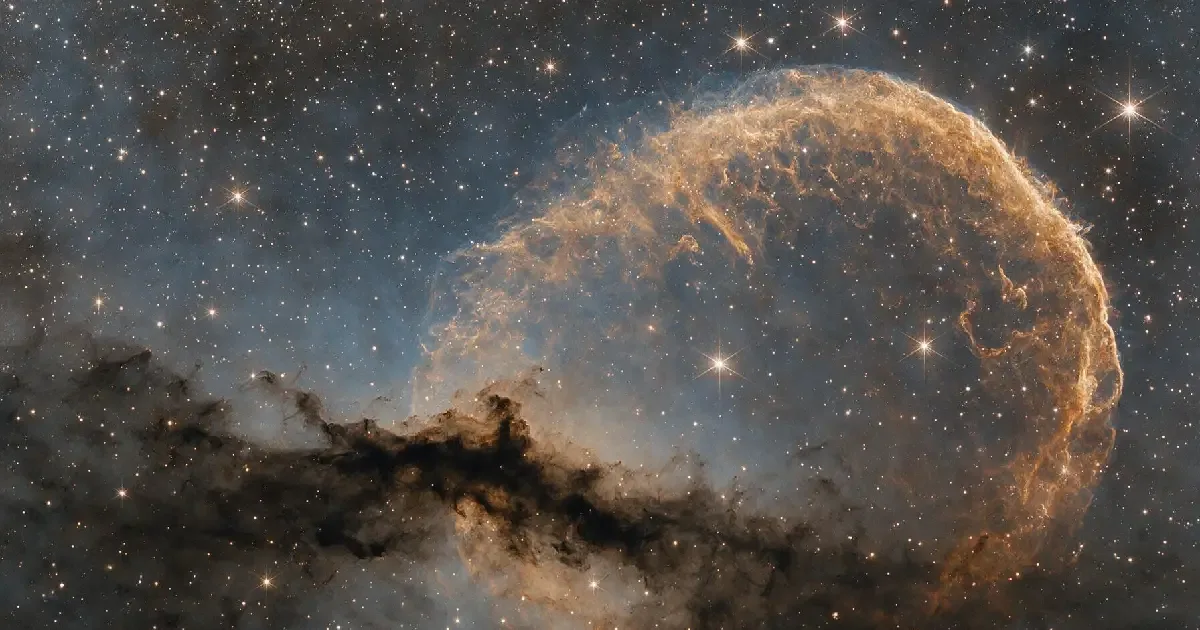
Kepler's supernova of 1604 was the last one anyone saw in the Milky Way, but not the last to explode. Here is how dust hid others, and how the next one will be caught.

The night sky is dark mainly because the universe has a finite age, not because the Sun set. The blazing sky an infinite universe would give us is still there, stretched into invisible microwaves.