JWST Mapped the Cosmic Web's Dark Matter Skeleton
JWST built the sharpest map yet of the universe's invisible dark matter scaffolding. Here's what it actually shows, what the headlines got wrong, and why depth beat width.
There are two ways to map something you cannot see. You can sweep a shallow net across a huge stretch of sky and catch the broad shape of the thing, or you can stare very hard at one small patch and resolve the fine threads nobody else could pull apart. In January 2026, a team led by Diana Scognamiglio at NASA's Jet Propulsion Laboratory chose the second path — and the result is the sharpest portrait yet of the dark matter scaffolding that holds the universe together. The honest thesis buried under the "13.7 billion years" headlines is this: JWST didn't out-map the wide surveys, it out-focused them, and that trade-off is the real story.
Dark matter is roughly 27% of the universe — more than five times the amount of ordinary matter that makes up stars, planets, and you. It emits no light, absorbs none, reflects none. Yet its gravity sculpts everything visible into a vast lattice of dense knots linked by thin strands, with near-empty voids between. Astronomers call that lattice the cosmic web. The question has never been whether the web exists. It's how finely you can trace its threads. That's where the comparison gets interesting.
Depth Versus Width: The Two Maps Astronomers Argue Over
Every dark matter map lives on a spectrum between two competing virtues, and you can't max out both at once.
On the width end sit missions like ESA's Euclid space telescope, which will eventually survey nearly a third of the entire sky and weigh billions of galaxies. Width buys you statistics — enough galaxies to test whether the universe really clumps the way standard cosmology predicts. The cost is sharpness. Spread your telescope time across thousands of square degrees and each patch gets only a glance.
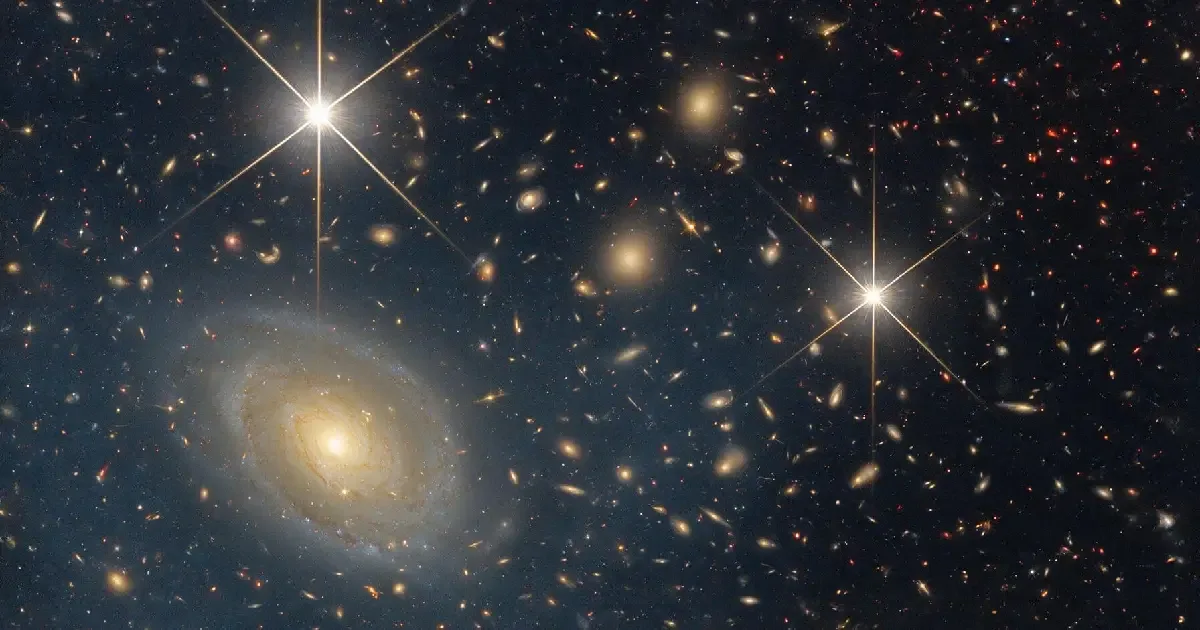
On the depth end sits what JWST just did with the COSMOS-Web survey. Instead of sweeping wide, the team poured roughly 255 hours of Near-Infrared Camera exposure into a single field in the constellation Sextans — an area of just 0.54 square degrees, about two and a half times the apparent size of the full Moon. That sounds tiny, and it is. But within that keyhole, JWST resolved the cosmic web at a sharpness no space-based survey had reached before.
The numbers make the trade visible. The JWST map reaches an angular resolution of about one arcminute — more than twice as sharp as previous space-based mass maps over a comparable area. It does this by measuring around 250,000 distant galaxies, packing roughly 129 of them into every square arcminute of sky. That galaxy density is the whole game, and it explains why depth, not width, won here.
Why Galaxy Density Is the Whole Game
You cannot photograph dark matter, so you have to weigh it indirectly. The tool is weak gravitational lensing. When light from a far-off galaxy passes a clump of dark matter on its way to us, that mass bends spacetime and very slightly distorts the galaxy's apparent shape — stretching a round galaxy into a faint ellipse. The distortion from any single galaxy is far too small to notice. But average the subtle warping across thousands of galaxies in one direction, and the dark matter responsible for the bending precipitates out of the noise like a fingerprint.
Here's the part the headlines skip: the resolution of your map is set almost entirely by how many background galaxies you can pack into each patch of sky. More galaxies per square arcminute means more independent shear measurements, which means you can map mass at finer scales. JWST's infrared eyes — using its F115W and F150W filters — pick up faint, distant, dust-reddened galaxies that ground telescopes and even Hubble simply miss. The result: the JWST field holds roughly 10 times more galaxies than ground-based maps and about twice as many as Hubble caught over the same patch back in 2007.
That density is why structures Hubble recorded as single blobs now split into multiple distinct mass concentrations, with filamentary bridges stretching between galaxy clusters that earlier maps blurred into a smear. As Scognamiglio's team put it, "now we're seeing the invisible scaffolding of the universe in stunning detail." This is the first non-obvious takeaway: the breakthrough wasn't a bigger telescope or a new theory — it was simply seeing more galaxies in one spot, and letting lensing statistics do the rest.
What "13.7 Billion Years" Really Means Here
Now the honest correction, because it matters and most coverage glides past it. The viral framing says JWST mapped dark matter across 13.7 billion years of cosmic history — the full age of the universe. The map does not literally reach the Big Bang.
What it actually does is trace mass structures out to a redshift of about z ≈ 2. Light from those structures has been traveling for billions of years, so we see them as they were when the universe was roughly 3 to 3.5 billion years old — the farthest of them lie about 5 billion light-years away. That epoch is not arbitrary. Redshift 2 is cosmic noon, the era when star formation across the universe hit its peak and galaxies were assembling stars roughly ten times faster than they do today.
So the accurate claim is sharper and, frankly, more interesting than the headline: JWST mapped the dark matter web during the exact epoch when the web was doing its most important work — funneling gas into the densest knots to fuel the greatest burst of galaxy-building in cosmic history. The "13.7 billion years" phrasing gestures at the theoretical span this method will eventually cover as surveys deepen, not what this one keyhole captured. That distinction is the second non-obvious point, and it's the kind of thing a content farm rewriting the press release will quietly get wrong.
Where This Map Goes Next
A 0.54-square-degree map is a proof of capability, not a finished atlas — and that's exactly how the field is treating it. The technique is now validated at high galaxy density; the next move is to scale the area without losing the sharpness.
That hand-off is already designed. NASA's Nancy Grace Roman Space Telescope, slated to begin science later this decade, is built to map an area roughly 4,400 times larger than the JWST field — pairing wide coverage with space-grade resolution. Euclid, meanwhile, keeps widening its survey toward a third of the sky. My read on what's worth watching: the genuinely decisive dark matter test won't come from any single instrument but from stitching them — using JWST's deep keyhole fields to calibrate and sharpen the wide, shallow maps Euclid and Roman produce. Depth teaches width how to see straight.
That matters beyond pretty pictures. The fine structure of the cosmic web is a direct test of what dark matter actually is. Cold, sluggish dark matter clumps down to small scales and produces lots of fine filaments and sub-clumps; "warmer" or more exotic dark matter smooths those small structures away. A high-resolution map is therefore a discriminating instrument — the sharper the web, the harder it squeezes the competing theories. JWST just proved the squeeze is possible from orbit. The wide surveys will turn it into a verdict.
Quick Answers About the JWST Dark Matter Map
How did JWST map something invisible?
It didn't image dark matter directly — nothing can. It measured the slight distortion that dark matter's gravity imprints on the shapes of ~250,000 background galaxies (weak gravitational lensing), then reconstructed the mass map that best explains all those tiny warps at once.
Is this the largest dark matter map ever made?
No — it's the sharpest space-based map over a sizable area, not the largest. Ground-based and future missions like Euclid cover vastly more sky. JWST's distinction is resolution: about one arcminute, more than twice as fine as previous space-based mass maps.
Did JWST really map dark matter back to the Big Bang?
Not literally. The map traces structures out to redshift z ≈ 2, when the universe was about 3 billion years old. The "13.7 billion years" headline refers to the cosmic span this method aims for as surveys deepen, not the depth of this particular field.
Why is dark matter called the skeleton of the universe?
Because its gravity forms the rigid framework — dense knots linked by thin filaments — along which visible gas and galaxies collect. Galaxies are strung along dark matter threads like droplets on a spider's web; the web came first and shaped where everything else could form.
Related Posts

The 2,000-Year-Old Greek Computer That Predicted Eclipses — Decoded Again in 2026
A YouTuber building a replica helped scientists crack the Antikythera mechanism's last great mystery. Here's what the 2,000-year-old eclipse computer can now tell us.