
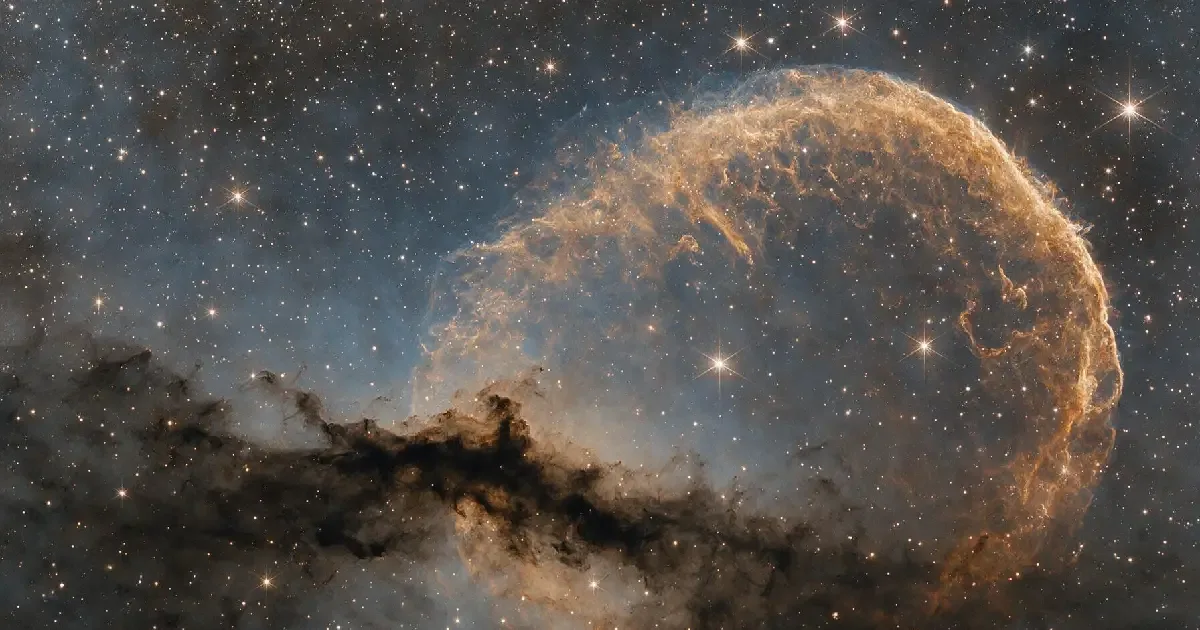
Kepler's Supernova of 1604 and the Blasts Dust Hid Since
Kepler's supernova of 1604 was the last one anyone saw in the Milky Way, but not the last to explode. Here is how dust hid others, and how the next one will be caught.
How many stars have exploded in the Milky Way since October 1604, and why has nobody on Earth watched a single one of them happen? It sounds like a trivia question. It is closer to a cold case. The best rate estimates say the galaxy should have produced somewhere between a handful and roughly twenty supernovae in that time, yet the confirmed tally is two, both found long after the fact. This article argues that Kepler's star was not the Milky Way's last supernova at all. It was the last one that happened to detonate in a clear window, and the 422 years of apparent silence since then are a story about dust, not about stars.
Seventeen Months in the Serpent-Bearer's Foot
Start with the case file. On October 9, 1604, the Italian astronomer Lodovico delle Colombe recorded a new point of light in Ophiuchus. Kepler, working in Prague, heard the rumors but did not see the star himself until October 17. It climbed to about magnitude -2.5, outshining Jupiter, stayed visible in daylight for roughly three weeks, and lingered until it faded in March 1606. Kepler tracked it for more than a year and published De Stella Nova in Prague that same year.
Modern X-ray work fills in what Kepler could not know. The remnant is the debris of a Type Ia supernova, a white dwarf that crossed a critical mass and detonated, either by siphoning gas from a companion star or by merging with another white dwarf.
Two details stand out. First, Kepler's event came just 32 years after the supernova Tycho Brahe documented in 1572: two naked-eye galactic supernovae in a single generation, then nothing for more than four centuries. Second, Galileo did not turn his telescope on the sky until about four years after Kepler's star faded. That timing means no human being has ever watched a Milky Way supernova through a telescope.
The Clue Hiding in a Catalog Number
The most useful piece of evidence is printed in plain sight. Chandra catalogs Kepler's remnant as G004.5+06.8. That label is a galactic address: 4.5 degrees of longitude from the direction of the galactic center, and 6.8 degrees above the galactic plane. At roughly 17,000 light-years, an angle of 6.8 degrees puts the remnant about 2,000 light-years above the midplane (17,000 × sin 6.8°). Kepler's star detonated above most of the gas and dust that hugs the Milky Way's disk, which helps explain how its light reached Europe bright enough to see at noon.
Now compare the youngest remnant known in the galaxy, G1.9+0.3. Its address is 1.9 degrees from the galactic center and just 0.3 degrees above the plane, at roughly 28,000 light-years, so its sightline runs through some of the densest dust in the Milky Way. Chandra researchers estimated that the intervening gas and dust made the explosion about a trillion times fainter in optical light, a loss of 30 astronomical magnitudes. The twist is that G1.9+0.3, like Kepler's star, was most likely a Type Ia detonation of a white dwarf, and NASA notes it would have been visible from Earth if it had not been heavily obscured. The difference between a star Europe watched at noon and one nobody noticed comes down to two numbers after a plus sign.
Two Blasts Found by Their Debris
Two cases are confirmed, and both were solved backward, by measuring how fast debris is expanding and rewinding the clock.
Cassiopeia A. Its light reached Earth about 340 years ago, which puts the explosion, as seen from here, in the late 1600s. That was already a telescope era, with John Flamsteed serving as England's Astronomer Royal, yet the only candidate record is a star Flamsteed logged in 1680, a suspected but unconfirmed sighting. Here dust plays a stranger role. In 2008, astronomers recorded the explosion's spectrum from a light echo, light scattered off interstellar dust and arriving more than three centuries late, and it showed a Type IIb supernova from a red supergiant that had shed most of its hydrogen. Dust can hide a supernova, and it can also hold its light in storage.
G1.9+0.3. Astronomers had it in radio images from 1985, but it was recognized as young only when Chandra images from 2007 showed it had expanded measurably, with debris moving at almost 35 million miles per hour, about 5 percent of light speed. A 2024 study built on 13 years of Chandra monitoring finds the expansion consistent with an explosion around 1900 CE, and reports that G1.9+0.3 is the only remnant known to be getting brighter, its X-ray output climbing about 1.2 percent per year.
Notice the pattern. Neither case was discovered by looking up at the right moment. Both were found by archaeology, decades or centuries after the fact, by instruments tuned to wavelengths that slip through dust, mainly radio and X-rays.
Four to Nineteen: The Supernova Shortfall
How many should there be? Published rate estimates span a wide range. Applied to the 422 years since Kepler, they look like this:
| Galactic supernova rate | Source | Expected since 1604 |
|---|---|---|
| One or two per century | Ohio State University, 2013 | About 4 to 8 |
| About one every 30 years | Chandra X-ray Center, 2008 | About 14 |
| About 4.6 per century | Adams et al., 2013 | About 19 |
Against those expectations, the confirmed count is two, which leaves somewhere between two and seventeen Milky Way supernovae since 1604 that nobody has pinned down. The 2020 Murphey, Hogan, Fields and Narayan study helps explain why the sky stayed dark: by their modeling, only about 13 percent of core-collapse supernovae and about 33 percent of Type Ia events are bright enough to have been discovered by naked-eye observers, and the authors attribute the shortfall at least partly to dust in the galactic plane. Ohio State researchers put it more starkly: soot-like dust dims optical light from stars near the galactic center by a factor of nearly a trillion, while infrared light is dimmed only about 20 times.
Here is a connection worth sitting with: some of that dust was made by supernovae. In 2014, ALMA observations of Supernova 1987A found about a quarter of the Sun's mass in freshly formed dust inside the remnant. Supernovae also destroy grains, so the net balance is debated. But the irony stands: generations of exploding stars help lay down the fog that hides their successors from optical eyes.
Why the Next One Will Probably Be Heard First
The forward-looking question is whether the next galactic supernova slips past too. Almost certainly not, because astronomy no longer depends on light alone. When a massive star's core collapses, it dumps about 99 percent of its energy into roughly 10⁵⁸ neutrinos, and the light only emerges hours later. The SuperNova Early Warning System links detectors worldwide, from Super-Kamiokande to IceCube and JUNO, and issues an alert when multiple experiments trigger within 10 seconds of each other.
Dust is not a wall at every wavelength, either. The Adams et al. analysis concluded that, at very high probability, the next galactic supernova will be easily detectable in the near-infrared. The infrared fleet is better stocked than ever: Webb is operating, and NASA's Roman Space Telescope launched on August 30, 2026, bound for an orbit around the Sun-Earth L2 point about a million miles away.
There is a catch. The neutrino network was built for core-collapse explosions; the original proposal was literally titled as a neutrino early warning system for galactic Type II supernovae. A Type Ia blast like Kepler's, a thermonuclear detonation with no collapsing core, would not deliver that kind of neutrino burst. Yet Type Ia events are the ones most likely to be bright enough to see with the eye, roughly 33 percent versus 13 percent in the Murphey model. The kind of supernova easiest to see is the kind the alarm cannot hear.
Our prediction: the odds favor a core-collapse event next, since Adams and colleagues put core collapse at about 3.2 of their 4.6 supernovae per century. So the first news of the next Milky Way supernova will most likely be an automated neutrino alert, the first image will be infrared, and there may be no new star to see at all. A Kepler-style naked-eye star would be the long shot, and it would arrive with no neutrino warning.
Questions Readers Ask About Kepler's Supernova
When was the last supernova in the Milky Way?
The last one seen was Kepler's, in 1604. The most recent one known is G1.9+0.3, whose explosion dates to around 1900 but went unnoticed behind dust. Rate estimates suggest others have happened since 1604 and remain unidentified.
How far away was Kepler's supernova?
About 17,000 light-years according to NASA's 2026 Chandra release, with older NASA material citing about 20,000. Either way, the explosion itself happened many thousands of years before 1604; that date marks when its light arrived.
Could a supernova in the Milky Way harm Earth?
Only a very close one. NASA has noted that a supernova would need to occur within roughly 50 light-years to damage Earth's ozone layer. Kepler's star was more than 300 times farther away than that.
What the Ledger Still Cannot Tell Us
Three questions stay open. First, where are the missing remnants? If the true count since 1604 is closer to nineteen than two, some young remnants may already sit in radio and X-ray catalogs, unrecognized because nobody has measured their expansion. Second, why do the historical supernovae appear where they do? The Murphey team found that predicted sky distributions do not match the positions of the confident historical events, so the models, the tiny sample, or both are missing something. Third, what exactly blew up in 1604? NASA's 2026 release still lists both routes for Kepler's white dwarf: a companion star feeding it, or a merger with another white dwarf.
The Chandra video released this January gives the case a fresh lead. Stitching together X-ray data from 2000 through 2025, it shows the fastest debris racing at about 13.8 million miles per hour, 2 percent of light speed, while the slowest side moves at about 4 million miles per hour after plowing into denser gas. That lopsided expansion is a fossil record of the environment the star exploded into. Kepler's star, which turned 422 this month counting from delle Colombe's sighting on October 9, is still sending evidence. The open question is how many of its unseen siblings are doing the same, waiting for someone to measure them.
Sources
- 420 Years Ago: Astronomer Johannes Kepler Observes a Supernova — NASA, 2024
- Supernova Remnant Video From NASA's Chandra Is Decades in the Making — NASA, 2026
- Kepler's Supernova Remnant image release — Chandra X-ray Center, 2026
- The Remarkable Remains of a Recent Supernova — NASA, 2013
- G1.9+0.3 image release — Chandra X-ray Center, 2008
- G1.9+0.3 feature, Chandra Chronicle — Chandra X-ray Center, 2008
- Brightening and Fading in the Youngest Galactic Supernova Remnant G1.9+0.3 — Borkowski, Reynolds, Petre and Green, The Astrophysical Journal, 2024
- NASA Telescopes Chase Down "Green Monster" in Star's Debris — NASA, 2024
- The Expansion Center and Dynamical Age of the Galactic Supernova Remnant Cassiopeia A — Thorstensen, Fesen and van den Bergh, The Astronomical Journal, 2001
- The Cassiopeia A Supernova Was of Type IIb — Krause et al., Science, 2008
- Witnessing History: Rates and Detectability of Naked-Eye Milky-Way Supernovae — Murphey, Hogan, Fields and Narayan, arXiv, 2020
- Observing the Next Galactic Supernova — Adams, Kochanek, Beacom, Vagins and Stanek, arXiv, 2013
- Could a Milky Way Supernova Be Visible From Earth in Next 50 Years? — The Ohio State University, 2013
- ALMA Spots Supernova Dust Factory — National Astronomical Observatory of Japan (ALMA), 2014
- Supernova's Super Dust Factory Imaged With ALMA — Astronomy, 2014
- About SNEWS — SuperNova Early Warning System collaboration
- SNEWS: A Neutrino Early Warning System for Galactic SN II — SNEWS collaboration, arXiv, 1999
- Roman Launch — NASA Science, 2026
- 2012: Fear No Supernova — NASA, 2011
Related Posts
Why the Night Sky Is Dark: The Universe Has an Age
The night sky is dark mainly because the universe has a finite age, not because the Sun set. The blazing sky an infinite universe would give us is still there, stretched into invisible microwaves.

A Star in Andromeda Vanished Without Exploding
A supergiant in Andromeda dimmed 10,000-fold and disappeared with no supernova. The numbers behind this 'failed supernova' point to a black hole born in silence.
