
Why the Night Sky Is Dark: The Universe Has an Age
The night sky is dark mainly because the universe has a finite age, not because the Sun set. The blazing sky an infinite universe would give us is still there, stretched into invisible microwaves.
Nobody has finished measuring the darkness yet. The faint glow between the galaxies has been measured from a spacecraft billions of miles from Earth, revised twice in four years, and is the target of a NASA telescope built to map the whole sky in infrared. The open question is not really why the night sky is dark, but whether every photon in that darkness has been accounted for.
The first half of the puzzle has a cleaner answer than the usual one, and it is not "because the Sun has set." The night sky is dark mainly because the universe has a finite age: light from beyond a certain distance has not had time to reach us, and the stars that could supply it do not shine forever. Cosmic expansion, which stretches distant light toward the red, is real but secondary. And the blazing sky an infinite universe would give us never went anywhere. It fills every direction right now as the cosmic microwave background, stretched into microwaves your eyes cannot see.
A Star at the End of Every Sightline
The obvious explanation covers less than it seems. At night there is no nearby bright source like the Sun to scatter light through the air, as NASA's StarChild explainer notes. That explains why the night sky is not blue, not why it is black.
The deeper problem is geometry. In an infinite, eternal, unchanging universe evenly sprinkled with stars, every line of sight eventually lands on the surface of a star. Distant stars look fainter, but each shell of distance holds more of them, and the two effects cancel. As Penn State's introductory astronomy course puts it, "the surface brightness of the night sky should be the same as the Sun's": one continuous stellar surface, glowing like the Sun's 5,500 °C (10,000 °F) photosphere.
Heinrich Olbers published on the puzzle in 1823, but he did not discover it. Overduin and Wesson's review of the background light credits Johannes Kepler with "arguably the first statement of the problem" in the early 1600s (Overduin & Wesson), and StarChild lists Edmond Halley among those who pondered it. What Olbers added was a fix: perhaps dust between the stars absorbs the light of the distant ones.
The fix fails, and the way it fails is the most useful clue in the story. Given an infinitely old universe, the absorbed light would "heat up the dust causing it to glow brightly enough to light up the night sky," in Penn State's words. Hiding light does not destroy its energy. A real answer must explain why that energy was never produced.
The Answer Hidden in a Prose Poem
The explanation that survived came from outside astronomy. In Eureka: A Prose Poem, published in 1848, Edgar Allan Poe wrote that if the succession of stars were endless, the sky "would present us an uniform luminosity," since there could be "absolutely no point, in all that background, at which would not exist a star." The dark gaps, he reasoned, exist because the background is so distant "that no ray from it has yet been able to reach us at all" (Eureka, Section 7).
That is the finite-age argument in a single sentence. If light travels at a finite speed and stars have been shining for a finite time, you can only see out to a finite distance. Beyond it, sightlines end on regions whose light is still in transit. Poe got there without a single measurement and called the result a poem. About a decade later, the German astronomer Johann Mädler argued in print that a dark sky is consistent even with an infinite universe, provided the universe began a finite time ago (Tipler, QJRAS 1988).
Neither man had the arithmetic. Lord Kelvin worked it out in a little-known 1901 paper that went largely unnoticed until Edward Harrison drew attention to it in 1986 (Harrison, Nature 1986). Harrison's own 1965 analysis showed that the brightness of the background is set by how long the galaxies have been shining (Harrison, MNRAS 1965). That turns a geometry puzzle into an energy budget: stars cannot pour out enough light in their lifetimes to paint the sky solid. The universe is not too big for a bright sky. It is too young, and its stars burn out too soon.
Finite Age First, Expansion Second
The modern answer has two ingredients, and they are not equal partners. The universe is about 13.8 billion years old, so only light that has had time to arrive can be seen. Separately, expansion stretches distant light toward longer, redder, weaker wavelengths, which StarChild lists as the second part of the solution.
The detailed calculations rank expansion second. Wesson, Valle and Stabell tackled the relative weights in 1987, and Overduin and Wesson's later review gives the verdict: "the brightness of the night sky is determined to order of magnitude by the lifetime of the galaxies, and reduced by a factor of only 0.6 ± 0.1 due to the expansion of the Universe" (Overduin & Wesson). In the simplest flat models, the same review puts the background with expansion at roughly 40 to 70 percent of its value in a static universe. That is a correction to the answer, not the answer. Freeze the expansion and the sky would still be dark, because the galaxies have not had long enough to fill it.
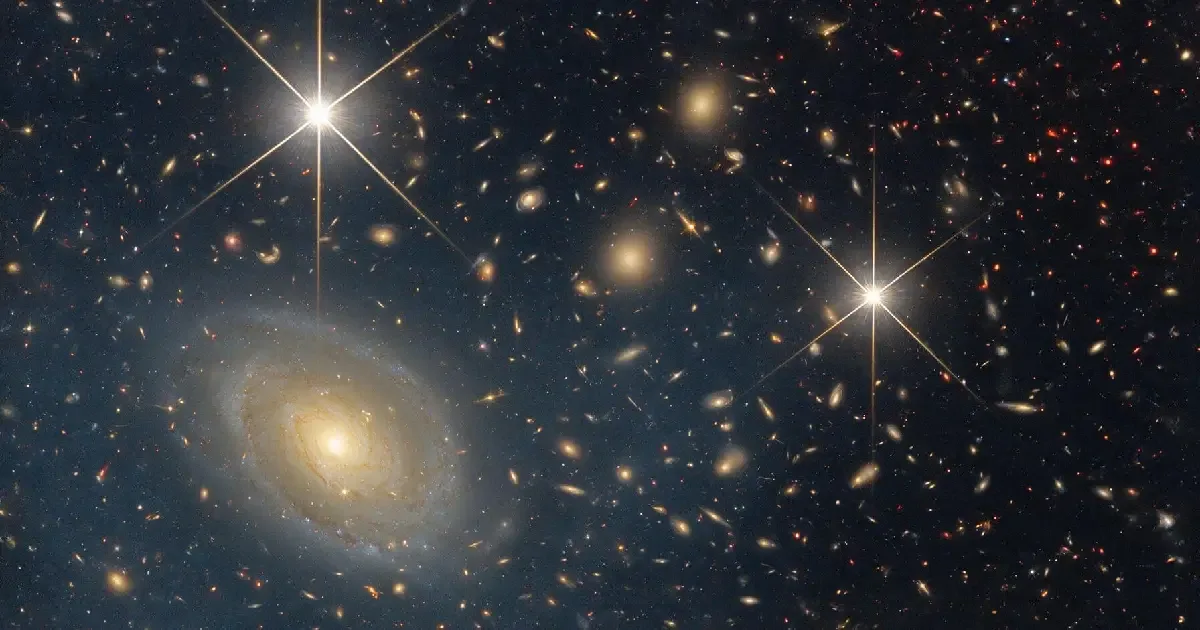
The Hubble eXtreme Deep Field is close to a photograph of this argument. Hubble stared at a patch covering just a 30-millionth of the whole sky for two million seconds and found about 5,500 galaxies, some seen as they were when the universe was less than 5 percent of its current age. Even that deep, the frame is mostly dark between the smudges. The darkness in a deep field is not where space runs out. It is where time does.
The Bright Sky Olbers Expected Never Went Away
Here the paradox turns inside out. Olbers' premise, that every sightline ends on a glowing surface, is correct. The surface just is not made of stars.
About 380,000 years after the Big Bang, the universe cooled enough for atoms to form, and space became transparent. At that moment it was near 3,000 K, about half the temperature of the Sun's visible surface. Trace any line of sight far enough back and it ends in that wall of light: a hot, luminous surface covering the sky edge to edge, just as the infinite-universe argument demanded.
What changed is the light. The universe has grown more than a thousand times larger since then, a redshift of about 1,100, stretching that radiation to wavelengths around a millimetre and a temperature of just 2.7 K. Arno Penzias and Robert Wilson detected it by accident in 1964 with a large radio antenna in New Jersey, work that earned them the 1978 Nobel Prize in Physics, according to ESA.
The connection explainers rarely make: this invisible background is no faint afterthought. The cosmic microwave background delivers about 960 nW m⁻² sr⁻¹, roughly 30 times the integrated infrared background from galaxies and about 40 times the optical background of their starlight, which sits near 24 nW m⁻² sr⁻¹. In energy terms, the Big Bang's leftover glow outshines the combined infrared and optical background from all the galaxies more than tenfold. The sky Olbers expected is here, at wavelengths no eye can see.
Flying Past the Dust to Weigh the Darkness
What remains open is whether every photon in the faint extragalactic glow comes from galaxies already on the books.
Measuring that from near Earth is close to hopeless, and dust returns in a role Olbers might appreciate. "The inner solar system is filled with tiny dust particles from disintegrated asteroids and comets," NASA explains; sunlight reflecting off them creates the zodiacal light, and even Hubble "still suffers from light pollution" (NASA, 2021). Olbers invoked dust to explain the darkness. Two centuries later, astronomers had to leave the dust behind to measure it, using the New Horizons probe from more than 4 billion miles out, where the sky is 10 times darker than the darkest sky available to Hubble.
The results have swung. The 2021 analysis found roughly twice the light that the galaxies Hubble can see would supply. A 2022 follow-up from 51.3 astronomical units measured 16.37 ± 1.47 nW m⁻² sr⁻¹, with an unexplained component of 8.06 ± 1.92 in "strong tension" with galaxies alone (Lauer et al. 2022). Then a 2024 study of 16 fields at high galactic latitude measured 11.16 ± 1.65, of which galaxies account for 8.17 ± 1.18, leaving a residual of 2.99 ± 2.03 that the authors call "not significantly different from zero" (Postman et al. 2024).
Cosmos in 60's take: the swing from "mystery light" to "nothing extra" is the most trustworthy part of this story, not an embarrassment. The anomaly was chased, corrected, and shrank. That is what a real measurement looks like, and it is why "for now" belongs in every honest version of the answer.
What's worth watching next is SPHEREx. NASA's all-sky mapper launched on March 11, 2025 to "measure the total collective glow of all the galaxies in the universe," completed its first all-sky map in 102 infrared colours in December 2025, and is scheduled for three more all-sky scans during its two-year primary mission. The prediction here: a total-glow survey is better placed than any galaxy count to catch hidden light sources, because it sums light from galaxies "too small, too diffuse, or too distant" for other telescopes to easily detect. If its totals match galaxy counts, the textbook answer holds all the way down.
Dark Sky Questions, Answered Briefly
Is the night sky dark because the universe is expanding?
Only in part. Expansion dims and reddens distant light, but the finite age of the galaxies dominates; expansion trims the background to about 0.6 of its static-universe value, according to Overduin and Wesson.
If the universe is infinite, why is the night sky dark?
Because age, not size, sets the limit. Even if space goes on forever, light has had only about 13.8 billion years to travel, so only a finite region is visible.
Can you see the cosmic microwave background?
Not with your eyes. Its light has been stretched to wavelengths around a millimetre, far outside the visible range. Microwave telescopes such as ESA's Planck map it across the whole sky at a temperature of 2.7 K (ESA).
Sources
- Why is the night sky dark? — NASA Goddard Space Flight Center (StarChild), undated
- Planck and the cosmic microwave background — European Space Agency, undated
- Cosmic History — NASA Science, undated
- Temperatures Across Our Solar System — NASA Science, undated
- Hubble Goes to the eXtreme to Assemble Farthest Ever View of the Universe (heic1214) — ESA/Hubble, 2012
- The Hubble eXtreme Deep Field (heic1214a) — ESA/Hubble, 2012
- New Horizons Spacecraft Answers Question: How Dark Is Space? — NASA, 2021
- Anomalous Flux in the Cosmic Optical Background Detected With New Horizons Observations — Lauer et al., arXiv / The Astrophysical Journal Letters, 2022
- New Synoptic Observations of the Cosmic Optical Background with New Horizons — Postman et al., arXiv / The Astrophysical Journal, 2024
- Dark Matter and Background Light, Section 2 — Overduin & Wesson, Physics Reports 402, via NASA/IPAC Extragalactic Database, 2004
- The Extragalactic Background Light and a Definitive Resolution of Olbers's Paradox — Wesson, Valle & Stabell, The Astrophysical Journal 317, 1987
- Olbers' Paradox and the Background Radiation Density in an Isotropic Homogeneous Universe — E. R. Harrison, Monthly Notices of the Royal Astronomical Society, 1965
- Kelvin on an Old, Celebrated Hypothesis — E. R. Harrison, Nature 322, 1986
- Johann Mädler's Resolution of Olbers' Paradox — F. J. Tipler, Quarterly Journal of the Royal Astronomical Society 29, 1988
- Eureka: A Prose Poem, Section 7 — Edgar Allan Poe, 1848 text via the Edgar Allan Poe Society of Baltimore
- The Cosmic Microwave Background Radiation — Gawiser & Silk, via NASA/IPAC Extragalactic Database, 2005 posting
- Extragalactic Background Light: Measurements and Applications — A. Cooray, Royal Society Open Science, via NASA/IPAC Extragalactic Database, 2016
- NASA Launches Missions to Study Sun, Universe's Beginning — NASA JPL, 2025
- NASA's SPHEREx Observatory Completes First Cosmic Map Like No Other — NASA JPL, 2025
- 6 Things to Know About SPHEREx, NASA's Newest Space Telescope — NASA JPL, 2025
- Olbers' Paradox (ASTRO 801: Planets, Stars, Galaxies, and the Universe) — Penn State University, undated
- Why Is the Night Sky Dark? You Can Thank the Big Bang — Phil Plait, Scientific American, 2024
Related Posts
Kepler's Supernova of 1604 and the Blasts Dust Hid Since
Kepler's supernova of 1604 was the last one anyone saw in the Milky Way, but not the last to explode. Here is how dust hid others, and how the next one will be caught.

A Star in Andromeda Vanished Without Exploding
A supergiant in Andromeda dimmed 10,000-fold and disappeared with no supernova. The numbers behind this 'failed supernova' point to a black hole born in silence.
