CosmosIn60CosmosIn60

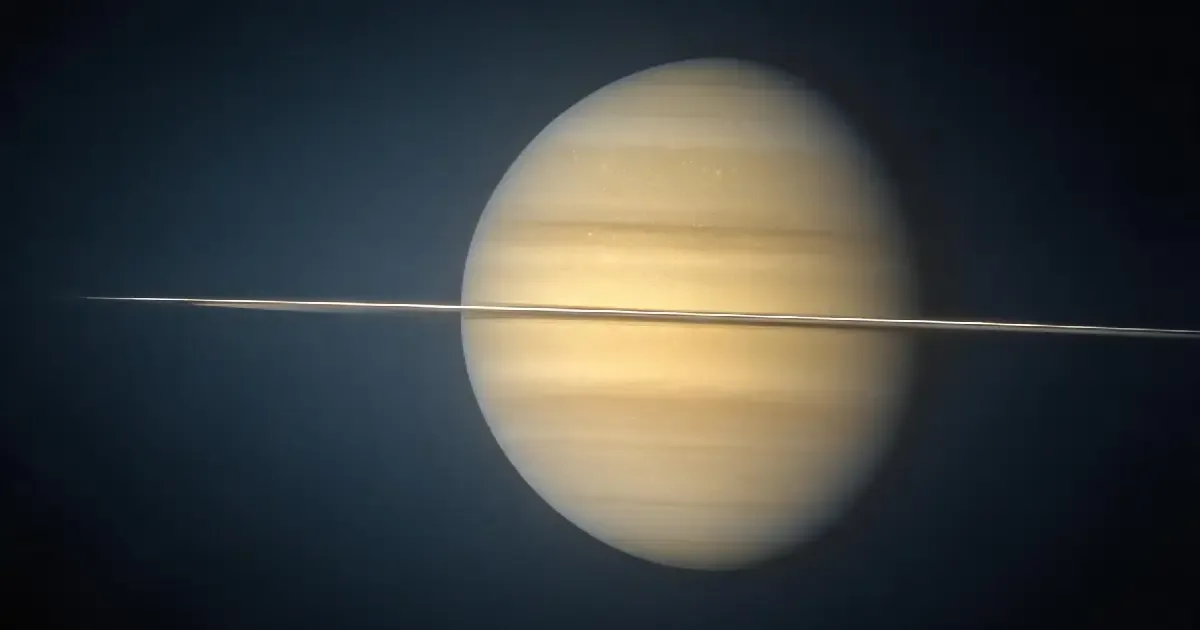
NASA's Dragonfly rotorcraft launches in 2028 toward Saturn's moon Titan — a world with methane lakes, a buried ocean, and chemistry that mirrors early Earth.
Right now, inside a clean room at Johns Hopkins University's Applied Physics Laboratory in Maryland, technicians are bolting together a nuclear-powered helicopter the size of a small car. Its destination: Titan, the largest moon of Saturn and the only moon in the solar system with a thick atmosphere, surface lakes, and an underground ocean. When NASA's Dragonfly rotorcraft finally touches down in 2034, it will become the first aircraft to fly on another world's moon — and the first machine ever designed to hop across an alien landscape searching for the chemical building blocks of life.
This is not a far-future dream. Construction formally began on 10 March 2026. The mission has a confirmed budget of $3.35 billion and a hard launch date of July 2028. What Dragonfly finds — or doesn't find — could rewrite the textbooks on where life can exist.
Titan defies easy categorization. At first glance it sounds hostile: the surface temperature is -290°F (-179°C) and the sky is a permanent orange haze. Yet look deeper and it begins to feel hauntingly familiar.
The atmosphere is composed of roughly 95% nitrogen and 5% methane — nitrogen-dominated just like Earth's, but with methane playing the role water plays here. Titan has weather. Methane clouds form, methane rain falls, and methane rivers carve valleys into the surface, eventually draining into seas of liquid methane and ethane near the poles. The largest, Kraken Mare, is bigger than the Caspian Sea. Lakes in the northern hemisphere have been measured at more than 300 feet (100 meters) deep.
Beneath that exotic surface, the Cassini spacecraft's gravity measurements revealed something even more striking: a subsurface ocean of liquid water, estimated to sit 35 to 50 miles (55 to 80 km) below the icy crust, likely laced with salts and ammonia. That means Titan potentially offers two distinct environments where life could arise: one using liquid water as a solvent (like every living thing on Earth), and another using liquid hydrocarbons — a form of biochemistry scientists have never observed but cannot rule out.
This dual habitability makes Titan unlike any other target in the solar system. Mars might have had liquid water once; Europa has an ocean now. But only Titan gives researchers the chance to study both simultaneously, alongside an atmosphere rich with the exact organic molecules that may have seeded life on early Earth.
The orange haze hanging over Titan is not simple smog. It is a photochemical soup of complex nitrogen-carbon-hydrogen compounds that planetary scientists call tholins — a term coined by astronomer Carl Sagan. Ultraviolet sunlight and cosmic rays rain down on the upper atmosphere and break apart methane and nitrogen molecules, which then recombine into increasingly complex organic chains. Over time these particles drift downward and settle onto the surface.
NASA's JPL and the ALMA Observatory have confirmed complex chemistry in Titan's atmosphere, including molecules like vinyl cyanide, acrylonitrile, and a range of compounds with molecular weights in the hundreds of atomic mass units — far more complex than anything previously detected in an outer-planet atmosphere. In a liquid methane environment, vinyl cyanide may spontaneously form cell-like membranes, according to laboratory simulations.
These are the chemical steps that precede biology. On Earth, the equivalent chemistry is locked in the Archean rock record more than 3.5 billion years ago. On Titan, the chemistry is happening right now, above our heads (relatively speaking), and Dragonfly will be able to scoop it off the surface and run it through a mass spectrometer. The analogy is striking: Titan is essentially running a planetary-scale prebiotic chemistry experiment in real time, one that Earth ran and then erased from its geological record.
Dragonfly is not a rover. It will not inch across the landscape on wheels. Instead it is an 875-kilogram (1,930-lb) rotorcraft with eight rotors — essentially a very large octocopter drone — powered by a Multi-Mission Radioisotope Thermoelectric Generator (MMRTG). The MMRTG converts heat from decaying plutonium-238 into electricity, producing approximately 110 watts at the start of the mission. That power charges a battery pack during the long Titan night (each Titan day, called a Tsol, lasts roughly 16 Earth days), and the stored charge is then used for flight.
Titan's thick atmosphere — about 1.48 times the pressure of Earth's sea level — and its lower gravity (roughly one-seventh of Earth's) make flying there far easier than flying on Mars. Where NASA's Ingenuity helicopter on Mars required extraordinary engineering to generate lift in a near-vacuum, Dragonfly can haul nearly a ton of science hardware into the air with eight rotors generating more than enough thrust.
Each flight will cover up to 10 miles (16 km) per battery charge, staying aloft for approximately 30 minutes at a time. Over its nominal 3.3-year surface mission, Dragonfly will land at dozens of locations, leapfrogging across hundreds of miles of terrain — a feat no rover could ever accomplish. It will launch on a SpaceX Falcon Heavy rocket, arriving at Titan after a six-and-a-half-year cruise in late 2034.
Flying is only half the mission. Each time Dragonfly lands, it will deploy a suite of four instruments to analyze exactly what it has landed on.
The Dragonfly Mass Spectrometer (DraMS) is the centrepiece. It uses laser desorption and gas chromatography to vaporize tiny samples of Titan's surface material and identify their molecular composition with extraordinary precision. DraMS is specifically designed to detect amino acids, nucleotides, and other molecules associated with life — or the chemistry that precedes it. A positive signal would not confirm life, but it would demonstrate that prebiotic chemistry on Titan has advanced far further than anyone expected.
The Dragonfly Gamma-Ray and Neutron Spectrometer (DraGNS) will probe the bulk composition of the surface below each landing site, detecting elements like carbon, nitrogen, hydrogen, and oxygen down to roughly a meter's depth. This gives mission scientists a chemical fingerprint of each location even before DraMS drills in.
The Dragonfly Geophysics and Meteorology Package (DraGMet) monitors wind, temperature, and pressure while also listening for marsquake-equivalent seismic signals from Titan's interior — data that could help refine estimates of how deep and how warm the subsurface ocean sits.
Finally, the DragonCam camera suite provides panoramic and microscopic imaging to characterize each site before and after sampling, and to scout ahead for the next landing target. Together, these four instruments can do in a single landing what a field geologist does in a day — which is exactly why the helicopter platform is so transformative compared to a fixed lander.
Dragonfly will begin its surface mission in the equatorial dune fields, a region scientists call Shangri-La — vast expanses of dark organic sand dunes shaped by Titan's slow winds. From there it will execute a series of longer leapfrog flights toward its primary science destination: Selk Impact Crater.
Selk is roughly 80 km (50 miles) across. When an asteroid or comet punched through Titan's icy crust billions of years ago, the heat of impact melted the water ice, creating a temporary liquid water environment that could have persisted for hundreds to thousands of years. During that window, the organic-rich surface material — tholins, complex carbon compounds, anything that had rained down from the atmosphere — would have been dissolved in liquid water, exactly the kind of reaction chemistry that may have produced the first amino acids on early Earth.
Selk is therefore a time capsule. When the melt refroze, it locked in a snapshot of the chemical reactions that were occurring at that moment. Dragonfly's instruments will be able to read that snapshot directly. If amino acids or other prebiotic compounds are present at Selk, it will represent the most significant astrobiological discovery since the Murchison meteorite.
The conventional search for life in the outer solar system focuses on subsurface oceans — Europa's, Enceladus's, possibly Titan's own. The logic is straightforward: liquid water plus chemical energy equals potential habitability. But all of those oceans are locked under kilometers of ice, completely inaccessible to current technology.
Titan breaks that paradigm. Its surface chemistry is accessible. Its atmosphere is observable. Its craters are readable. Dragonfly can sample the residue of impact-melt events that connected the surface organics to liquid water — without drilling through 20 kilometers of ice to do it.
There is also the broader philosophical implication. If Titan's tholins have progressed to amino acids or nucleotide-like compounds, it would confirm that the chemistry of life is not a miraculous accident unique to Earth. It would mean that wherever you find the right raw ingredients and a source of energy, the chemistry moves inevitably in the direction of biology. That finding alone — regardless of whether any living organism is ever detected — would transform how humanity understands its place in the cosmos.
On a more practical level, understanding how Titan's chemistry works will inform the design of future missions. If DraMS detects compelling biosignatures at Selk, it will make the case for a dedicated follow-up mission with even more capable analytical tools — and potentially the first mission explicitly designed not just to detect chemistry, but to detect life.
Dragonfly is not primarily a life-detection mission — it is a prebiotic chemistry and habitability investigation. Its instruments are designed to detect amino acids, organic compounds, and other molecules that serve as precursors to life, not to identify living organisms directly. A detection of complex organics or biosignature-relevant chemistry would be a landmark result, but definitive confirmation of life would require follow-up missions.
Dragonfly uses a Multi-Mission Radioisotope Thermoelectric Generator (MMRTG), the same type of nuclear power system used by NASA's Curiosity and Perseverance rovers on Mars. It converts heat from the natural radioactive decay of plutonium-238 into approximately 110 watts of electricity. Solar panels would be essentially useless at Saturn's distance from the Sun, where sunlight is about 100 times weaker than at Earth.
Europa and Enceladus are primarily interesting for their subsurface liquid water oceans, which are hidden beneath thick ice shells. Titan offers something unique: an accessible surface and atmosphere rich in complex organic chemistry that can be directly sampled. Titan may have a subsurface ocean too, but its surface prebiotic chemistry is what makes it an unparalleled laboratory for studying the steps that precede life.
Dragonfly is scheduled to launch in July 2028 and arrive at Titan in late 2034 after a six-and-a-half-year cruise. Once on the surface, it will conduct a nominal 3.3-year science mission. First scientific results would not be expected until late 2034 at the earliest, with the mission's most significant findings likely coming in the 2035–2037 timeframe as data from multiple landing sites accumulates.
Images from the European Space Agency's Huygens probe, which landed on Titan in 2005, showed a flat plain littered with rounded pebbles of water ice carved smooth by flowing methane. The sky glows a dim orange from the dense photochemical haze. At the equatorial dune fields where Dragonfly will land first, vast ridges of dark organic sand stretch across the landscape like Saharan erg formations — but made of carbon compounds rather than silicate grains.
Dragonfly is not just another planetary mission — it is the first spacecraft in history designed to systematically traverse an alien world by air, sampling chemistry that may parallel the processes that gave rise to life on Earth more than 3.5 billion years ago. Whether or not it finds definitive biosignatures, the data it collects at Selk Crater and the Shangri-La dunes will represent the most detailed astrobiological survey of any world beyond Earth ever conducted. The real question is not whether Titan is interesting — it clearly is. The question is how far the chemistry has gone. That answer is now about eight years away.
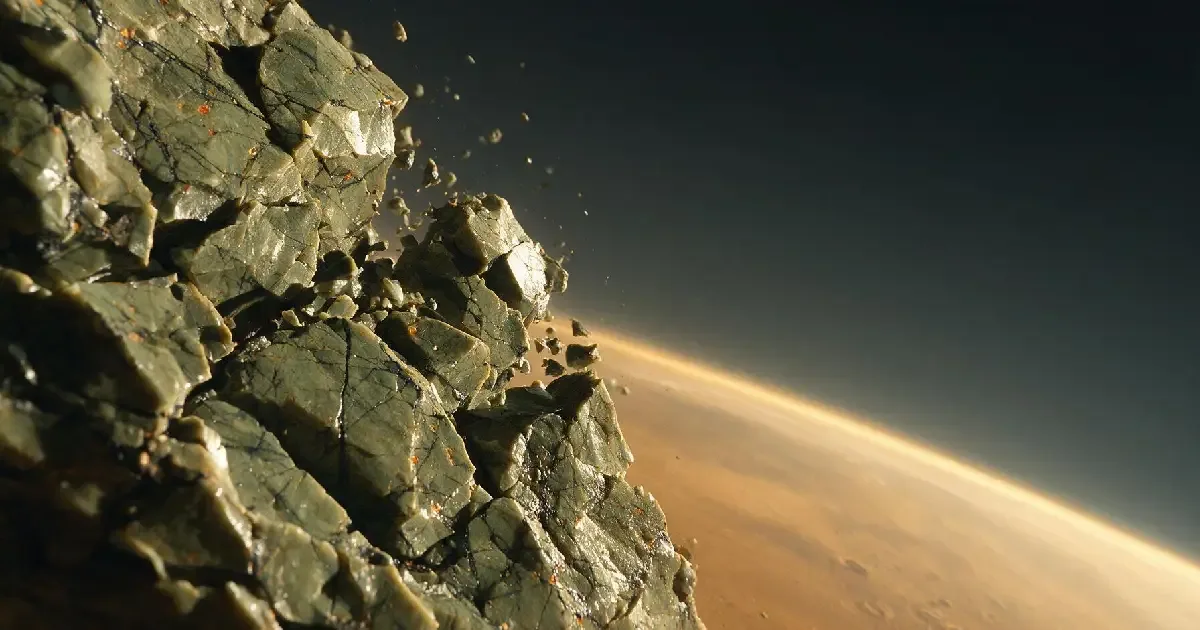
NASA said Mars meteorite ALH84001 held fossils in 1996. Set beside Perseverance's 2025 Cheyava Falls find, it shows what any Mars life claim must now survive.
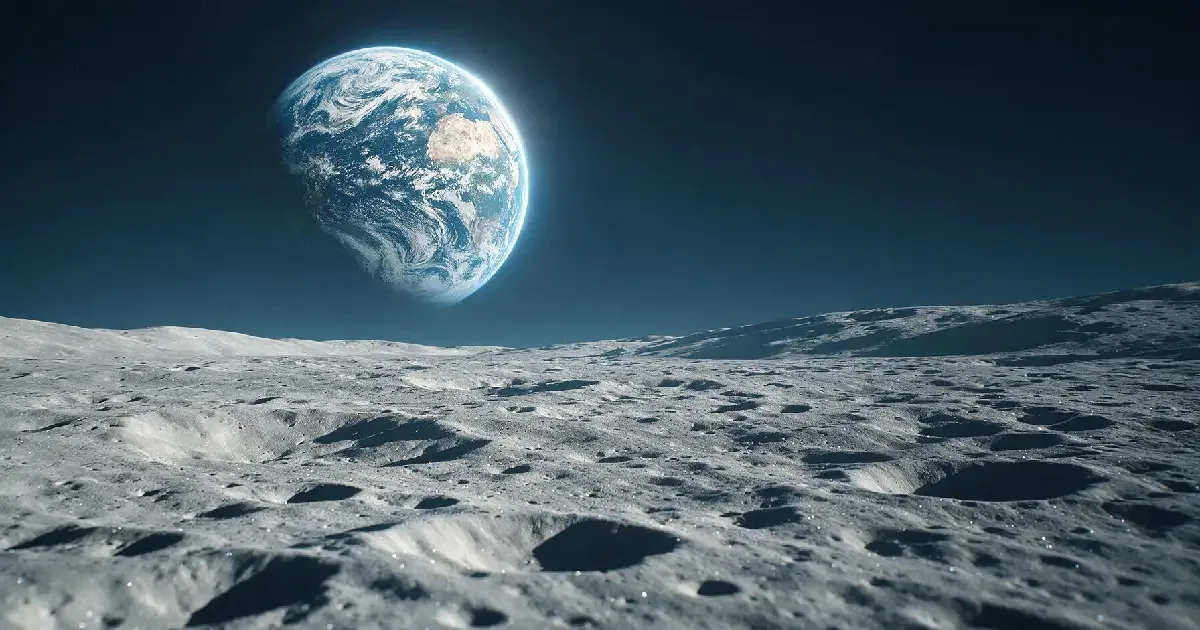
The ashen glow on a thin crescent Moon is sunlight bounced off Earth. Decades of measuring that earthshine revealed something unsettling: the planet is reflecting less light.