Earth May Be Rusting the Moon
Oxygen escaping Earth's atmosphere reaches the Moon around each full Moon and may be turning lunar iron into hematite. New lab and Chang'e-6 results show that is only half the story.
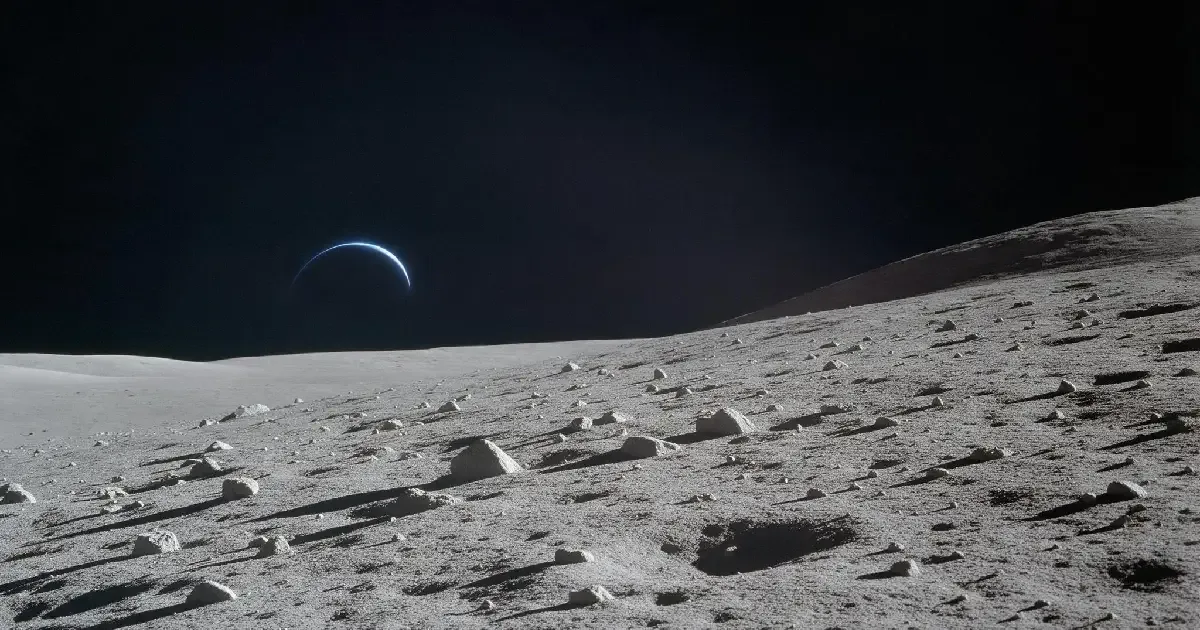
A lunar polar highland ridge seen at ground level, its sunlit equator-facing slope filling the lower half of the frame and rising toward the right edge, an Apollo Hasselblad plate, Earth hanging low above the far horizon in the left third as a thin backlit crescent with its atmosphere glowing as a thin blue arc around the limb, sunlight grazing in at a very low angle from the left so every boulder throws a long hard-edged shadow across the slope, fine grey regolith catching the light along crater rims while the crater floors stay in shadow, the airless sky above deepening to near-black, pale grey and bone-white palette with the blue atmospheric arc as the single saturated accent, deep value range, scientifically accurate colours, ultra detailed, 1.91:1 landscape aspect ratio"
The Hunter's Moon rose full on October 26, 2026. Around that date the Moon slid through the long magnetic wake that Earth trails on its night side and, if a run of recent studies is right, it was sprinkled with oxygen that had escaped from our own upper atmosphere. A little of that oxygen may now be locked into hematite, the iron oxide behind the red of rust and of Martian dust.
"Earth is rusting the Moon" has been a headline since 2020. What changed between September and December 2025 is that the idea was tested from three directions in quick succession: a laboratory ion beam, soil returned from the lunar far side, and a simulation of Earth's magnetic field. Taken together, they suggest the headline is about half right. Earth's oxygen almost certainly reaches the Moon and can make rust there, yet the Moon also makes some of its own, and the one test that would separate the two, an oxygen isotope measurement on a high-latitude grain, has not been done because no mission has brought such a grain home.
A Mineral With No Business on the Moon
Hematite forms when oxygen strips electrons from iron. The Moon offers almost nothing to do that job. It has no breathable atmosphere and no liquid water, and the solar wind keeps delivering hydrogen, which pushes iron chemistry the opposite way, toward the reduced, metallic state. "The Moon is a terrible environment for hematite to form in," Shuai Li of the University of Hawaiʻi said when NASA's Jet Propulsion Laboratory announced his team's result in September 2020. JPL's Abigail Fraeman, who helped check the data, was blunter: "It shouldn't exist based on the conditions present on the Moon."
Li had been studying water in data from the Moon Mineralogy Mapper, or M3, a JPL-built spectrometer carried by the Indian Space Research Organisation's Chandrayaan-1 orbiter. The Science Advances paper that followed reported a pair of absorption features near 0.85 and 0.66 micrometers consistent with hematite. Almost every detection sat above 60 degrees latitude, north or south. Hematite also favored the east- and equator-facing sides of hills, and the Earth-facing near side showed more hematite-rich pixels than the far side.
That near-side bias is what pointed at Earth. Rust made by purely lunar processes has no obvious reason to prefer the hemisphere that faces home. It pays to be precise about what the detection was, though: a spectral fit from orbit, with a third hematite band near 0.53 micrometers that the authors could not verify because of calibration limits in the M3 data. The paper calls its detections putative. Six years of follow-up have been an effort to turn that word into something firmer.
The Oxygen Conveyor Behind the Full Moon
The solar wind stretches Earth's magnetic field into a long tail on the planet's night side. Near full Moon, the Moon is on that night side and passes through the tail. Inside it, the solar wind flux can fall to less than 1 percent of its value outside, which shuts off most of the hydrogen that would undo oxidation. Meanwhile the tail carries ions that have leaked out of Earth's upper atmosphere, oxygen among them, across a gap of roughly 239,000 miles (385,000 kilometers).
Japan's Kaguya orbiter measured that traffic directly. In a 2017 Nature Astronomy paper, Kentaro Terada's team reported oxygen ions at energies of 1 to 10 kiloelectronvolts that appeared only while the Moon sat in Earth's plasma sheet, at a flux of about 26,000 ions per square centimeter every second during the roughly five days of each lunar cycle that the Moon spends shielded by Earth's magnetosphere.
The paper's title opens with the word "biogenic," and that word carries the most surprising implication in this whole story. Earth's atmosphere holds free oxygen because photosynthesis put it there. If the hematite hypothesis holds, cyanobacteria, forests, and ocean plankton are leaving a chemical mark on another world, with no spacecraft involved.
A December 2025 study added a twist to the delivery route. Shubhonkar Paramanick and colleagues at the University of Rochester simulated an early Earth with no magnetic field and a modern Earth with a strong one, and found that transfer to the Moon worked best in the modern case. The title of their paper in Communications Earth & Environment places the implantation in the "nearside lunar regolith," which lines up with the M3 near-side bias. A magnetic field usually described as a shield also works as a conveyor, as long as the Moon is sitting in its tail.
What an Ion Beam Showed in 2025
In September 2025, a team led by Xiandi Zeng of the Macau University of Science and Technology put the idea through a laboratory test in Geophysical Research Letters. They fired oxygen and hydrogen ions at Earth-wind energies, plus low-energy hydrogen standing in for the solar wind, at iron-bearing minerals found in lunar soil. The oxygen ions turned metallic iron, the iron sulfide troilite, and the titanium-iron mineral ilmenite into hematite, and they did it anhydrously, with no water in the system. According to ScienceAlert's report on the paper, the common silicates olivine and pyroxene produced none, and magnetite appeared as a stepping stone between iron and hematite.
The hydrogen results revised the 2020 picture. Low-energy hydrogen of the solar-wind kind was largely ineffective against hematite. Faster hydrogen, of the kind carried in Earth's own wind, reduced it back to metallic iron. The authors concluded that whether lunar hematite survives depends on the energy of the incoming Earth wind and its ratio of oxygen to hydrogen. Earth, in other words, appears to both make the rust and partly unmake it. The team also suggested that oxygen freed during that reduction could combine with hydrogen into water, an intriguing echo of Li's 2020 observation that hematite and water travel together at high latitudes.
Mars makes a useful contrast. Its famous rust came from iron, water, and oxygen in its ancient past. The lunar version, if this mechanism is right, is a dry rust assembled one ion at a time. Back in 2020, Fraeman had already suggested that a similar model might explain hematite on other airless bodies, such as asteroids.
The Far-Side Rust Earth Did Not Make
Two months after the ion-beam paper, a team from Shandong University, the Chinese Academy of Sciences' Institute of Geochemistry, and Yunnan University reported micron-sized crystals of hematite and maghemite in soil returned by Chang'e-6, which brought 1,935.3 grams back from the far side's South Pole-Aitken Basin in 2024. Their Science Advances paper ties the oxides to large impacts, with magnetite and maghemite as intermediate products, and proposes those magnetic minerals as carriers of the magnetic anomalies that orbiters have mapped along the basin's northern rim.
The team describes this as the first ground-truth evidence of strongly oxidized iron in the lunar surface. Note where it came from: the hemisphere that faces away from Earth, through a process its authors link to impacts rather than to Earth's wind. Li's group had already found that hematite was not absent from the far side and had pointed to water and interplanetary dust impacts as possible contributors.
Cosmos in 60's take: the Chang'e-6 result is less a rebuttal of the Earth-wind idea than a warning attached to it. The Moon has at least two routes to hematite, and probably more. Any future high-latitude grain will need its origin tested, not assumed, and a headline that credits Earth alone gets ahead of the evidence.
The Sample That Would Settle It
Li's team proposed the decisive test back in 2020. Oxygen from Earth's upper atmosphere is poor in oxygen-16, so hematite made from it should carry the same signature, and hematite at craters of different ages could preserve how Earth's atmosphere evolved over billions of years. Terada's team had already linked an oxygen-16-poor component of lunar soil to the composition of Earth's ozone layer. JPL noted that the Moon was closer to Earth in the past, so more oxygen may once have crossed the gap. Put together, the polar Moon could be holding air samples from eras whose evidence Earth's own restless crust has long since buried or recycled.
The spacecraft best placed to sharpen the orbital map is gone. NASA's Lunar Trailblazer, carrying HVM3, a new version of M3, launched on February 26, 2025, lost contact the following day, and was declared ended on July 31, 2025. The best global hematite map is still the one built from M3 data more than fifteen years ago.
That leaves surface sampling. NASA's nine candidate landing regions for Artemis cluster around the lunar south pole, deep inside the band above 60 degrees where M3 saw nearly all its hematite. None of the sample-return missions flown so far has landed in that band.
What's worth watching next: a published oxygen isotope measurement on hematite collected above 60 degrees latitude. Our prediction is that the first polar grains will tell a mixed story, some carrying an Earth-like signature and some not, because the evidence already points to more than one oxidation route. If the signal comes back strongly poor in oxygen-16, Earth will be confirmed as an exporter of its own air. Until then, "Earth is rusting the Moon" is a strong hypothesis with laboratory support. The next magnetotail crossings come with the full Moons of November 24 and late December.
Quick Answers About Rust on the Moon
Is the Moon turning red?
No. To the eye and to ordinary cameras the Moon stays gray. The orbital hematite signal shows up only as faint absorption features in reflected light measured by M3, and the Chang'e-6 crystals are micron-sized, far too small and sparse to tint the surface.
How does oxygen from Earth get to the Moon?
Ions escape from Earth's upper atmosphere, follow magnetic field lines into the magnetotail on the night side, and reach the lunar surface when the Moon passes through that tail around each full Moon. Kaguya saw the oxygen only while the Moon sat in the tail's plasma sheet.
Does rust need water?
The flaky rust on a bike or a car is a hydrated iron oxide, so it does. Hematite is an anhydrous iron oxide, and the 2025 Geophysical Research Letters experiments produced it from ion bombardment alone. Mars needed water for its rust; the Moon apparently does not.
Why is the Moon's rust mostly near the poles?
M3 found almost all of its hematite above 60 degrees latitude. Li's team noted the link with higher water content at those latitudes, and coverage of the 2025 lab study reports the authors' suggestion that the magnetotail funnels oxygen toward high latitudes while steering hydrogen elsewhere.
Sources
- The Moon Is Rusting, and Researchers Want to Know Why — NASA Jet Propulsion Laboratory, 2020
- Widespread hematite at high latitudes of the Moon — Li et al., Science Advances, 2020
- Biogenic oxygen from Earth transported to the Moon by a wind of magnetospheric ions — Terada et al., Nature Astronomy, 2017
- Moon found to be periodically showered with oxygen ions from Earth — Phys.org, 2017
- Earth Wind-Driven Formation of Hematite on the Lunar Surface — Zeng et al., Geophysical Research Letters, 2025
- The Moon Is Rusting, And It's All Earth's Fault — ScienceAlert, 2025
- Discovery of crystalline Fe2O3 in returned lunar soils — Science Advances, 2025
- Study on Chang'e-6 Samples Sheds New Light on Lunar Oxidation Mechanism — Chinese Academy of Sciences (Xinhua), 2025
- Terrestrial atmospheric ion implantation occurred in the nearside lunar regolith during the history of Earth's dynamo — Paramanick et al., Communications Earth & Environment, 2025
- Earth's atmosphere may help support human life on the moon — University of Rochester, 2025
- NASA's Lunar Trailblazer Moon Mission Ends — NASA Jet Propulsion Laboratory, 2025
- NASA Provides Update on Artemis III Moon Landing Regions — NASA, 2024
- Full moon calendar 2026: When to see the next full moon — Space.com, 2026
Related Posts
The Water Bears That Crashed on the Moon
Thousands of dehydrated tardigrades crashed into the Moon aboard Beresheet in 2019. The impact physics says they died — and a tun with no liquid water to revive in was never alive anyway.
Earthshine: The Moon's Glow That Shows Earth Is Dimming
The ashen glow on a thin crescent Moon is sunlight bounced off Earth. Decades of measuring that earthshine revealed something unsettling: the planet is reflecting less light.