
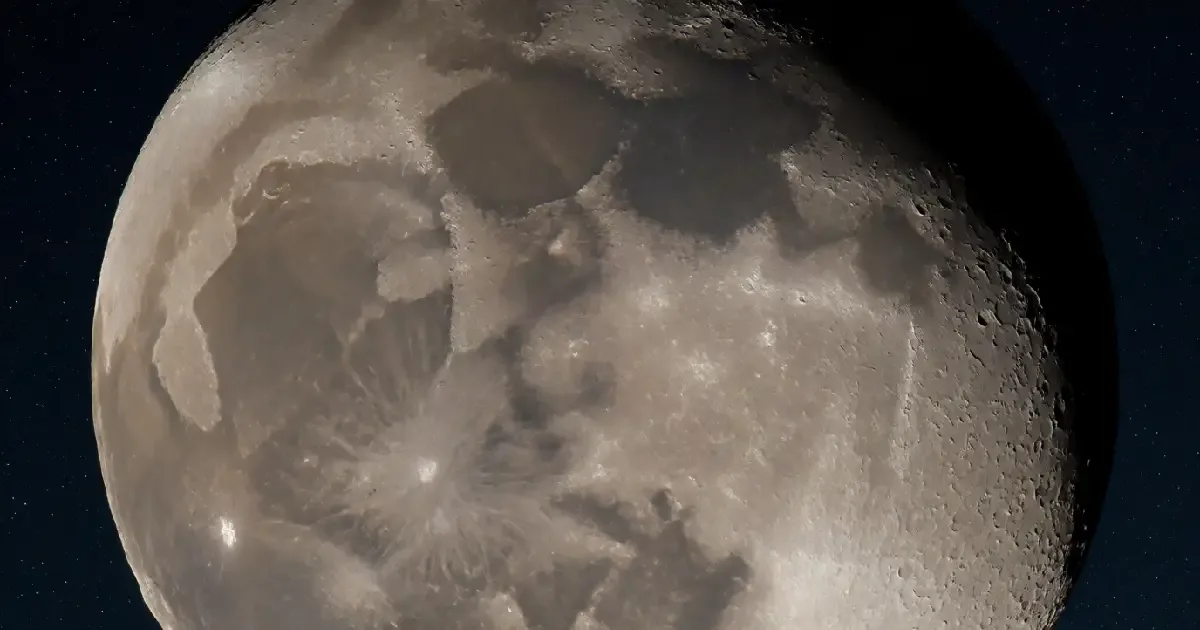
The 1835 Moon Hoax: When New York Believed in Bat-People
Six articles in the New York Sun claimed Sir John Herschel had found winged humanoids on the Moon. The physics of his real telescope disproves it in one line of arithmetic.
Two telescopes were aimed at the sky from the outskirts of Cape Town in 1835. Only one of them existed.
The real one stood in a garden at Feldhausen, a leased estate about five miles from the Royal Observatory at the Cape. It was a Newtonian reflector with a 20-foot focal length and a polished speculum-metal mirror 18¼ inches wide, shipped from England by Sir John Herschel, who had departed Southampton on 13 November 1833 to survey the half of the sky he could never reach from home.
The other telescope was a fantasy assembled in a New York newsroom, and beginning 25 August 1835 the New York Sun used it to show America a lunar civilisation. The Great Moon Hoax is usually retold as a story about how gullible 1835 was. It reads far better as a story about specificity: the invented expedition was described in more numerical detail than the real one, every one of those numbers was checkable, and the single number that would have collapsed the whole thing in an afternoon was the one nobody thought to look at.
The Two Telescopes: 18¼ Inches Against a Seven-Ton Lens
Herschel's actual instrument was, by the standards of its day, a monster — and still modest by ours. A speculum mirror 18¼ inches (46 cm) across gathers roughly as much light as a mid-range amateur telescope you can buy today, with worse optics and a mirror that tarnished and had to be repolished.
The Sun's version was engineered for headlines. It described a lens weighing 14,826 pounds (about 6,700 kg) with a magnifying power of 42,000 times — an instrument allegedly able to pick out objects on the lunar surface "of little more than eighteen inches in diameter." That last claim is the load-bearing lie. Everything that followed — the bison, the horned goats, the tailless bipedal beavers carrying fire, and finally Vespertilio-homo, the winged man-bat — depends on it being true.
Notice which number the Sun led with. Magnification is the figure that sounds impressive and means almost nothing; past a point it just enlarges a blur, which optical engineers call empty magnification. Aperture is the figure that decides what can be seen at all. A hoax that led with aperture would have had to invent a mirror the size of a house, and someone would have asked where it was cast.
The Arithmetic That Ends the Story
Every telescope has a hard ceiling set by the wave nature of light. Two points can only be told apart if their angular separation exceeds roughly 1.22 λ / D, the Rayleigh criterion, where λ is the wavelength and D the aperture diameter. No amount of eyepiece magnification beats it. No amount of observing skill beats it.
Run Herschel's mirror through it. At green-visible light (550 nm) with D = 0.464 m, the limit is about 1.45 millionths of a radian. The Moon sits an average of 384,400 kilometres (238,855 miles) away. Multiply the two and you get roughly 560 metres — about 1,830 feet — as the finest detail that mirror could theoretically separate on the lunar surface, and that is before the atmosphere above Cape Town smeared it further.
A person-sized creature is somewhere near 1.8 metres tall. That is more than 300 times smaller than the best-case limit. The Sun's claimed 18-inch resolution is off by a factor of roughly 1,200. Herschel's telescope could not have resolved the man-bats; it could not have resolved a cathedral; on a very good night it might have resolved a large crater rim as a smudge with structure.
The resolution the Sun invented in 1835 does exist now. NASA's Lunar Reconnaissance Orbiter, launched 18 June 2009, carries narrow-angle cameras that return 0.5-metre-scale images across a 5 km swath. But it achieves that from lunar orbit, not from a garden 384,400 km away — the problem was never solved by a better eyepiece. It was solved by moving the camera.
Two Catalogues, Two Publication Speeds
The real expedition was extraordinarily productive. Over four years at the Cape, Herschel catalogued more than 1,700 nebulae, over 2,000 double-star systems, and several comets — a systematic sweep that extended into the southern hemisphere the survey work he had already completed from England. He also tracked the 1835 apparition of Halley's Comet, and was the last observer to record it as it receded from the Sun after perihelion.
Here is the asymmetry that still governs misinformation. Herschel's results were published as Results of Astronomical Observations Made at the Cape of Good Hope — in 1847, twelve years after the hoax and nine years after he sailed home. The fabricated expedition was fully published in six days. Verification is slow because it is verification; invention is fast because it has no dependencies. In 1835 that gap was measured in months of transatlantic post. The gap has narrowed since, but it has never closed, and it never will.
A Dead Journal Versus a Living Reputation
The cleverest part of the hoax was not the zoology. It was the citation.
The articles were presented as reprints from a supplement to the Edinburgh Journal of Science, credited to a "Dr. Andrew Grant" described as Herschel's assistant. Grant did not exist, and the journal had ceased publishing under that title in 1833. A defunct journal is the perfect fake source: prestigious enough to disarm a reader, extinct enough that nobody can pull the issue.
That combination — a real, verifiable astronomer doing real, verifiable work, wrapped in a source nobody could check — defeated the people best equipped to catch it. A committee of Yale scientists travelled to New York looking for the original Edinburgh Journal articles; Sun staff shuttled them between the printing office and the editorial office until they gave up and went back to New Haven. They asked exactly the right question. They were simply outrun by a newsroom that knew the answer did not exist.
The satire had a target, too. Richard Adams Locke, the Sun reporter now generally credited with writing the series, was mocking the "plurality of worlds" enthusiasm of writers such as Thomas Dick, who had gone as far as calculating populations for other worlds. The joke failed in the most instructive way possible: readers did not detect the parody, because a parody of a scientific claim is indistinguishable from the claim when it is dressed in the same citation format.
How It Ended, and Why Herschel Stopped Laughing
The Sun's circulation reached 19,360, briefly the largest of any daily paper anywhere. On 16 September 1835 the paper admitted the articles were fabricated — and sales held. A pamphlet reprinting the series sold something on the order of 40,000 copies. There was no meaningful penalty, no retraction that undid anything, and no legal consequence.
Herschel, an ocean away and entirely uninvolved, absorbed it first with amusement and then with fatigue, eventually complaining that he had been "pestered from all quarters with that ridiculous hoax — in English, French, Italian, and German!" He had spent four years producing one of the most important catalogues in observational astronomy and would spend much of the rest of his life being asked about beavers.
Locke's own confession is murkier than most retellings admit. Some accounts say he acknowledged authorship in an 1840 letter to the weekly New World; the Linda Hall Library describes it as a private letter written five years after the fact. The sources genuinely disagree on whether the admission was public, and the Sun never formally retracted the series itself. Treat any confident version of that detail with suspicion.
Editor's view: the 191st anniversary lands later this month, and the contrast with 2026 is sharper than usual. Between 1 and 10 April 2026, NASA's Artemis II carried Reid Wiseman, Victor Glover, Christina Koch and Jeremy Hansen around the Moon on a 9-day, 1-hour, 32-minute flight, passing 4,070 miles above the lunar surface on 6 April and spending about seven hours making live, broadcast observations of the surface geology. In 1835 a lunar report arrived as unverifiable text and took three weeks to be walked back. In 2026 it arrived as a live downlink anyone could watch in real time. What has not changed is the incentive structure: the Sun was rewarded for the hoax, kept its readers after confessing, and paid nothing. That, rather than the credulity of 1835 readers, is the part worth worrying about.
Common Questions About the 1835 Moon Hoax
Who actually wrote the Great Moon Hoax?
Richard Adams Locke, a Cambridge-educated reporter at the New York Sun, is the person historians credit. The articles themselves carried the byline of the fictitious "Dr. Andrew Grant." Locke acknowledged authorship around 1840, though accounts differ on whether that admission was public or private.
Did Sir John Herschel know about it?
No. He was at Feldhausen near Cape Town, mid-survey, and had no involvement whatsoever. News reached him only after the story had already been translated and reprinted across Europe.
Could any Earth-based telescope see a person on the Moon?
No, and not for lack of trying. The diffraction limit scales with aperture: separating two objects 1.8 metres apart at 384,400 km would demand an aperture around 140 metres wide — and even then, atmospheric turbulence above the telescope would smear the image long before diffraction became the limiting factor. High-resolution lunar imaging is done from orbit instead, which is precisely what LRO's 0.5-metre cameras do.
Could bat-winged creatures live on the Moon anyway?
No. The Moon has only a vanishingly thin atmosphere, no protection from solar radiation, and surface temperatures swinging from about 127 °C in sunlight to about −173 °C in darkness. There is no air for a wing to push against, which rules out flight before biology even enters the argument.
Related Posts
The Water Bears That Crashed on the Moon
Thousands of dehydrated tardigrades crashed into the Moon aboard Beresheet in 2019. The impact physics says they died — and a tun with no liquid water to revive in was never alive anyway.
Earthshine: The Moon's Glow That Shows Earth Is Dimming
The ashen glow on a thin crescent Moon is sunlight bounced off Earth. Decades of measuring that earthshine revealed something unsettling: the planet is reflecting less light.
