The Water Bears That Crashed on the Moon
Thousands of dehydrated tardigrades crashed into the Moon aboard Beresheet in 2019. The impact physics says they died — and a tun with no liquid water to revive in was never alive anyway.
The Beresheet story is always told as a cliffhanger. Thousands of dehydrated tardigrades rode an Israeli lander into the Moon on 11 April 2019, and nobody knows whether they made it. That framing has survived seven years because it is irresistible, not because it is correct. The honest reading of the evidence is narrower and considerably stranger: the water bears almost certainly did not survive the impact, and even in the version of the story where some of them did, nothing at that site could ever have made them alive again. "Did they survive?" is the wrong question, because it smuggles in an assumption — that a tardigrade in its tun state is an animal taking a nap, waiting for someone to shake it awake. It is not.
What follows is that argument, pillar by pillar, along with the places where the public record turns out to be much thinner than the headlines built on top of it.
What Was Actually Bolted to the Lander
Beresheet was built by SpaceIL with the Israeli Space Agency and launched on a SpaceX Falcon 9 on 22 February 2019, aiming for the Sea of Serenity — Mare Serenitatis, an ancient volcanic plain on the lunar nearside. NASA was not a bystander: the agency installed a small laser retroreflector aboard the lander to test it as a navigation aid.
Riding along was the Arch Mission Foundation's Lunar Library: a stack of 25 nickel discs, each roughly 40 microns thick, etched at microscopic resolution and laminated with resin, carrying some 30 million pages of human writing. Encapsulated in that resin were human cell samples and thousands of dehydrated tardigrades. Those payload details come from the Arch Mission Foundation itself rather than from a space agency, which is worth holding in mind — the organization is the primary and largely only source on what it packed.
The biology weighed almost nothing. A few micrograms of freeze-dried animals, a rounding error against a lander of several hundred kilograms, and the entire reason anyone still talks about the mission.
The Impact Speed Nobody Can Agree On
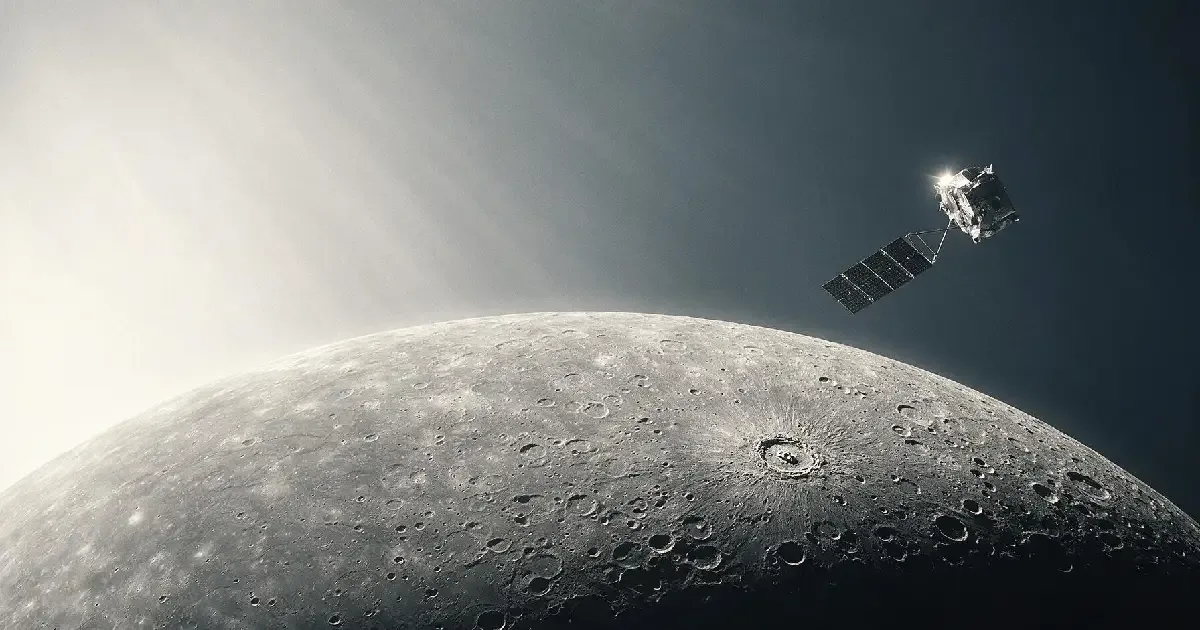
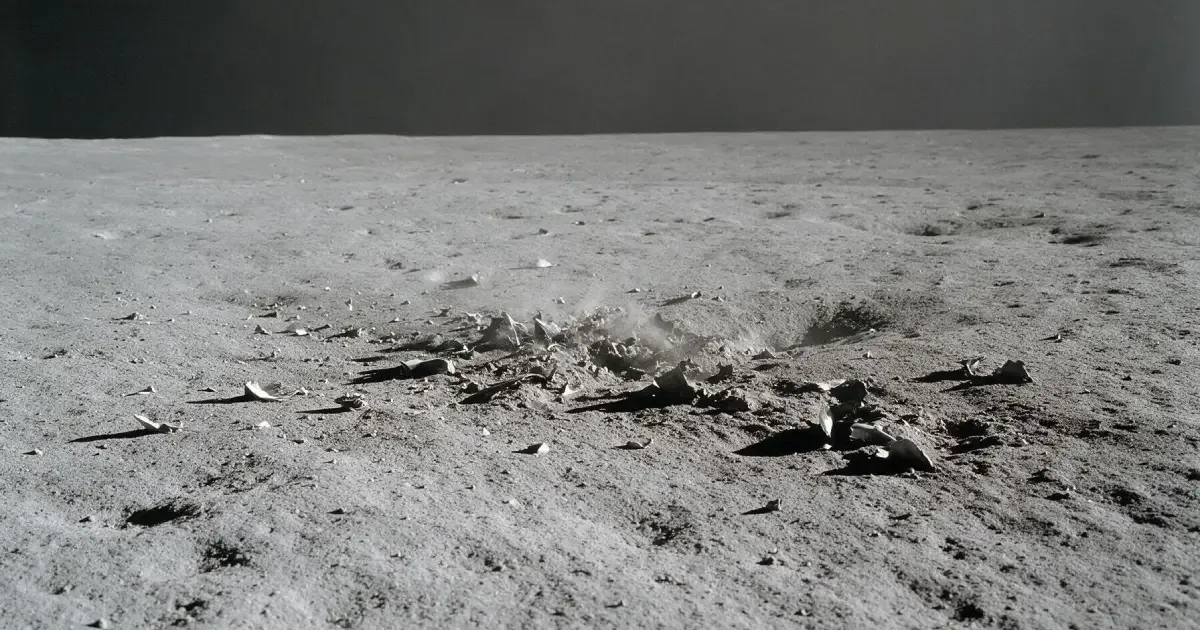
NASA's Lunar Reconnaissance Orbiter photographed the site on 22 April 2019, eleven days after the crash. What it found was modest: a dark smudge, about 10 metres wide, elongated to the south, the dark tone indicating "a surface roughened by the hard landing, which is less reflective than a clean, smooth surface." The image was taken from 90 kilometres up at an approach angle of about 8.4 degrees, and from that distance LROC "could not detect whether Beresheet formed a surface crater upon impact."
That is the extent of the direct observational record. No agency has published a verified impact velocity for Beresheet, and the numbers circulating in coverage do not agree with one another. Some accounts put the crash at roughly 140 metres per second. Others cite figures near 950 metres per second — nearly seven times higher. A widely syndicated science piece reports the lander still moving at about 500 km/h when it was 150 metres above the surface, which is roughly 139 m/s and looks very much like the source of the lower number, describing a moment during descent rather than the moment of contact.
Treat any survival argument that rests on a velocity comparison as built on sand. The figures are not measurements of the same thing, and the published scientific case does not use velocity at all.
What a Gas Gun in Canterbury Established
In 2021, Alejandra Traspas and Mark Burchell published the experiment everyone now cites: "Tardigrade Survival Limits in High-Speed Impacts", Astrobiology, volume 21, pages 845–852 (DOI 10.1089/ast.2020.2405).
The method matters more than the headline. Hypsibius dujardini were loaded into a water-filled shaft in a nylon sabot and frozen for 48 hours "so that the tardigrades were in a tun state during the shot," then fired from a two-stage light-gas gun at the University of Kent's Centre for Astrophysics and Planetary Science. Impact speeds were measured to better than ±1% using laser light stations. Tardigrades came through at 0.728 km/s. At 0.901 km/s — corresponding to a peak shock pressure of 1.14 GPa — none did.
Read that ceiling carefully, because it is routinely misquoted. The limiting variable is shock pressure, not speed. Speed is simply how the experiment reached the pressure, using one specific arrangement of nylon, water and target.
The paper itself never mentions Beresheet. Not once. The lunar connection exists entirely in press interviews given around publication, where Traspas argued that the shock pressure produced by the lander's metal frame striking the surface would have been well above 1.14 GPa, and concluded, in her words, "we can confirm they didn't survive." That is an informed estimate by the researcher best placed to make it. It is not a measurement — no instrument recorded pressure at the Beresheet site, and none ever will.
The same result quietly damages a much grander idea. The paper notes that terrestrial debris blasted off Earth arrives at the Moon at an average of about 2.5 km/s, far past the tardigrade ceiling, though 43% of such impacts land below 1 km/s. Panspermia by impact is not impossible for these animals, but the window is narrow and the odds are worse than the "indestructible water bear" reputation implies.
A Tun Is Not a Sleeping Animal
Here is the part the survival framing skips entirely.
Anhydrobiosis is not sleep. A tardigrade entering the tun state loses up to 98% of its body water, leaving 2–3% behind, with "almost complete cessation of metabolism" (Krakowiak et al., Zoological Journal of the Linnean Society, 2024). The body shrinks, the legs retract, and the chemistry stops. A tun does not breathe, does not consume, does not age in any ordinary sense, and — crucially — does not wait. It is a biochemical configuration that can restart if liquid water returns and the cellular protectants hold. The same review notes that forming a proper tun does not by itself guarantee successful rehydration later.
Mare Serenitatis offers nothing to restart with. The Moon's weak atmosphere and lack of liquid water cannot support life as we know it; surface temperatures swing from about 127 °C in full Sun to −173 °C in darkness, and night-side surface pressure is around 3 × 10⁻¹⁵ bar. Water cannot exist as a liquid there. The lunar water ice that does exist sits in permanently shadowed craters near the poles, thousands of kilometres from a mid-latitude mare.
So grant the Arch Mission Foundation its strongest claim — that the nickel discs came through intact and are lying on the surface today. What you have is preserved biological material, not life. Could a future astronaut revive them? In principle, you would need to carry a disc into a pressurized lab and add water; whether decades of unshielded radiation and 250-degree thermal cycling leave anything revivable is an open and entirely untested question. Nobody has tried, and the discs have not been recovered.
Category II, and the Rule That Was Not Broken
Beresheet broke no planetary-protection rule. The Moon sits in COSPAR Category II, reserved for bodies of genuine interest to origin-of-life research where there is only a remote chance that spacecraft contamination could compromise future investigations. No biological inventory was required, and none was withheld in violation of anything.
What the episode did do was push a conversation. In August 2021, COSPAR kept the Moon at Category II but split it in two: Category IIa missions to the general lunar surface still need only report volatiles released by their propulsion systems, while Category IIb missions reaching the permanently shadowed regions and the poles — latitudes south of 79°S and north of 86°N — must record their full organic inventory.
Notice where the tightening landed. The stricter rule now covers exactly the terrain that holds water ice, which is the only place on the Moon where revival chemistry is even conceivable. The policy got sharper precisely where the biology would matter and stayed loose where Beresheet actually hit. Whether that sequence was a response to the crash or simply good timing, the alignment is neat.
What the Crash Actually Changed
NASA currently has 17 lunar deliveries contracted to five vendors carrying more than 60 payloads through 2028 under the Commercial Lunar Payload Services program. Landers from several companies are queued for attempts across 2026 alone.
An editorial prediction, offered as one: the Beresheet question gets asked again before 2028, and probably more than once. Not because anyone intends to seed the Moon with anything, but because commercial manifests are assembled by many parties with uneven disclosure, and the success rate of lunar landing attempts is conspicuously not 100%. Somewhere in those 60-plus payloads is a sample, a culture, or a novelty capsule that will make a headline if its ride ends the way Beresheet's did.
The useful legacy of the water bears, then, is not the water bears. It is that a hobbyist archive on a failed lander turned "what biological material is on your manifest?" into a question worth asking before launch rather than after a crash. The tardigrades themselves almost certainly died in the impact, and in the most generous reading of the evidence they are cargo, not colonists. That distinction is worth defending, because the loose version — Earth life is living on the Moon — is the one that travels.
Related Posts
ALH84001: The Mars Rock NASA Said Held Fossils
NASA said Mars meteorite ALH84001 held fossils in 1996. Set beside Perseverance's 2025 Cheyava Falls find, it shows what any Mars life claim must now survive.
Saturn's Rings: Far Thinner Than Paper, at Scale
Saturn's main rings span about 273,600 km yet are typically only 10 meters thick. Run the math and the famous paper comparison undersells them by a factor of roughly 10,000.