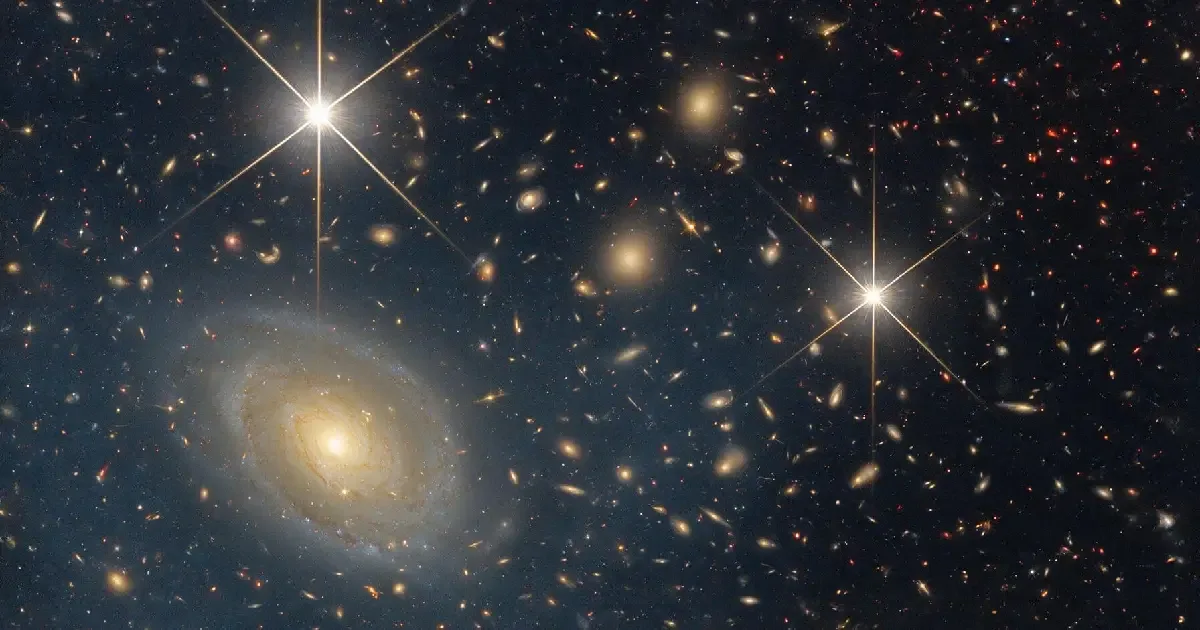
The Universe Is 93 Billion Light-Years Wide — But Only 13.8 Billion Years Old
The observable universe spans 93 billion light-years, yet is only 13.8 billion years old. Here's the physics that resolves this mind-bending contradiction.
The observable universe is 93 billion light-years across. Yet the universe is only 13.8 billion years old. If light travels at a fixed speed, how can anything be farther away than the distance light could have covered in the entire age of the universe? This apparent contradiction sits at the heart of modern cosmology — and resolving it requires rethinking what the word "distance" actually means when space itself is a dynamic, stretching fabric.
Background
For most of human history, the universe was assumed to be static — infinite, unchanging, and eternal. That assumption collapsed in the late 1920s when astronomer Edwin Hubble catalogued the recession velocities of distant galaxies and found something startling: the farther a galaxy was, the faster it was moving away. This relationship, now called Hubble's law, implies that the universe is not simply old and empty — it has been expanding continuously since a single, extraordinarily hot and dense beginning.
Run that expansion backward in time and everything converges to a point. The Big Bang happened approximately 13.787 billion years ago, a figure pinned down by NASA's Wilkinson Microwave Anisotropy Probe (WMAP) to within half a percent. But the "bang" was not an explosion of matter into empty space. It was the origin of space itself — every cubic centimeter of the universe popping into existence simultaneously and then stretching outward.
That distinction — space expanding rather than galaxies flying through space — is why the size of the universe can dwarf its age. The speed-of-light limit in special relativity applies to objects moving through space, not to the expansion of space itself. No object traveled faster than light. The fabric they all sit on simply grew.
The Difference Between Distance and Light-Travel Time
When astronomers say a galaxy is 13 billion light-years away, they often mean that light from that galaxy took 13 billion years to reach us. But that figure describes a light-travel distance, not a current distance. During those 13 billion years of transit, the universe never stopped expanding, which means the galaxy that emitted that ancient light has since been carried much further away.
Think of it this way: imagine throwing a ball to a friend 50 feet away, but both of you are on moving walkways drifting apart at a slow, steady pace. By the time the ball arrives, the gap between you is larger than the 50 feet the ball traveled. The ball's journey time does not equal the final separation distance.
This is exactly what happens with light crossing the expanding universe. The comoving distance — the "proper" current distance accounting for all expansion that has occurred since a photon was emitted — is what produces that 46-billion-light-year radius (93 billion light-years diameter) for the observable universe. Objects near the edge of our observable sphere emitted their light not long after the Big Bang, but cosmic expansion has since carried them roughly 46 billion light-years from Earth. The light-travel time was 13.8 billion years. The current location is three times further.
This also reveals why the observable universe has a definite edge at all: any galaxy whose light, emitted at the Big Bang, has not yet had time to reach us remains invisible to us — not because the universe ends there, but because our information horizon does.
Cosmic Inflation: The Growth Spurt That Changed Everything
The 93-billion-light-year scale of the observable universe would be surprising enough if expansion had been gradual and steady. But the very early universe underwent a phase of growth so extreme it makes ordinary Hubble expansion look like standing still. This period is called cosmic inflation.
Proposed by physicist Alan Guth in 1979 and published in 1981, inflation describes a brief window roughly 10⁻³² seconds after the Big Bang during which the universe expanded exponentially — doubling in size at least 90 times in a fraction of a second. At its peak, the universe was growing at a rate trillions of trillions of times faster than light. This does not violate relativity because, again, the fabric of space was stretching, not any object moving through it.
Inflation solves several otherwise baffling problems in cosmology. First, it explains the horizon problem: opposite sides of the sky have nearly identical temperatures in the cosmic microwave background — roughly 2.725 Kelvin — despite those regions never having been close enough to exchange heat in a universe expanding at normal rates. Inflation explains this by showing those regions were in contact before the inflationary burst blew them apart. Second, it flattens the geometry of space: WMAP found that space is flat to within 0.4%, precisely what inflation predicts. A small, dense universe stretched enormously in every direction will appear flat locally, just as the surface of an enormously large balloon appears flat to a tiny observer on it.
The CMB temperature fluctuations that WMAP and ESA's Planck satellite mapped in such detail are the frozen imprints of quantum fluctuations that existed before inflation stretched them to cosmic scales — which is to say, the large-scale structure of today's universe (galaxies, filaments, voids) was written into reality in the first trillionth of a trillionth of a second.
The Hubble Tension: A Crack in the Model
If the math of cosmic expansion were fully settled, this would be a clean, satisfying story. It is not. Cosmologists are currently grappling with a conflict known as the Hubble tension — a disagreement between two independent ways of measuring how fast the universe is expanding today.
The Hubble constant (H₀) sets the expansion rate: roughly how many kilometers per second faster a galaxy recedes for every additional megaparsec of distance. Measurements based on the cosmic microwave background yield a value near 67-68 km/s/Mpc, a figure anchored to conditions in the early universe. Direct measurements of the local universe — using Cepheid variable stars and Type Ia supernovae as standard candles — consistently come in near 73 km/s/Mpc, about 8-9% higher. NASA's James Webb Space Telescope, in its largest study of universe expansion published in December 2024, confirmed the local measurement is not a calibration error in the older Hubble Space Telescope data. The tension is real.
An 8% gap might sound minor, but in cosmology it is enormous — the two values disagree at a statistical confidence level that should almost never occur by chance if the same physics governs both eras. Proposed explanations include early dark energy, additional neutrino species, interactions between dark matter and dark energy, or modifications to general relativity. None has emerged as a consensus winner. The Hubble tension may be the first observational signal of physics beyond the Standard Model of cosmology, which would rewrite our understanding of how the universe grew to its current 93-billion-light-year span.
The Part We Cannot See
The 93-billion-light-year figure describes the observable universe — the sphere from which light has had time to reach us. The full universe almost certainly extends well beyond that horizon, possibly infinitely. Inflation predicts that the universe grew so enormously in its first fraction of a second that the observable bubble we inhabit is an almost negligible fraction of the whole.
Physicists define the "particle horizon" as the maximum distance from which a signal could have reached us since the Big Bang. Beyond that boundary exists a vast realm from which no information has arrived yet — not because space ends there, but because even light emitted at the moment of the Big Bang has not yet made the crossing. Some cosmological models suggest the total universe is at least 250 times larger than the observable portion. Some inflationary models predict an effectively infinite universe, with our observable bubble being an infinitesimally small patch.
What lies in that unreachable expanse is, by definition, unknowable from Earth — at least with our current understanding of physics. Other regions could have different densities, different ratios of matter to dark energy, or regions where the initial quantum fluctuations played out differently. The observable universe, vast as it is, may be cosmologically provincial.
Why It Matters
The size-age paradox of the universe is not just an interesting puzzle for physicists — it carries direct implications for some of the deepest questions in science. The fact that the universe is 93 billion light-years wide, rather than the naive 27.6 billion (twice the age times the speed of light), is direct empirical evidence that space is a physical thing capable of expanding, not merely an empty backdrop. That insight underpins the entire field of physical cosmology.
The Hubble tension now active in the field is particularly consequential. If the early-universe expansion rate and the current rate genuinely disagree, something in the standard cosmological model — the Lambda-CDM model built on dark matter, dark energy, and inflation — is incomplete or wrong. Resolving the tension would likely require new particles, new forces, or a revision to general relativity, any of which would ripple across every field in physics. The JWST era has already produced surprises: galaxies far older and more massive than models predicted appearing in the early universe, adding to the sense that our picture of cosmic history has unresolved gaps.
Understanding the true size of the universe also matters for questions about cosmic loneliness and uniqueness. If the total universe dwarfs the observable portion by orders of magnitude, the argument that the conditions that produced Earth and life here are extraordinarily rare becomes simultaneously more plausible (rare configuration in a vast space) and less verifiable (we can never observe most of the available volume). The 93-billion-light-year figure is not the answer — it is the boundary of the question.
Frequently Asked Questions
Why can't I just multiply 13.8 billion years by the speed of light to get the universe's size?
That calculation would give you the distance light has traveled since the Big Bang: roughly 13.8 billion light-years. But space itself has been expanding continuously during those 13.8 billion years, carrying distant objects farther away. The current, "proper" distance to the edge of the observable universe is about 46 billion light-years in any direction — not because light outran its own speed, but because the fabric of space stretched while light was in transit.
Did anything actually move faster than light during cosmic inflation?
No object moved faster than light through space. During inflation, space itself expanded at an extraordinary rate, which is not constrained by special relativity's speed limit. The speed limit applies to motion through space. Inflation stretched the fabric; no particle violated causality by traveling faster than light within that fabric.
What is the cosmic microwave background and how does it help measure the universe's size and age?
The cosmic microwave background (CMB) is thermal radiation released about 380,000 years after the Big Bang, when the universe cooled enough for atoms to form and light to travel freely. It bathes the entire sky at a uniform temperature of 2.725 Kelvin with tiny fluctuations on the order of 1 part in 100,000. Those fluctuations encode the geometry, age, and composition of the universe. NASA's WMAP spacecraft used them to determine the universe's age as 13.77 billion years to within 0.5%.
Is the observable universe the same as the whole universe?
No. The observable universe is the sphere — 93 billion light-years across — from which light has had time to reach us since the Big Bang. The full universe extends beyond this horizon; we simply cannot observe it because light from those regions has not yet arrived. Some inflationary models suggest the total universe could be orders of magnitude larger than what we can see, possibly infinite.
What is the Hubble tension and why does it matter?
The Hubble tension is a statistically significant discrepancy between two independent measurements of how fast the universe is currently expanding. Measurements based on the early universe (from the CMB) give about 67-68 km/s/Mpc, while direct measurements of nearby galaxies consistently return about 73 km/s/Mpc. The gap has survived increasingly precise instruments including JWST. If it is real physics rather than measurement error, it points to something missing or wrong in the current standard model of cosmology.
The Takeaway
The universe's 93-billion-light-year width is not a measurement error or a paradox — it is a consequence of an expanding spacetime in which the rules of distance cannot be separated from the rules of time. The more precisely astronomers measure that expansion, the more clearly the cracks in the current model appear. With JWST now surveying the deep universe in unprecedented detail, and next-generation surveys like the Euclid mission and the Vera Rubin Observatory coming online, the Hubble tension may resolve into a quiet footnote — or it may widen into the fracture line that finally breaks the Lambda-CDM model apart and forces cosmology to start again from new first principles. Either outcome would be extraordinary.
Sources
- Cosmic History — Universe Overview — NASA Science, 2024
- WMAP Overview: Key Measurements — NASA Science, 2024
- Hubble Constant and Tension — NASA Science, 2024
- How Can the Visible Universe Be 46 Billion Light-Years in Radius? — Astronomy Magazine, 2024
- Age and Size of the Universe Through the Years — NASA Goddard / Cosmic Times, 2024
- 3 Questions: Alan Guth on New Insights into the Big Bang — MIT News, 2023
Related Posts

A Star in Andromeda Vanished Without Exploding
A supergiant in Andromeda dimmed 10,000-fold and disappeared with no supernova. The numbers behind this 'failed supernova' point to a black hole born in silence.
Kepler's Supernova of 1604 and the Blasts Dust Hid Since
Kepler's supernova of 1604 was the last one anyone saw in the Milky Way, but not the last to explode. Here is how dust hid others, and how the next one will be caught.