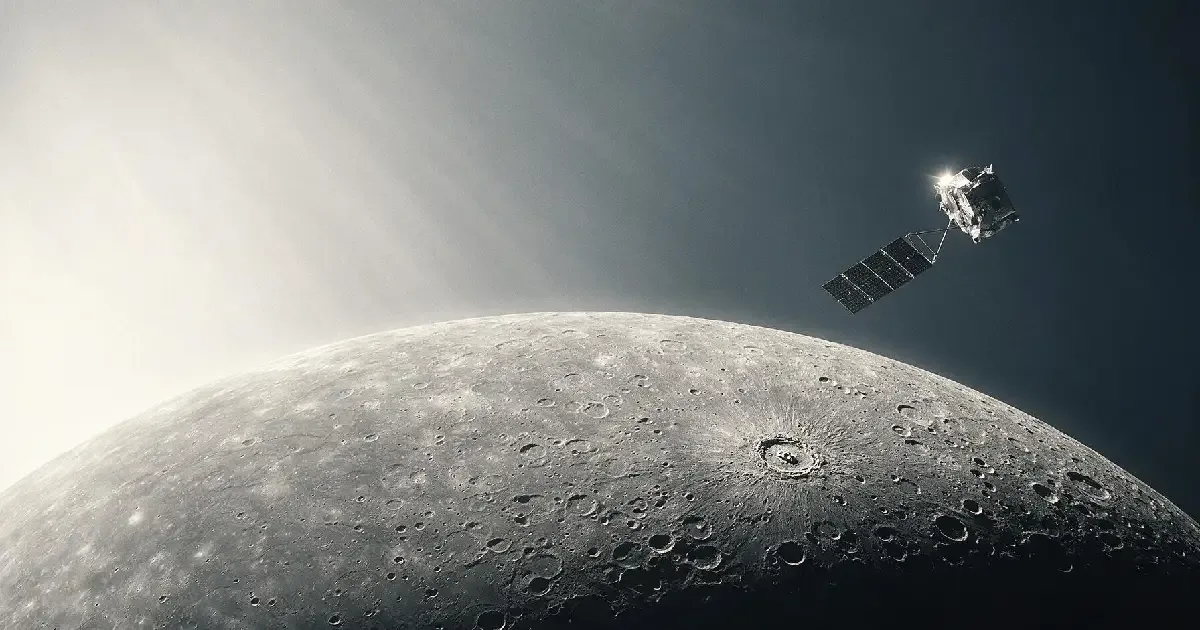
The Moon Is 1.3 Light-Seconds Away — Here's the Catch
The Moon sits just 1.3 light-seconds from Earth — close enough to talk to, far enough that every Apollo conversation carried a built-in 2.6-second pause.
Here is a claim that sounds like a contradiction: the Moon is close enough to phone, yet too far away to have a normal conversation. Both halves are true, and the reason sits inside a single number — 1.3 seconds. That is how long light, and therefore radio, takes to cross the gap from Earth to the Moon. It is short enough that we treat the Moon as our backyard, and just long enough that it quietly rewrote how humans speak to each other across space. The Apollo astronauts did not pause on the Moon because they were nervous or careful. They paused because physics gave them no choice.
This post argues something specific: the famous clipped, formal rhythm of Apollo radio chatter — "over," "copy," "say again" — was not a style decision or military habit alone. It was a direct engineering response to a 2.6-second hole punched into every exchange by the speed of light. Once you hear it that way, the recordings stop sounding like old-fashioned formality and start sounding like two teams negotiating around a wall of time.
The Number That Sets Everything: 1.3 Seconds
The Moon orbits at an average distance of about 384,400 km (238,855 miles) from Earth. Radio waves are light, and light in a vacuum moves at exactly 299,792,458 metres per second, a constant fixed by definition. Divide the distance by the speed and you get roughly 1.28 seconds for a signal to travel one way — call it 1.3.
That single value does more work than almost any other number in spaceflight. It defines how "live" a Moon broadcast can ever be, how quickly mission control can react to an emergency, and why the Moon feels reachable while Mars does not. The honest framing is that the Moon is not measured in kilometres in any way your gut understands; it is measured in time. At 1.3 light-seconds, it is the only natural object close enough that a human voice can leave Earth, land somewhere else, and return before you have finished a slow breath.
For comparison, the Sun is about 8 light-minutes away and Mars ranges from roughly 3 to 22 light-minutes depending on orbital geometry. The Moon's 1.3 seconds is in a category of its own — near enough to keep a conversation alive, which is exactly what makes the delay so noticeable rather than so total that you stop trying.
Why It's Really 2.6 Seconds — the Round Trip Nobody Counts
People quote 1.3 seconds and stop there, but a conversation is never one-way. When mission control in Houston asked a question, the words took ~1.3 seconds to reach the crew. The astronaut's reply took another ~1.3 seconds to come home. The total dead air between "do you read me?" and hearing the answer was therefore close to 2.6 seconds — the round-trip light time confirmed across NASA's own communication records, averaging about 2.56 seconds.
Two and a half seconds does not sound like much written down. Spoken, it is an eternity. Try it: ask a friend a question, then both of you stare silently for a slow count of "one-one-thousand, two-one-thousand" before either speaks. The silence feels broken, like the line went dead. Now imagine doing that while guiding a fragile lander toward an alien surface with seconds of fuel to spare. The natural human instinct — to fill silence, to talk over a pause, to repeat yourself when no answer comes — becomes actively dangerous, because your repeat collides with the reply that was already on its way.
A reasonable question readers raise here is why the delay sounds almost invisible in the Apollo audio if it was really 2.6 seconds. The answer is partly the round trip itself. When you listen to a recording made at mission control, you hear Houston speak instantly (they are in the room) and then the reply arrives one round trip later — but the recording captures both ends of the loop, and trained crews left no extra hesitation on top of the physics, so the only gap you hear is the light delay, not light delay plus human dithering.
The Protocol Built Around the Pause
This is the heart of the argument. Faced with an unavoidable 2.6-second gap, the Apollo program leaned on a communication discipline borrowed from aviation and radio operators and sharpened it: half-duplex, one-speaker-at-a-time, explicitly handed-off speech. A transmission ended with "over," signalling the channel was now clear. Acknowledgements were compressed to single words — "copy," "roger" — so the round trip carried maximum meaning per second of delay. When something was missed, the fix was the ritual "say again," never a frustrated "what?"
Strip the romance away and this is a latency-management system. Every convention exists to stop two voices from overlapping across a gap neither side can see in real time. The "over to you" handoff is not politeness; it is the only way to know whose 1.3-second-old words you are actually hearing. Engineers had effectively designed a human protocol to sit on top of a radio link, the same way modern networks layer rules on top of physical wires.
It is worth saying plainly, as opinion rather than fact: this is one of the most underrated pieces of design in the whole space program. The hardware gets the documentaries — the Apollo Unified S-band system that merged voice, telemetry, ranging, and television into a single radio link, first flown on Apollo 4 in 1967 and supported by JPL's deep-space tracking expertise. But the hardware only moved the signal. The speech protocol is what let two teams reason together across a wall of time, and it cost nothing but discipline.
"The Eagle Has Landed" — Listening for the Wall
You can hear the delay in the most famous radio call in history. When Armstrong reported, "Houston, Tranquility Base here. The Eagle has landed," the reply from Houston — "We copy you down, Eagle... you got a bunch of guys about to turn blue. We're breathing again" — arrives after a beat that is easy to mistake for emotion. Some of it surely was emotion. But baked into that pause is the same 2.6-second round trip every exchange carried. The relief in the controllers' voices and the physics of light are layered on top of each other in that single recording.
That layering is the part most retellings miss. We hear the pause as drama. It is also a measurement — a direct, audible readout of the Earth-Moon distance, captured on tape in 1969 and still sitting there in the archive for anyone who wants to time it with a stopwatch.
The Number Isn't Even Fixed
One more wrinkle complicates the tidy "1.3 seconds" headline, and it is the kind of detail that separates a real understanding from a memorised fact. The Moon's orbit is an ellipse, not a circle. It swings as close as about 363,300 km at perigee and as far as about 405,500 km at apogee. That means the one-way light time is not a constant 1.28 seconds — it breathes between roughly 1.21 and 1.35 seconds depending on where the Moon is in its monthly loop.
The practical effect during Apollo was small but real: the conversational gap was slightly shorter at perigee and longer at apogee, and the ranging systems had to track the changing distance continuously rather than assume a fixed number. It is a useful reminder that in orbital mechanics there are almost no truly fixed numbers — only averages we round off for convenience.
What's Worth Watching Next
Here is a forward-looking reason this 1.3-second number matters again right now, not just as Apollo nostalgia. NASA's Artemis program and a wave of commercial landers are returning hardware and, soon, crews to the lunar surface. Every one of them inherits the exact same physics the Apollo crews did — the same 1.3-second wall, the same 2.6-second round trip. No amount of modern bandwidth shortens it, because nothing travels faster than light.
What changes is how we cope. Future lunar operations lean harder on autonomy and onboard computing precisely because a 2.6-second loop is too slow for split-second control, exactly as it was in 1969. The Apollo protocol and modern lunar automation are two answers to the identical problem, decades apart: when you cannot beat the speed of light, you design around the silence it leaves behind. The next time a crew radios from the Moon, listen for the pause. It will still be there. It always will be.
Related Posts
Kepler's Supernova of 1604 and the Blasts Dust Hid Since
Kepler's supernova of 1604 was the last one anyone saw in the Milky Way, but not the last to explode. Here is how dust hid others, and how the next one will be caught.
Saturn's Rings: Far Thinner Than Paper, at Scale
Saturn's main rings span about 273,600 km yet are typically only 10 meters thick. Run the math and the famous paper comparison undersells them by a factor of roughly 10,000.