 CosmosIn60CosmosIn60

HD 140283, nicknamed the Methuselah Star, has an age that rivals — and may slightly exceed — the universe itself. Here's how that's possible and what it tells us about cosmic history.
A star sitting just 190 light-years away in the constellation Libra has been quietly unsettling cosmologists for decades. Known formally as HD 140283 — and nicknamed the Methuselah Star after the oldest person recorded in the Bible — this dim, fast-moving object has produced age estimates that at times appeared to exceed the 13.787 ± 0.020 billion year age of the universe itself. That apparent impossibility — a star older than the cosmos it inhabits — is one of the most compelling puzzles in modern astrophysics. The short answer is that measurement uncertainties blur the timeline. The long answer is far more interesting.
Astronomers first catalogued HD 140283 more than a century ago, not because of its age, but because of its peculiar speed. The star tears across our sky at roughly 800,000 miles per hour (1.3 million km/h), completing an arc equal to the width of the full Moon in just 1,500 years — extraordinarily fast for a visible star. That velocity was the first clue that this object did not form inside the Milky Way's disk in any ordinary fashion.
When spectroscopy became sophisticated enough to measure stellar chemistry, a second red flag appeared: HD 140283 contains only 1/250th the heavy-element content of our Sun. Iron, calcium, and similar metals are produced inside stars through nuclear fusion and scattered by supernova explosions. A star this deficient in those elements formed before most such explosions had taken place — meaning it belongs to the universe's second generation of stars, Population II, born from gas that had barely been touched by prior stellar generations.
By the early 2000s, estimates placed the star's age at 16 billion years — a figure that required the universe to be older than every measurement of the cosmic microwave background suggested. Even after Hubble Space Telescope observations in 2013 tightened the estimate to 14.46 ± 0.8 billion years, the uncertainty window still overlapped an impossible territory: a star born before the Big Bang. The measurement error, not the star itself, was producing the contradiction — but proving that required steadily improving tools and methods.
Unlike rocks, stars cannot be radiometrically dated. Instead, physicists use a star's position on the Hertzsprung-Russell diagram — a chart plotting brightness against temperature — to infer how far along in its life cycle it has traveled. Every star of a given mass burns through hydrogen at a predictable rate. When hydrogen in the core runs out, the star expands into a subgiant and then a red giant. By measuring exactly how far HD 140283 has evolved away from the hydrogen-burning main sequence, astronomers can work backward to calculate its age.
This technique is sensitive to several input variables: the star's precise distance, its exact chemical composition, and the opacity of its stellar interior. Small errors in any of these cascade into large age uncertainties. The 2013 Hubble measurement used the telescope's Fine Guidance Sensors to nail down HD 140283's parallax — the apparent shift in its position against distant background stars as Earth orbits the Sun — with an uncertainty of just 0.44%. Even that level of precision left an 800-million-year error bar, which was enough to include ages both older and younger than the universe.
The Gaia satellite later refined the distance to approximately 190 light-years (62 parsecs), compressing the parallax uncertainty further. But the most dramatic improvement came from a completely different technique: listening to the star.
In 2025, a team of researchers published the first detailed asteroseismic analysis of HD 140283 in the journal Astronomy & Astrophysics, using data from NASA's TESS (Transiting Exoplanet Survey Satellite) mission. Asteroseismology works by detecting tiny oscillations — essentially sound waves — reverberating through a star's interior. These oscillations create rhythmic brightness variations at the star's surface. The frequencies of those variations encode information about the star's internal structure: its mass, radius, and age.
TESS observed HD 140283 in 20-second cadence during Sector 51, capturing a rich spectrum of solar-like oscillations, including what are called "mixed modes" — oscillations that probe both the star's outer layers and its deep core simultaneously. Mixed modes are particularly valuable because the core is where age-sensitive nuclear burning has been occurring for billions of years.
From this data, the team derived a mass of 0.75 ± 0.01 solar masses and a radius of 2.078 solar radii — consistent with a star that has evolved off the main sequence and is now a subgiant. Most critically, the asteroseismic age came to 14.2 ± 0.4 billion years. The study noted that this result is in agreement with the age of the universe within one standard deviation (1σ). In statistics, that means the true age of the star almost certainly falls below the cosmic age limit when measurement uncertainty is properly accounted for. The paradox, at this precision, effectively dissolves — though only just.
Understanding why HD 140283's chemistry is so striking requires a brief look at what the early universe was and was not made of. In the minutes after the Big Bang, nuclear reactions produced hydrogen, helium, and trace quantities of lithium. Nothing heavier. Every other element on the periodic table — carbon, oxygen, iron, gold — had to be forged later, inside stars, and distributed by supernovae.
HD 140283 formed from gas that had only been processed by the earliest, most massive Population III stars, which are hypothesized but have never been directly observed. Those primordial giants lived fast and died in violent explosions that seeded the surrounding gas with the first traces of heavier elements. HD 140283 condensed from that lightly enriched gas — giving it a metallicity of [Fe/H] = −2.3 dex, meaning it contains roughly 250 times less iron than the Sun per unit of hydrogen.
It also carries an excess of oxygen and alpha elements (like magnesium and silicon) relative to iron. This alpha-element enhancement is a signature of rapid star formation in an environment dominated by core-collapse supernovae rather than the slower type Ia supernovae that gradually add iron over billions of years. The chemical fingerprint is a timestamp: HD 140283 condensed when the universe was still young enough that only the fastest-burning, shortest-lived stars had yet exploded.
The 2024 paper in Astronomy & Astrophysics used tailored chemical abundances — custom-fitted to the star's actual measured composition — to find an age between 12 and 14 billion years, depending on the precise abundance ratios applied. The range reflects how sensitive age determination is to chemical inputs that are still being refined.
HD 140283's trajectory tells a story beyond its chemistry. Its orbit carries it far above and below the plane of the Milky Way on a highly elongated, nearly radial path — the signature of an object that did not form in the galaxy's disk. The leading hypothesis is that the star originated in a primordial dwarf galaxy that was gravitationally shredded and absorbed by the Milky Way more than 12 billion years ago. The high proper motion — that 800,000-miles-per-hour streak across the sky — is a remnant of the violent tidal disruption that stripped that galaxy apart.
This origin story places HD 140283 among a population of "halo stars" — ancient survivors from the earliest epoch of galaxy assembly, orbiting in the diffuse outer halo rather than the dense, star-forming disk. Most halo stars are too faint and distant to study with precision. HD 140283's relative proximity, at under 200 light-years, makes it an extraordinary specimen: one of the oldest objects in the Milky Way, close enough to examine in detail with current instruments.
HD 140283 sits at the intersection of three of the biggest open questions in astrophysics: How accurately do we know the age of the universe? How did the first stars form and die? And do our stellar evolution models reliably describe stars of extreme age and low metallicity?
The Hubble constant tension — the ongoing disagreement between different methods of measuring the universe's expansion rate — means that the 13.787 billion year figure may itself carry more uncertainty than its formal error bars suggest. Some alternative cosmological models produce a slightly older universe, which would erase any remaining tension with HD 140283 entirely. The star's apparent age may not be wrong — it may be a signal that our cosmological model still has room to improve.
The 2025 asteroseismic study also has methodological importance. TESS was built primarily to find exoplanets, but observing a 14-billion-year-old star and resolving oscillations sensitive enough to constrain its age to within 400 million years demonstrates that asteroseismology can now routinely date the oldest stars in the galaxy. That capability is critical for mapping the Milky Way's assembly history: if we can age ancient halo stars precisely, we can reconstruct when and from which infalling galaxies they originated. HD 140283 is not just a scientific curiosity — it is a calibration point for a technique that may ultimately reveal the full chronology of how our galaxy was built.
Probably not, but the answer is genuinely close. The most precise current measurement, using asteroseismology from 2025, places its age at 14.2 ± 0.4 billion years, compared to the universe's age of 13.787 billion years. The overlap of the uncertainty ranges means the star's true age is consistent with being younger than the universe — but only within one standard deviation. Earlier estimates of 14.46 billion years carried even larger uncertainties, making the apparent paradox worse than it actually was.
Stellar age is inferred from two main techniques. The first is isochrone fitting: plotting a star on a brightness-temperature diagram and comparing its position to theoretical evolution tracks, which predict how fast stars of different masses age. The second, newer technique is asteroseismology, which measures the frequencies of pressure waves reverberating inside the star. Those frequencies reveal the star's internal structure — density, mass, radius — and together constrain how far along in its life cycle the star has traveled.
Iron and other heavy elements are products of stellar nucleosynthesis — they only exist because generations of stars lived and died before HD 140283 formed. When the universe was very young, fewer supernovae had occurred and the interstellar gas was still nearly pristine. HD 140283 condensed from that gas, inheriting an iron abundance 250 times lower than the Sun's. Each subsequent generation of stars has been born from progressively more metal-enriched gas, which is why younger stars like our Sun have far richer chemistry.
HD 140283 almost certainly did not form inside the Milky Way. Its highly elongated orbit, which carries it far out of the galactic plane, and its extreme proper motion of roughly 800,000 miles per hour point to an origin in a small dwarf galaxy that was gravitationally consumed by the early Milky Way over 12 billion years ago. The star survived the merger and is now orbiting as part of the galactic halo — a refugee from a galaxy that no longer exists.
Not quite, but it is visible with binoculars. HD 140283 shines at magnitude 7.2 in the constellation Libra, just above the naked-eye threshold of about magnitude 6.5. Under dark skies with good binoculars, it appears as a faint yellow-white point of light moving — imperceptibly night to night, but detectably over years — against the background stars.
HD 140283 has forced astrophysicists to sharpen every tool available — Hubble parallax measurements, Gaia astrometry, TESS asteroseismology, detailed spectral abundance modeling — all focused on a single aging subgiant in Libra. Each refinement has narrowed the apparent contradiction without fully eliminating it, leaving the Methuselah Star poised at the very edge of what is cosmologically possible. The next generation of precision instruments, including the Roman Space Telescope and new asteroseismic surveys, may finally deliver an age measurement tight enough to settle the question definitively. Until then, the oldest star we know continues to ask a question that the universe itself has not yet fully answered: how precisely do we know when everything began?
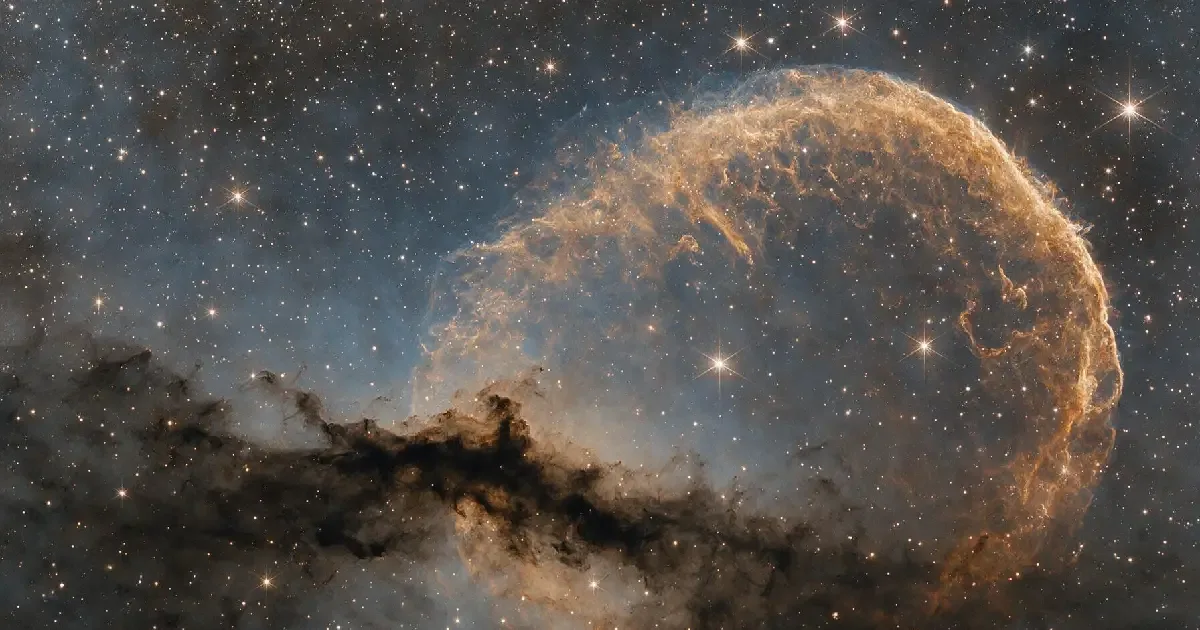
Kepler's supernova of 1604 was the last one anyone saw in the Milky Way, but not the last to explode. Here is how dust hid others, and how the next one will be caught.
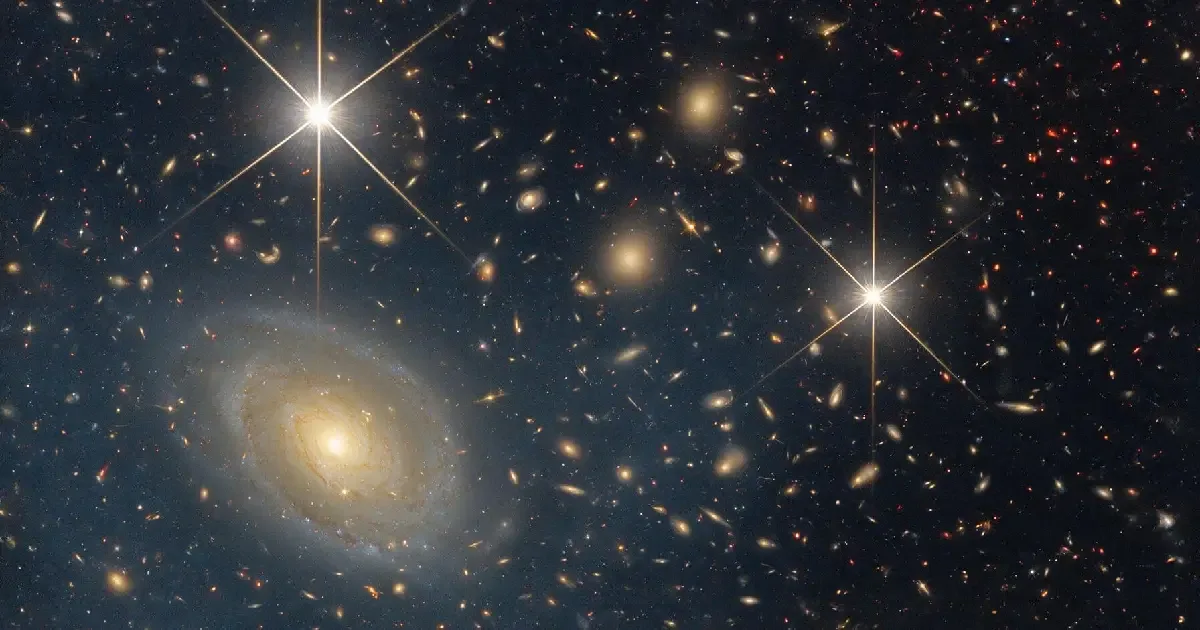
The night sky is dark mainly because the universe has a finite age, not because the Sun set. The blazing sky an infinite universe would give us is still there, stretched into invisible microwaves.

A supergiant in Andromeda dimmed 10,000-fold and disappeared with no supernova. The numbers behind this 'failed supernova' point to a black hole born in silence.