
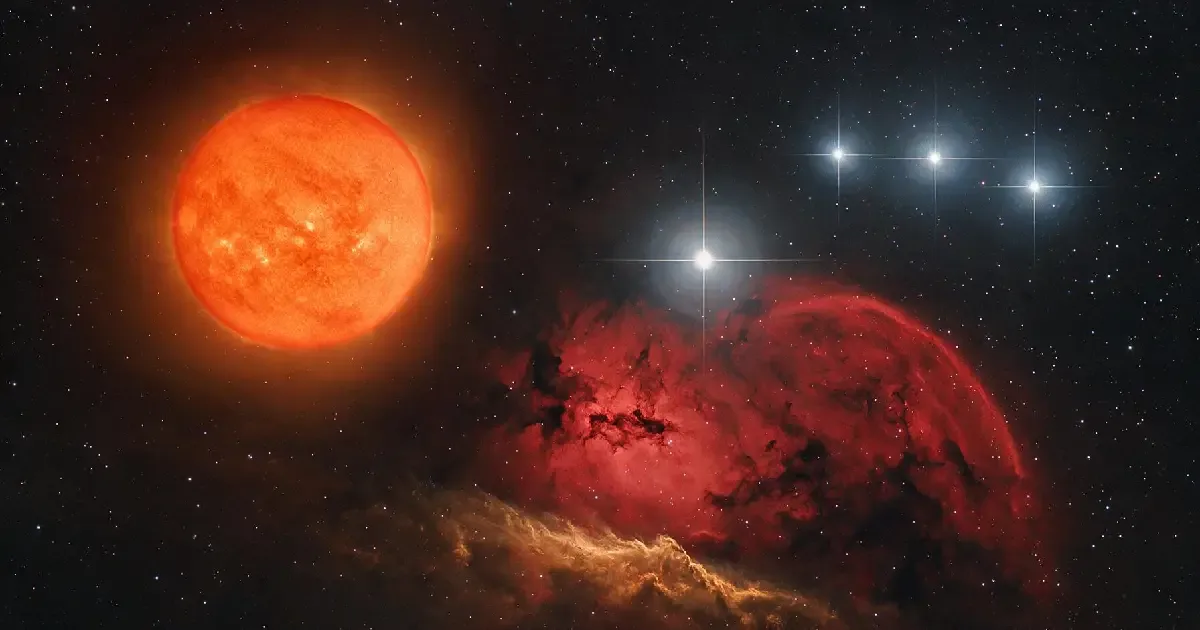
Orion's Stars Are Hundreds of Light Years Apart
Betelgeuse is about 530 light years away. Orion's middle belt star is well over 1,000. Why a popular 3D map of Orion is out of date, and what each star's distance really rests on.
Seven hundred light years. On the newest estimates, that is roughly how much deeper into space you travel going from Orion's red shoulder to the middle star of its belt. The Hunter looks like a figure painted on a flat dome, but it is a chance alignment of suns strung along a corridor so long that light needs about seven centuries to cross it.
That constellations are three-dimensional is not news; astronomers have known it for a very long time. The news is how badly the numbers still disagree for Orion's most famous stars, and why. The brightest stars in the sky are among the hardest to measure, and a widely shared depth map of Orion rests on a distance for its middle belt star that newer work has pulled in by about 700 light years. Each section below takes one number, shows where it came from, and asks how much weight it can carry.
530 Light Years to the Shoulder, 860 to the Foot
Start with Betelgeuse, the orange-red supergiant at the Hunter's upper left as seen from the Northern Hemisphere. Its parallax, the tiny yearly shift of a star against the background as Earth circles the Sun, has never settled down. The estimates listed in a 2020 study run from 153 parsecs in the revised Hipparcos catalogue, about 500 light years, to a radio-plus-Hipparcos solution of 222 parsecs, about 724.
So the 2020 team, led by Meridith Joyce, came at the question from the inside. They modeled the slow pulsations that make Betelgeuse brighten and fade, worked out how large a star must be to pulse that way, and turned that physical size into a distance. The university's announcement put the result at "a mere 530 light years from us – 25 per cent closer than previous thought". The paper itself gives 168 parsecs, with a range of roughly 153 to 195, which converts closer to 550. Even a headline number about Orion carries a spread of more than a hundred light years.
Rigel, the blue-white star at the opposite corner, sits about 300 light years farther out. The revised Hipparcos parallax gives 264 ± 24 parsecs, about 860 light years. A 2022 team then tried intensity interferometry, correlating photon arrival times at two telescopes about 15 meters apart and fitting the result with a model of the star, and landed on 260 ± 20 parsecs. The fine print matters: the model needed a luminosity as an input, and the authors assumed 123,000 times the Sun's. Feed it 279,000, another published value, and the same data return about 420 parsecs, close to 1,370 light years. For Rigel, how far away it is and how powerful it is are one question, not two.
2,000 Light Years or 1,250? The Middle Belt Star
Here is the number most readers have met. In 2020, NASA's Astronomy Picture of the Day ran a 3D illustration of Orion built from Hipparcos parallaxes. It placed Alnilam, the middle belt star, "nearly 2,000 light-years away, almost 3 times as far as fellow belt stars Alnitak and Mintaka", and honestly warned that parallax errors for Orion's stars can mean distance errors of about 100 light years.
That warning undersold the problem. Hipparcos, ESA's star-mapping satellite, operated from 1989 to 1993 and charted 118,218 stars at its highest precision, and its raw data have been reduced twice. The original 1997 catalogue put Alnilam at 412 parsecs. The 2007 re-reduction put it at 606. Same star, same spacecraft, two answers about 630 light years apart.
A 2025 study by Alžběta Oplištilová and colleagues, published in Astronomy & Astrophysics and based on observations with ESO's Very Large Telescope Interferometer, went around the problem. Gaia, ESA's far more precise successor, ought to settle a question like this, but Alnilam is so bright that it saturates Gaia's detector, leaving its parallax unreliable. So the team took the Gaia distances of the faint stars in the same stellar family, the Orion OB1b association, and adopted their median. Their preferred value is 384 ± 8 parsecs, about 1,250 light years, give or take 26.
Sit with the inversion in that method. In the Gaia era, a faint, unnamed star near the belt can have a better-measured distance than the belt star everyone knows. Astronomers now place the famous star the way you might fix the position of a lighthouse by surveying the houses around it.
The choice of catalogue even moves Alnilam's light through human history. At 606 parsecs, the light entering your eye tonight left the star around the reign of the Roman emperor Claudius. At 384 parsecs, it left in the second half of the eighth century, the age of Charlemagne.
294, 381, 387: Rival Rulers for the Belt's Ends
Alnitak and Mintaka, the eastern and western ends of the belt, are just as contested. In the Hipparcos-based view behind the 2020 illustration, both sat near 700 light years. Newer methods disagree.
Both are multiple-star systems, which spoils a simple parallax but opens other doors. Track a binary's orbit on the sky and in its spectrum, and orbital mechanics hands you the distance directly. Christian Hummel's team did this for Alnitak with the Navy Precision Optical Interferometer and derived an orbital distance of 294 ± 21 parsecs, about 960 light years. The same paper gives a photometric distance of 387 ± 54 parsecs, about 1,260 ± 180 light years, and the authors leaned toward that one because it matches the Orion OB1 association. They set aside the Hipparcos value of about 225 parsecs because its solution could not account for the binary's orbital motion.
For Mintaka, a 2015 analysis found that the Hipparcos parallax produced surprisingly low values for the star's mass, radius, and luminosity, and that everything became consistent only if Mintaka lies at about twice the Hipparcos distance. In 2023 the same Czech-led group behind the Alnilam study used the lighthouse trick again: the Gaia parallax of Mintaka's faint companion star puts the system at 381 ± 8 parsecs, about 1,240 light years, right at the centre of the Orion OB1b association.
| Star | Place in the figure | Estimate | Light years | Method |
|---|---|---|---|---|
| Betelgeuse | shoulder | 153 pc; 168 pc; 222 pc | ~500; ~530–550; ~724 | Hipparcos 2007; pulsation modeling, 2020; radio plus Hipparcos, 2017 |
| Rigel | foot | 264 ± 24 pc; 260 ± 20 pc | ~850–860 | Hipparcos 2007; intensity interferometry, 2022 |
| Alnilam | belt, middle | 606 pc; 412 pc; 384 ± 8 pc | ~1,980; ~1,340; ~1,250 | Hipparcos 2007; Hipparcos 1997; OB1b median, 2025 |
| Alnitak | belt, east end | 225 pc; 294 ± 21 pc; 387 ± 54 pc | ~730; ~960; ~1,260 | Hipparcos 2007; binary orbit, 2013; photometric, 2013 |
| Mintaka | belt, west end | ~2× Hipparcos; 381 ± 8 pc | ~1,240 | spectral consistency, 2015; companion's Gaia parallax, 2023 |
So is the belt a real group or a trick of perspective? The dispute is not closed, but if the newer figures hold, all three stars sit near 1,250 light years, well inside one another's uncertainties, as siblings in one association. That would make the belt the most physically honest part of the Hunter: a genuine family of massive stars, framed by a shoulder and a foot that are hundreds of light years in front of it.
271,000 Suns: A Title Now in Dispute
The 2020 caption made a second claim: Alnilam looks fainter than Rigel and Betelgeuse, yet it is intrinsically the brightest of the familiar stars in Orion. That follows from the 2,000-light-year distance. Push a star farther away and it has to be more powerful to look as bright as it does.
Pull Alnilam in to 1,250 light years and the case weakens. The 2025 model gives it a luminosity of 271,000 ± 38,000 Suns and a surface temperature of about 25,000 kelvin, hot enough that most of its output is ultraviolet light your eye never sees. Rigel's published values run from the 123,000 adopted in the interferometry work to a spectroscopic 182,000 to 263,000, and a higher luminosity pushes Rigel farther away. The ranges overlap, so nobody can currently crown Orion's most powerful star.
One comparison does survive every number. The Joyce study puts Betelgeuse's total output at about 87,000 Suns (a logarithmic value of 4.94, about 110,000 at the top of its widest range). Even the low end of Alnilam's 2025 value is more than twice that. Betelgeuse looks brighter only because, on the ANU and 2025 figures, it is less than half as far away.
Seven Hundred Light Years Deep, Seen From One Spot
Put the current figures together and Orion becomes a corridor: Betelgeuse at roughly 530 light years, Rigel near 860, the belt stars anywhere from about 700 to nearly 2,000 depending on the study, with the newest work putting all three near 1,250. Behind them lie the star-forming clouds of the Orion complex at roughly 400 to 430 parsecs, about 1,300 to 1,400 light years. The same 3D study of the region names the most massive and luminous stars in Orion, such as the belt stars, among the likely sources lighting up Barnard's Loop, the great arc of glowing gas around the constellation. The belt stars belong to the clouds behind them more than to the shoulder in front.
That answers a question readers often search: are constellations 3D? Every one is, and Orion makes it vivid. From a vantage a few hundred light years off to one side, Betelgeuse would swing far away from the belt and the Hunter would fall apart. The figure belongs to our corner of the galaxy.
Our take: the popular 3D Orion graphics deserve a redraw, with the belt drawn as the newer data suggest and the older Hipparcos depths marked as disputed. The 2020 caption was not careless. It used the best catalogue then available and flagged its own error bars. But "how far away is that star?" remains a live question even for the stars everyone can find, and the answer depends on which ruler you trust: geometry, orbits, pulsation, or the company a star keeps.
What is worth watching next: the 2025 paper is titled "I. eps Orionis," a numbering that suggests more VLTI work on the belt is coming. And in November 2027, Betelgeuse's faint companion star returns to its greatest separation from Betelgeuse, the easiest time to detect it. As Alnitak shows, a companion's orbit can be one more ruler.
Meanwhile, Orion is climbing back into the late-evening sky for Northern Hemisphere observers. When it clears the eastern horizon, the belt lines up so neatly that it is hard to believe the Hunter is about seven centuries of light deep from shoulder to belt.
Related Posts
Kepler's Supernova of 1604 and the Blasts Dust Hid Since
Kepler's supernova of 1604 was the last one anyone saw in the Milky Way, but not the last to explode. Here is how dust hid others, and how the next one will be caught.
Why the Night Sky Is Dark: The Universe Has an Age
The night sky is dark mainly because the universe has a finite age, not because the Sun set. The blazing sky an infinite universe would give us is still there, stretched into invisible microwaves.
