

Cosmic Rays From Dead Stars Are Passing Through You
The particles drilling through your body right now didn't come from the Sun. They were flung out of exploding stars that died before humans existed — and they only survive the trip because of Einstein.
Ask most people where the radiation passing through their body comes from, and they'll point at the Sun. It's a reasonable guess and almost entirely wrong. The Sun does pelt you with light and a thin breeze of solar particles, but the high-energy projectiles punching clean through your chest several times every second were not made by any star that is currently alive. They were forged in the death throes of stars that exploded thousands of years ago, accelerated to nearly the speed of light by the most violent events the galaxy produces. Here's the uncomfortable, beautiful truth: you are being gently shot, around the clock, by the ghosts of dead stars — and the only reason those bullets reach you at all is a quirk of Einstein's relativity.
The Myth: "That Radiation Is Coming From the Sun"
The Sun is the obvious culprit. It's the brightest, closest, most obviously energetic thing in the sky, so it absorbs the blame for everything that falls from above. And to be fair, the Sun does contribute. It throws out a stream of relatively low-energy particles — the solar wind — and occasionally belches a flare that spikes the radiation count near Earth.
But the truly energetic stuff, the particles physicists actually call cosmic rays, mostly do not come from the Sun at all. They come from outside the solar system entirely. Below an energy of about 10^17 electron-volts, the majority of cosmic rays are thought to be produced inside the Milky Way, and the leading accelerators are not stars but their corpses. The Sun's particles are featherweights by comparison; a single galactic cosmic ray can carry millions of times more energy than anything the Sun routinely produces. So the reflex to credit the Sun isn't just slightly off — it points in the wrong direction in the sky.
What's Actually Happening: Exploded Stars as Particle Cannons
When a massive star runs out of fuel, it collapses and rebounds in a supernova, blasting its outer layers into space at thousands of kilometers per second. What's left behind is a supernova remnant — an expanding bubble of superheated gas and tangled magnetic field. That bubble is the most powerful particle accelerator in the galaxy.
Here's the mechanism: protons and atomic nuclei get caught in the shockwave at the edge of the expanding remnant. Each time a particle crosses the shock front, it picks up a little energy, like a ball bouncing between two converging walls. Trapped by the remnant's magnetic field, a particle can bounce back and forth across that shock thousands of times, gaining speed until it finally escapes the system moving at very nearly the speed of light. The corpse of a star, in other words, behaves like a natural cosmic cannon — and it keeps firing for tens of thousands of years after the star itself has died.
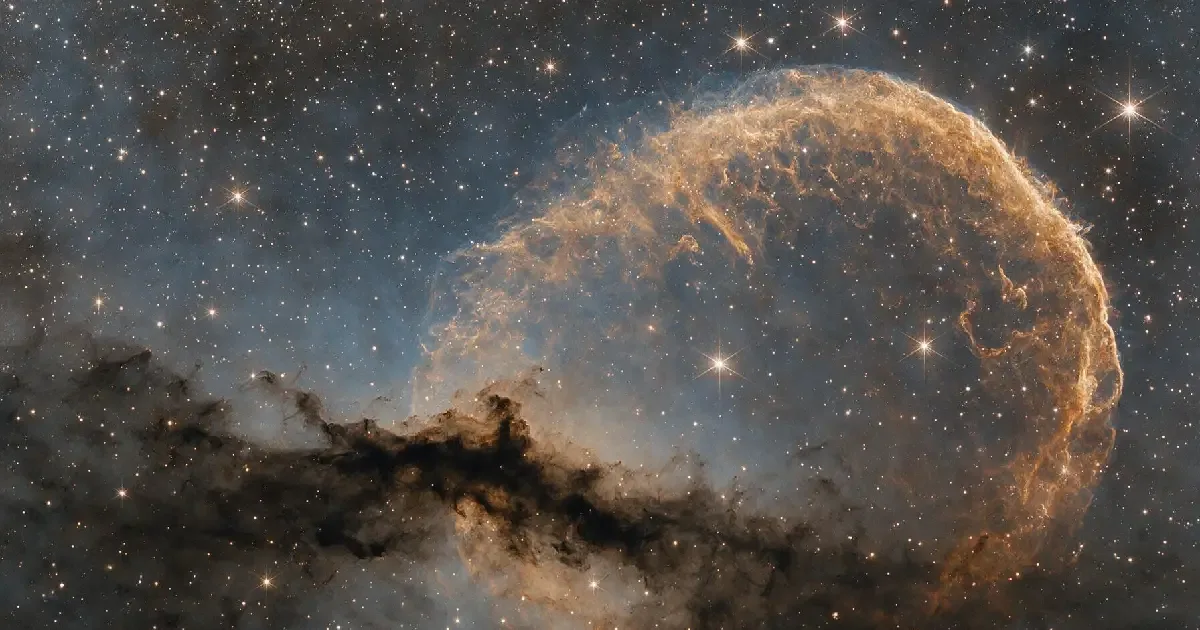
For a century this was a strong suspicion without a smoking gun. The proof arrived in 2013. NASA's Fermi Gamma-ray Space Telescope stared at two specific remnants — IC 443, the Jellyfish Nebula about 5,000 light-years away, and W44, roughly 9,500 light-years off — and found a telltale fingerprint. When accelerated protons smash into ordinary gas, they create a short-lived particle called a neutral pion, which decays into gamma rays with a very particular energy signature. Fermi detected exactly that signature in both remnants, providing the first clear-cut evidence that exploded stars produce cosmic-ray protons. The findings were published in the journal Science on February 14, 2013 — a fittingly violent kind of valentine.
It's worth pausing on the timescales involved. IC 443 is roughly 10,000 years old; W44 is closer to 20,000. The stars whose deaths created these accelerators exploded while the last ice age was still gripping Earth. The particles still streaming out of them today are, quite literally, older than agriculture.
How a Dead Star's Bullet Reaches Your Body
A galactic proton that's spent millennia crossing interstellar space doesn't hit you directly. When it slams into a nitrogen or oxygen nucleus high in the atmosphere — typically 15 to 20 kilometers up — it shatters into a spray of secondary particles, which collide again and again in a chain reaction physicists call an air shower. One primary cosmic ray can produce a cascade of millions of particles raining down over a wide patch of ground.
By the time that cascade reaches sea level, the survivors are mostly muons — heavy, unstable cousins of the electron. At the surface, about 80 percent of all charged particles hitting the ground are muons, arriving at a rate of roughly one per square centimeter every minute. Scale that up to the cross-section of a human body and the numbers get personal fast: depending on how you're standing, somewhere between 10 and 100 muons pass through you every second. Hold your hand out flat and a couple of them are drilling through your palm right now. You will never feel a single one.
That naturally raises the question most people ask next: if these things are passing through me constantly, should I be worried? The honest answer is no. Muons are weakly interacting and your body has co-evolved with this background flux for the entirety of human history — it's part of the natural radiation budget every living thing on Earth's surface absorbs. The dose is real but small, far below what you'd get from a single medical CT scan. The more interesting reaction isn't fear; it's that something this exotic is this ordinary.
The Twist Einstein Hid in the Numbers
There's a problem with this whole story, and it's a big one. Muons are catastrophically short-lived. A muon at rest survives for just 2.2 microseconds before decaying. Even traveling at essentially light speed, a muon should cover only about 660 meters before it dies — yet they're created 15 kilometers up. By every classical calculation, not a single one of these particles should ever reach the ground. They should all evaporate kilometers above your head.
They reach you anyway. And the reason they do is the second non-obvious thread running through this entire phenomenon: time dilation. Because the muon is moving so close to light speed, its internal clock runs slow relative to ours — roughly 70 times slower from Earth's frame of reference. Stretch that 2.2-microsecond lifespan by a factor of 70 and the muon suddenly lives long enough to complete the plunge. Every muon that taps you on the shoulder is a tiny, perfect experiment confirming Einstein's special relativity. The radiation from a star that died 20,000 years ago can only finish its journey because the universe genuinely bends time for fast-moving things. Take Einstein out of the equation and you'd be standing in an eerie silence, untouched, because nothing would survive the fall.
One More Correction Worth Making
While we're dismantling misconceptions, here's a related one that even some space fans get tangled up in: cosmic-ray muons are not the famous "100 trillion particles passing through you per second." That staggering figure refers to neutrinos, ghostlier particles that stream from the Sun, from distant black holes, and from the Big Bang itself, and which pass through you almost without interacting at all. Roughly 100 trillion cosmic neutrinos cross your body each second. Muons are the rarer, heavier, harder-hitting traffic — tens per second, not trillions. Conflating the two is the most common error in this corner of physics, and now you won't make it.
What's worth watching next is precision. Observatories like the High-Altitude Water Cherenkov detector are mapping cosmic-ray sources across the sky with sharper resolution than ever, and the open question physicists are still chasing is where the highest-energy cosmic rays come from — the rare monsters that carry more energy than a fast-pitched baseball packed into a single subatomic particle. Supernova remnants explain the bulk of the flux, but not those extreme outliers. The dead stars are confirmed. The most violent accelerators in the universe are still, in part, hiding.
So the next time you feel the urge to blame the Sun for the invisible stuff falling on you, look further out and further back. The particles passing through your body this very second are messages from stars that died before written history, delivered by an air shower, and decoded only because time itself runs differently at the speed of light. You are not separate from the violent universe. You are, quietly and continuously, being rained on by it.
Related Posts
Kepler's Supernova of 1604 and the Blasts Dust Hid Since
Kepler's supernova of 1604 was the last one anyone saw in the Milky Way, but not the last to explode. Here is how dust hid others, and how the next one will be caught.
Why the Night Sky Is Dark: The Universe Has an Age
The night sky is dark mainly because the universe has a finite age, not because the Sun set. The blazing sky an infinite universe would give us is still there, stretched into invisible microwaves.
