Altair Spins So Fast It's Squashed: Why Stars Aren't Round
Altair spins about three times a day, fast enough to flatten its middle and split its surface into hot poles and a cooler belt. Here is why the idea that stars are round falls apart.
Stars are spheres. Gravity pulls a star's gas toward its center equally from every direction, so the gas settles into a ball, the same way a raindrop rounds itself in free fall. The rule holds so well for the Sun that it is easy to assume it holds for every point of light overhead. Altair, the brightest star in Aquila and the southern corner of the Summer Triangle, breaks it. The star spins so fast that its middle bulges outward, its poles flatten, and its surface runs at two very different temperatures at once. The usual telling stops at "squashed." The sharper point is that roundness was never the default for stars. It is the signature of a slow spin, and treating a fast spinner as a ball has already cost astronomers a factor of ten in one star's age.
The Sun Taught Everyone the Wrong Shape
Why does the myth feel so safe? Because the only star anyone has seen up close is almost absurdly round. In 2012, a team using the Helioseismic and Magnetic Imager on NASA's Solar Dynamics Observatory measured the Sun's shape precisely enough to state that, shrunk to a ball one meter across, its equatorial diameter would be only 17 millionths of a meter larger than its pole-to-pole diameter. The same release notes the Sun turns about once every 28 days. That is slow enough for gravity to win almost completely.
Every other star reaches Earth as an unresolved point. With no visible disc, there is no visible shape, and the default assumption fills the gap.
The planets were always a hint that the assumption was too tidy. NASA's Earth fact sheet lists an equatorial radius of 6,378 km against a polar radius of 6,357 km, a flattening of 0.003353 from a roughly 24-hour spin. Saturn, which turns in about 10.7 hours, carries a flattening of 0.098, with an equatorial radius of 60,268 km and a polar radius of 54,364 km. Rotation visibly reshapes worlds. The open question was whether any star spins hard enough to do the same, and how anyone could measure it from light-years away.
A Waistline Measured From 17 Light-Years
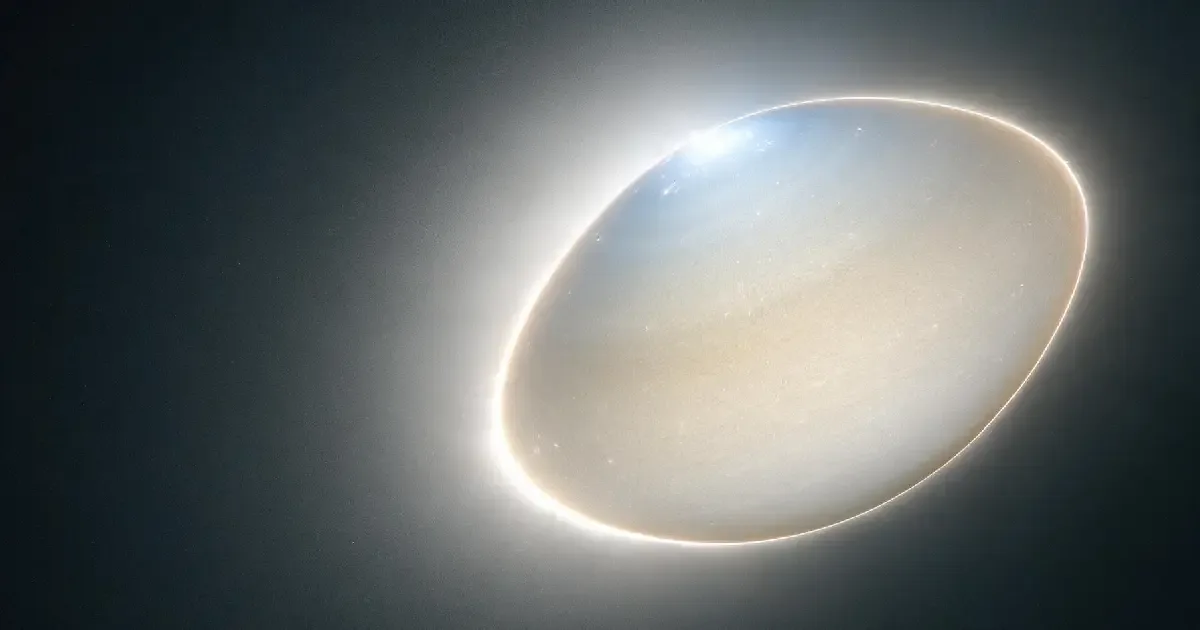
The answer came from interferometry, which links separate telescopes so they behave like a single instrument as wide as the gap between them. Altair sits about 17 light-years from Earth, close enough for the trick to work. Astronomers used the Palomar Testbed Interferometer, three 50-centimeter telescopes operated in pairs, to show that Altair's measured diameter changed with direction. Their verdict: an equator at least 14 percent wider than the poles, and an equatorial speed of at least 210 km/s, or one turn every 10.4 hours at most. That flattening result was published in 2001.
Those were lower limits. In 2007, a team led by John Monnier at the University of Michigan combined light from four telescopes of Georgia State University's CHARA array on Mount Wilson and produced what the university billed as the first image of surface features on a Sun-like star. The best-fitting model in that paper gives an equatorial radius of 2.03 times the Sun's and a polar radius of 1.63, which makes Altair about 24 percent wider across the middle than from pole to pole.
Could anyone see this with a backyard telescope? No. In that same model, Altair's whole disc spans less than four thousandths of an arcsecond, and the CHARA image needed resolution finer than one milliarcsecond to show any structure at all. The squashing is real, but it is only visible to an instrument hundreds of meters across.
The most complete model so far, a two-dimensional reconstruction published in 2020, was refined by a 2024 follow-up using TESS data that gives an equatorial velocity of about 313 km/s, a rotational flattening of 22 percent, and a spin of roughly three turns per day. That is about 1.1 million kilometers per hour at the equator. The Toulouse team behind the model describes the rotation as more than a hundred times faster than the Sun's.
Here is a way to hold that number in mind. Build a one-meter model of the Sun and a one-meter model of Altair. The Sun's poles sit 17 micrometers closer together than its equator. Altair's poles sit about 22 centimeters closer, a gap more than ten thousand times larger. In proportion, Altair's bulge is more than double Saturn's, which makes this star more flattened than the most famously flattened planet in the solar system.
Why doesn't it fly apart? It is near the limit, not past it. The 2007 fit put Altair at about 92 percent of its breakup angular velocity, the spin rate at which gravity would no longer hold the equator. The 2020 model, which lets the core spin about 50 percent faster than the outer envelope, gives 74 percent of the Keplerian rate at the equator. The figures differ because the models define the interior and the limit differently, but both agree that gravity is still winning, by a margin that would make an engineer uneasy.
Hot Poles, a Cooler Belt
A squashed outline would be strange enough. Altair's spin also splits its temperature. At the poles, the surface sits closer to the dense core and feels stronger effective gravity. At the equator, rotation partly cancels gravity, and the gas puffs outward. Stronger surface gravity means a hotter, brighter surface. This effect is called gravity darkening, and the Roche–von Zeipel models used in the 2007 paper trace it back to a law Hugo von Zeipel worked out in 1924.
The numbers are striking. Monnier's best model gives a polar temperature near 8,450 K and an equatorial temperature near 6,860 K, a spread of about 1,600 K across a single star. By the usual classification bands, the poles burn like an A-type star while the belt glows more like a cooler F-type star. NASA's Night Sky Network is careful with the wording: the equator is not truly dark, only dark compared with the poles, much as a sunspot looks black only because it sits beside hotter plasma.
The image held a second surprise. Altair's equator turned out darker than standard models predicted, and the paper concluded that uniform rotation cannot explain the data, pointing instead to differential rotation, a different gravity-darkening law, or both. The first time anyone resolved a fast spinner's face, the textbook recipe for that face needed rewriting.
The Round Star That Wasn't
This is where Altair turns from a curiosity into a warning. When the Palomar team measured Altair, they needed proof that the stretched shape was not an artifact of their own telescopes. So they also measured Vega, which did not change with angle. Vega looked round, and it served as the control.
Five years later, interferometry showed that Vega is rotating at 93 percent of breakup speed. It only looked round because Earth sees it almost exactly pole-on, the way a spinning plate looks like a perfect circle from directly above. The control star was a squashed star too, viewed from the one angle that hides it.
That matters well beyond one footnote. As the Vega study points out, Vega is the primary photometric calibrator, the star used to anchor the brightness scale for a vast number of other measurements. Its hot pole faces Earth, which explains why it looks unusually bright for its type, and the large temperature differences across its surface add uncertainty to its age.
So two of the Summer Triangle's three corners are fast-spinning, flattened stars. One shows its bulge; the other hides it behind geometry. Farther south, Achernar pushes the effect further still: a 2003 ESO measurement with the Very Large Telescope Interferometer found its equatorial radius more than 50 percent larger than its polar radius. A star's apparent roundness depends on two things, how fast it spins and the angle from which it is seen.
A Shape That Rewrites a Birthday
The correction stops being trivia at this point. Modeled as a sphere, the way standard one-dimensional stellar codes treat stars, Altair came out around 1 billion years old. The 2020 two-dimensional model, built with the ESTER code and checked against interferometry, spectroscopy, and the star's pulsations, cut that to about 100 million years and fixed its mass at 1.86 Suns. The 2024 TESS analysis, which derived 22 new oscillation frequencies and confirmed 12 known ones, refined the age again to 88 ± 10 million years. Treating a fast spinner as a ball had the star's age wrong by roughly a factor of ten.
Those pulsations are the quiet hero of the story. Altair flickers at many frequencies at once as waves ring through its interior, and a squashed star rings in a pattern a round one cannot. Matching the observed tones to a flattened model is what pins down the mass and the age.
Our take: Altair should change how readers hear any single number attached to a star. "Its temperature is X" and "its age is Y" are approximations that work for slow rotators like the Sun and quietly fail for Altair, Vega, and Achernar. For a fast spinner, temperature depends on latitude, and age depends on whether the model admits the star is not a sphere.
What is worth watching next is ESA's PLATO mission, currently planned to launch in April 2027. Besides hunting for Earth-like planets, it will observe more than 200,000 stars and characterise planets' host stars by studying tiny variations in their light. Our prediction: as that asteroseismic data arrives, more fast-spinning stars will follow Altair's path, with ages revised once their shapes are modeled honestly. Altair's billion-to-hundred-million correction is unlikely to be the last.
The evidence is overhead tonight. On late-October evenings, the Summer Triangle sinks lower into the western sky after dusk for observers at mid-northern latitudes. Altair is its southernmost corner, flanked by two fainter stars. It will look like a perfect point. It is a flattened, two-temperature star roughly 100 million years old, turning about three times a day.
Related Posts
Kepler's Supernova of 1604 and the Blasts Dust Hid Since
Kepler's supernova of 1604 was the last one anyone saw in the Milky Way, but not the last to explode. Here is how dust hid others, and how the next one will be caught.
Algol: The Demon Star Where the Lighter Star Aged First
Algol dims every 2.87 days, but its real puzzle is stranger: the lighter star is the older one. Here is how a star gave its mass away and flipped the rules of stellar aging.