
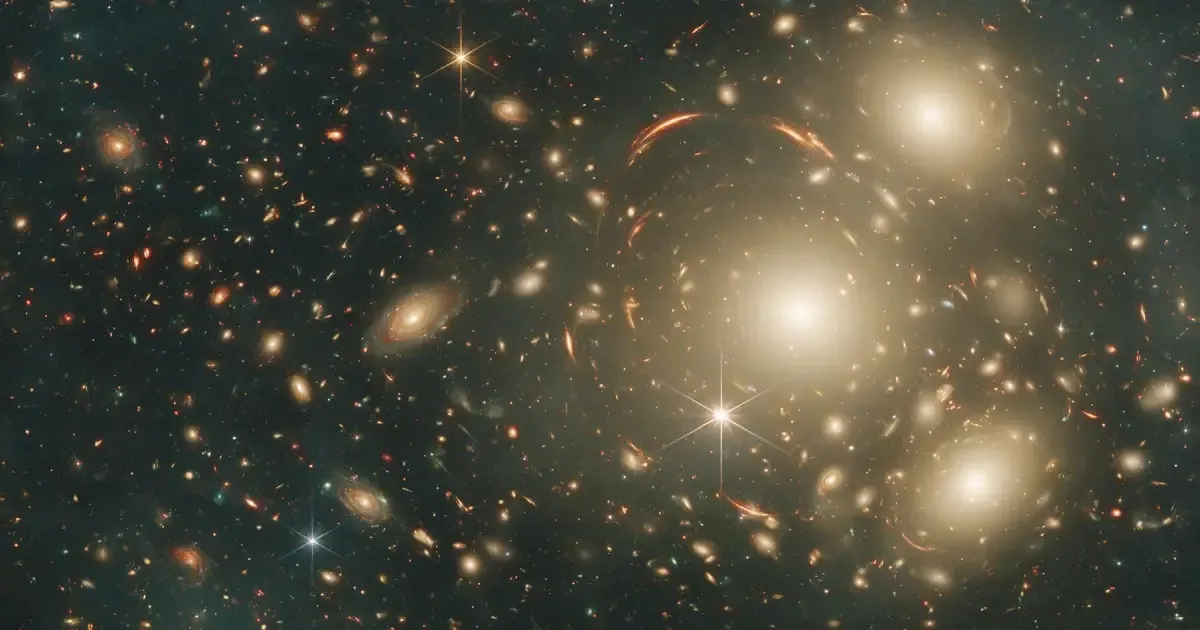
Why Matter Beat Antimatter (and the Standard Model Can't)
Less than one particle in a billion survived the Big Bang's great annihilation. The Standard Model has every ingredient needed to explain that, in doses far too small to work.
You are drifting through a fog with no walls, no up and no down, at more than a trillion degrees. It is a few millionths of a second after the Big Bang. Quarks and antiquarks, electrons and positrons, photons and neutrinos stream past at nearly the speed of light. Count the quarks in any handful of this soup, then count the antiquarks, and the totals look identical. Keep counting into the billions and a difference finally shows: a surplus of matter amounting to less than one part in a billion. In a moment, nearly every pair will annihilate. The surplus will become every galaxy, every planet and the hand doing the counting.
The popular version of this story says physics is missing an ingredient. The stranger truth is that the Standard Model of particle physics stocks every ingredient the recipe calls for, in doses far too small to work. Its built-in matter-antimatter bias falls short by about ten orders of magnitude, and the one moment that could have knocked the early universe out of balance turned out to be a gentle fade rather than a jolt. Follow the journey stop by stop and the shortfall becomes measurable. That is why the hunt for the missing dose has moved to some unexpected places: a truck, a molecule and a beam of neutrinos.
Stop One: The Higgs Field Fades In at 159.5 GeV
Rewind to a tiny fraction of a nanosecond after the Big Bang. The Higgs field is about to take on the value it holds today, the change that hands quarks, electrons and the W and Z bosons their masses. Lattice simulations place the moment at a temperature of 159.5 ± 1.5 GeV, close to two quadrillion kelvin.
In 1967 the Soviet physicist Andrei Sakharov listed what any universe needs to turn perfect balance into a surplus. Some process must change the number of baryons, the family that includes protons and neutrons. Matter and antimatter must obey slightly different rules, a breaking of the symmetries physicists call C and CP. And the process must run out of thermal equilibrium, because in equilibrium every reaction is cancelled by its reverse. A review by Canetti, Drewes and Shaposhnikov scores the Standard Model against all three.
The first condition holds up surprisingly well. Baryon number, which looks sacred in everyday physics, is not conserved in the Standard Model at these temperatures. Transitions called sphalerons can create or destroy baryons and leptons together, keeping only the difference between the two fixed. The ingredient is in the cupboard.
The third condition is where the first dose problem appears. The Standard Model's own route, electroweak baryogenesis, needs the Higgs switch-on to be violent: a first-order transition in which bubbles of the new phase form and spread through the old one like steam in boiling water, with quarks and antiquarks scattering differently off the bubble walls. In the Standard Model that only happens if the Higgs boson weighs less than about 72 GeV; an earlier lattice study placed the cutoff between 70 and 95 GeV. In 2012 the Higgs turned up at about 125 GeV. At that mass there are no bubbles. The field fades in like a dimmer switch across a window roughly 5 GeV wide.
In a twist, the Higgs discovery, the Standard Model's crowning success, also closed its most elegant route to explaining why there is any matter for the Higgs to give mass to.
Stop Two: A CP Ledger Short by Ten Zeros
In 1964 James Cronin and Val Fitch caught neutral kaons decaying in a way that broke CP symmetry, work that earned them the 1980 Nobel Prize in Physics. Sakharov's list followed in 1967. Within the Standard Model, that CP violation comes from a single complex phase inside the CKM matrix, the table that governs how quarks change flavour through the weak force.
The trouble is how weakly that phase reaches the early universe. Its effect requires interference among all three generations of quarks, and in a plasma at electroweak temperatures the quark mass differences that make it visible are tiny compared with the heat. The resulting measure of CP violation comes out around 10⁻²⁰, against an observed asymmetry near 10⁻¹⁰. That is a shortfall of ten billion times, the ratio between a one-millimetre grain of sand and a line 10,000 kilometres long, most of the way across Earth. A 1994 calculation by Gavela and colleagues found the Standard Model effect falls many orders of magnitude short of what observation requires, even if the phase transition had cooperated.
So why did a 2025 result from CERN make headlines about matter and antimatter? In July of that year the LHCb collaboration reported in Nature the first observation of CP violation in baryons. Beauty baryons called Λb, decaying into a proton, a kaon and two pions, showed an asymmetry of (2.45 ± 0.46 ± 0.10) percent relative to their antimatter twins, at 5.2 standard deviations, in collisions recorded from 2011 to 2018.
A 2.45 percent gap sounds like plenty. It is not, and the paper says as much: the asymmetry the CKM mechanism can explain is "vastly smaller" than what astronomy demands. A single decay channel can show a large effect when two decay routes interfere; in a hot plasma, the same phase is suppressed almost to nothing. What the result does is extend the CP test to the particle family your body is built from, and every new channel is another place where a contribution from beyond the Standard Model could reveal itself.
Stop Three: The Great Annihilation and the Light It Left
Fast-forward to where this journey began. The plasma cools enough for quarks to bind into protons and neutrons, and antiquarks into their mirror images. Then the pairs meet and annihilate into radiation, and within the first seconds electrons and positrons follow. What survives is the surplus.
That radiation's descendants are still around you, cooled and stretched into the cosmic microwave background, released about 380,000 years after the Big Bang and mapped by ESA's Planck satellite. That relic light doubles as a scoreboard. Today the baryon-to-photon ratio is (6.10 ± 0.04) × 10⁻¹⁰, roughly 1.6 billion photons for every proton or neutron in the universe. That overwhelming crowd of photons is a rough record of how many pairs were lost for each survivor.
Two clocks read that number independently. Planck's map of hot and cold spots gives a baryon density, written Ωbh², of about 0.0224. Deuterium forged in the first few minutes gives a second reading, provided you know how fast deuterium burns. In 2020 the LUNA experiment, running an accelerator deep beneath Italy's Gran Sasso mountains to escape cosmic rays, measured that reaction rate and pinned the baryon density from nucleosynthesis to a precision of 1.6 percent. A machine under a mountain checked a number written across the whole sky, and the two match.
Could the surplus be an illusion, with antimatter galaxies hiding somewhere far away? Wherever matter and antimatter regions touched, annihilation would glow in gamma rays. The absence of that glow forces any antimatter domains to be comparable in size to the observable universe, which leaves no room for them anywhere telescopes can see.
That gamma-ray signature is not hypothetical. In 2011 NASA's Fermi Gamma-ray Burst Monitor team reported the first direct evidence that thunderstorms make antimatter particle beams, identified by the 511,000-electron-volt flash of positrons meeting electrons. The terrestrial gamma-ray flashes behind them occur roughly 500 times a day worldwide. Antimatter is not exotic; Earth's weather manufactures it. What is rare is antimatter that lasts.
Stop Four: A Truck, a Molecule and a Neutrino Beam
The journey ends in the present, and the search for the missing dose looks nothing like one giant collider. On 24 March 2026, CERN's BASE team loaded 92 antiprotons into a portable cryogenic trap weighing about 1,000 kilograms and drove it across the laboratory's main site. The reason is almost comic: CERN's antimatter factory produces magnetic fluctuations of about a billionth of a tesla, roughly 20,000 times weaker than Earth's field, and that noise limits how precisely BASE can measure antiproton properties. Any difference between a proton and its antimatter twin would be a crack in the symmetry, and a clue.
The sharpest probe may sit on a lab bench. At JILA in Colorado, physicists used trapped hafnium fluoride ions to show that the electron's electric dipole moment, a CP-violating lopsidedness in its charge, is smaller than 4.1 × 10⁻³⁰ e·cm. The authors note that this constrains new physics above 10¹³ electron volts, beyond the direct reach of current colliders. Many theories that add the extra CP violation baryogenesis needs also predict a nonzero electron dipole moment, so every null result squeezes them.
Then there are neutrinos. In leptogenesis, heavy partner neutrinos decay unevenly in the first instant and leave an imbalance between leptons and antileptons, which the Standard Model's own sphalerons convert into the baryon surplus. Wilfried Buchmüller showed the mechanism can produce the observed asymmetry if light neutrino masses fall between about 10⁻³ and 0.1 eV, the range oscillation experiments point to. In October 2025 the rival T2K and NOvA experiments published their first joint analysis: no strong preference yet for how the three neutrino masses are ordered, but if the ordering is inverted, the data are evidence of CP violation among leptons. Japan's Hyper-Kamiokande is scheduled to begin operations in 2028.
Editor's take: Headlines claiming physics cannot explain why anything exists oversell the mystery and undersell the progress. Physics pins down nearly every stop on this journey: the temperature of the Higgs fade, the asymmetry in a single baryon decay, the cosmic baryon count to better than one percent. What it cannot do is make the surplus with the Standard Model's doses. The best bet is leptogenesis, because it reuses the sphalerons the Standard Model already contains and builds on a gap physics has already found: the Standard Model's silence on why neutrinos have mass. Watch Hyper-Kamiokande's first seasons after 2028. A clear sign of CP violation among neutrinos would not prove leptogenesis, but it would make it the default answer.
The One-in-a-Billion Inheritance
Go back to the fog where this began and look at the counted handful once more. For roughly every billion quarks, a billion antiquarks are waiting, and one quark has no partner. That orphan ends up in hydrogen, then in stars, then in the carbon and iron of later generations, and eventually in you. The Standard Model describes how the leftovers behave with astonishing precision. It cannot explain why they were left over, and the next real clue is more likely to come from a neutrino tank in Japan or a trapped molecule in Colorado than from a bigger collider.
Sources
- Matter and Antimatter in the Universe — Canetti, Drewes & Shaposhnikov, New Journal of Physics, 2012
- The Standard Model cross-over on the lattice — D'Onofrio & Rummukainen, Physical Review D, 2016
- Is There a Hot Electroweak Phase Transition at mH ≳ mW? — Kajantie, Laine, Rummukainen & Shaposhnikov, Physical Review Letters, 1996
- Observation of a new boson at a mass of 125 GeV with the CMS experiment at the LHC — CMS Collaboration (CERN), Physics Letters B, 2012
- The Nobel Prize in Physics 1980 — Nobel Prize Outreach, 1980
- Standard Model CP-violation and Baryon asymmetry — Gavela, Hernández, Orloff & Pène, Modern Physics Letters A, 1994
- Observation of charge–parity symmetry breaking in baryon decays — LHCb Collaboration (CERN), Nature, 2025
- Observation of charge–parity symmetry breaking in baryon decays (preprint, full text) — LHCb Collaboration (CERN), arXiv, 2025
- Planck and the cosmic microwave background — ESA
- Planck 2018 results. VI. Cosmological parameters — Planck Collaboration (ESA Planck mission), Astronomy & Astrophysics, 2020
- Introduction to Big Bang Nucleosynthesis and Modern Cosmology — Mathews, Kusakabe & Kajino, International Journal of Modern Physics E, 2017
- The baryon density of the Universe from an improved rate of deuterium burning — LUNA Collaboration (Mossa et al.), Nature, 2020
- Fermi catches thunderstorms hurling antimatter into space — NASA Goddard Space Flight Center, Imagine the Universe, 2011
- BASE experiment at CERN succeeds in transporting antimatter — CERN, 2026
- A new bound on the electron's electric dipole moment — Roussy et al. (JILA), Science, 2023
- Neutrinos and matter-antimatter asymmetry of the universe — Buchmüller (DESY), arXiv, 2003
- Joint neutrino oscillation analysis from the T2K and NOvA experiments — NOvA and T2K Collaborations, Nature, 2025
- Tour of Hyper-Kamiokande's massive vertical cavern; facility scheduled to begin operations in 2028 — The University of Tokyo
Related Posts
Kepler's Supernova of 1604 and the Blasts Dust Hid Since
Kepler's supernova of 1604 was the last one anyone saw in the Milky Way, but not the last to explode. Here is how dust hid others, and how the next one will be caught.
Why the Night Sky Is Dark: The Universe Has an Age
The night sky is dark mainly because the universe has a finite age, not because the Sun set. The blazing sky an infinite universe would give us is still there, stretched into invisible microwaves.
